
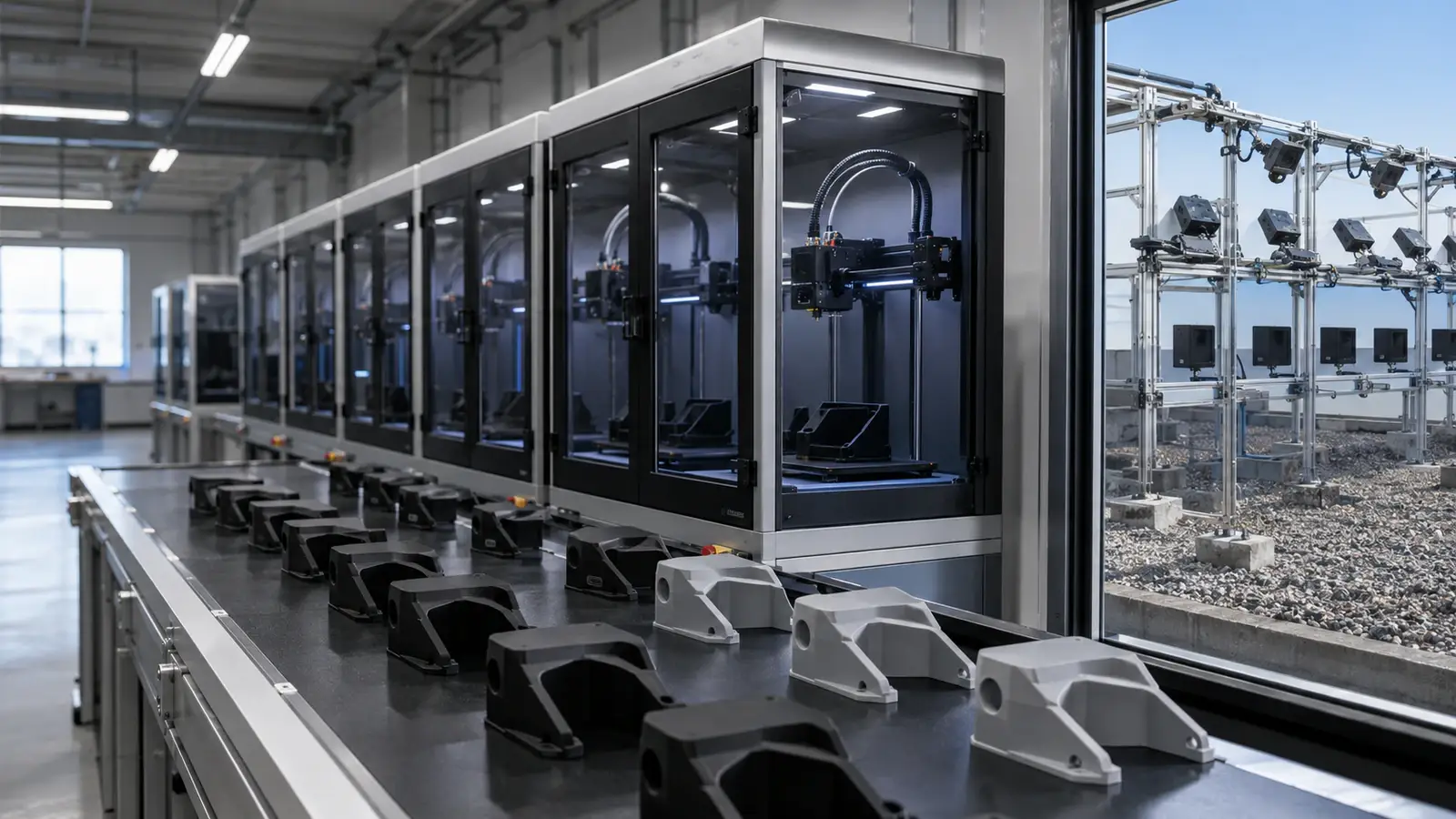
ABS+ and ASA are often considered side by side: both belong to the styrenic engineering thermoplastic family, produce rigid, strong parts, and require similar printing conditions. For a one-off prototype, the difference between them is often minor. But in series FDM/FFF production of functional parts, it becomes decisive: the choice affects not only the quality of an individual part, but also batch repeatability, scrap rate, and the durability of the final product in real operating conditions.
The choice depends on more than sample strength. You need to account for the operating environment, part geometry, print stability, color requirements, assembly method, and acceptable scrap level.
Shared foundation and key difference
ABS is a terpolymer of acrylonitrile, butadiene, and styrene. Styrene provides rigidity and ease of processing, acrylonitrile contributes chemical and thermal resistance, and the butadiene phase provides impact toughness. ABS+ is a modified formulation of standard ABS in which manufacturers reduce the tendency to warp and improve print stability while retaining characteristic impact resistance.
ASA has a similar structure, but the butadiene phase is replaced with acrylic rubber. This replacement is the main technical difference. Butadiene is sensitive to ultraviolet light: under UV exposure, its chains break down, so ABS yellows in sunlight, becomes brittle, and gradually loses mechanical properties. The acrylic rubber in ASA is significantly more resistant to UV and weathering, so the part retains its color and strength during long-term outdoor use.
That comes at a cost: the acrylic phase makes ASA somewhat less impact-resistant than ABS. The difference is moderate, but it matters in applications with impact or vibration. Conversely, ASA should not automatically be considered stronger: actual values depend on the formulation, layer orientation, print settings, and test method.
ABS+ is not one standardized formulation
The plus sign does not define a specific composition or a guaranteed set of properties. Two ABS+ filaments from different manufacturers can differ noticeably in stiffness and ductility, warping resistance, bridge and overhang behavior, heat resistance, odor and emissions, color and gloss, and batch-to-batch stability.
For production, you therefore need to qualify a specific grade and formulation, not a material with a generic name. Results from one ABS+ cannot be transferred to another without revalidation: a formulation change affects shrinkage, fits, snap strength, and the behavior of threaded joints.
Heat resistance and mechanics
The materials are close in their thermal characteristics. The glass transition temperature of ABS is approximately 105 °C, and ASA is in the same range. The heat deflection temperature (HDT) for ABS is usually 80-100 °C depending on the formulation and load. Both materials perform reliably at room and moderately elevated temperatures, but they are not intended for continuous contact with hot surfaces or heating above the glass transition range.
ABS+ and ASA are similar in stiffness and tensile strength. In practice, the choice is more often determined by operating conditions than by datasheet numbers.
Practical comparison
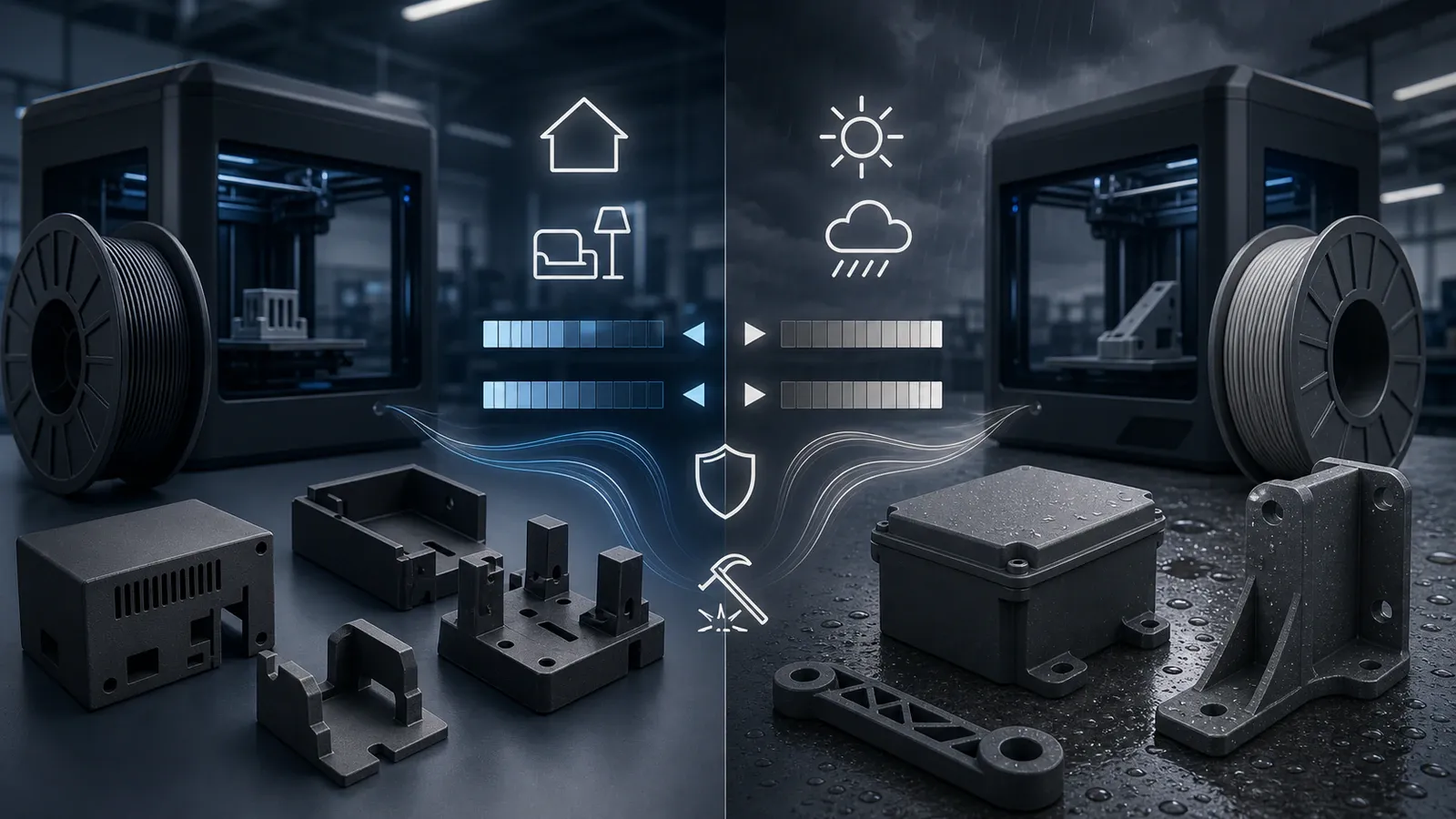
| Criterion | ABS+ | ASA |
|---|---|---|
| Indoor operation | Usually appropriate | Suitable; weather resistance may be unnecessary |
| Long-term outdoor operation | Requires separate confirmation | Preferred option |
| UV resistance | Depends on the formulation | Usually high |
| Warping of large parts | Possible even in modified grades | Also requires a thermally stable chamber |
| Impact behavior | Often one of the main advantages | Depends on grade and print settings |
| Outdoor color stability | Must be verified | Usually better |
| Post-processing | Mechanical finishing, painting, acetone smoothing for compatible formulations | Similar options; compatibility is verified separately |
| Material cost | Often lower | Often higher due to specialization |
When to choose ABS+ and when to choose ASA
ABS+ is a logical choice for parts used mainly indoors without long-term UV exposure: electronics and industrial device housings, internal brackets and mounting elements, tooling, jigs, templates, holders, protective covers, and functional prototypes. It is convenient where impact toughness, moderate heat resistance, mechanical post-processing or acetone vapor smoothing are needed, and where the production profile is already validated and a material change provides no functional advantage.
ASA is worth considering when the product is exposed to sunlight, precipitation, and seasonal temperature changes: outdoor sensor and camera housings, fasteners for facades, roofs, and solar installations, parts for garden and utility equipment, automotive elements outside or near glass, plates and signs, antenna housings, and telecommunication equipment enclosures. ASA is also justified indoors if the part is constantly exposed to sunlight through a window or if there are higher requirements for color retention.
If the product combines requirements, the decision should be based on the dominant risk factor. For a production run, it is more practical to lock one material for the application than to balance a compromise in every batch. And when high sliding wear resistance, flexibility, or contact with aggressive media is required, it is more appropriate to consider PA/Nylon, TPU, PETG, or a custom formulation.
Series printing: material plus a controlled process
Both materials require a heated bed and, for stable results, an enclosed chamber: it keeps the part at a uniform elevated temperature and allows slow cooling, which reduces internal stresses, warping risk, and delamination. For production, this is not optional; it is a requirement. Some ASA formulations warp less than ABS+ and provide stable layer adhesion, but they usually print in a higher nozzle temperature range.
Repeatable results require an enclosed build volume, stable temperature around the part, no cold drafts, a clean and prepared build surface, controlled part cooling, consistent preheating of equipment before launch, and gradual cooling. In a print farm, copying only the nozzle and bed temperatures is not enough: printers differ in actual heater temperatures, air circulation, and feed calibration, so the profile is checked on each equipment model, and sometimes on groups of machines.
Warping is not always solved by changing the material alone; the cause is often geometry: long solid walls, sharp thickness transitions, a massive base with a thin upper section, or sharp internal corners. Before launch, it is worth adding radii in corners, evening out wall thicknesses, introducing local ribs, changing orientation, or splitting a large part into assembly components.
How to qualify a material for production
Comparison by TDS alone is not enough: some values are obtained on molded or specially oriented specimens and cannot be transferred directly to a finished FFF part. Practical qualification includes:
- A control specimen and the real part - a standard test compares batches, but does not show the behavior of corners, snaps, and mounting seats in a specific model.
- Dimensional checks - holes, flatness, center-to-center distances, and assembly zones, not just overall length.
- Assessment of interlayer strength, especially under load along the Z axis.
- A thermal test under conditions that match real operation.
- An assembly test - screws, inserts, latches, adhesive joints, and repeated disassembly.
- Environmental exposure testing - outdoor exposure for ASA; contact with oils or detergents for both materials if expected.
- Repetition on several spools or batches - one successful print is not enough to confirm production stability.
Acceptance criteria (allowable deformation, appearance, dimensions, mass, joint strength, share of successful prints) are defined before testing starts.
The full cost must be calculated
Comparing ABS+ and ASA only by price per kilogram is incorrect. The cost of a production run is affected by the number of failed prints, warm-up and cooling duration, need for post-processing, dimensional stability, operator time, recalibration, warranty risks after installation, and need for painting or protective coating. More expensive ASA can be economically justified for an outdoor product if it reduces the risk of premature aging; at the same time, ASA for an internal jig does not always offer an advantage over already qualified ABS+.
Ventilation should also be considered separately: during printing, both materials emit odor and volatile compounds. An enclosure maintains temperature, but by itself it does not control emissions into the room, so a production area needs organized ventilation, local air extraction, or filtration that accounts for the number of printers and their operating time.
Summary
For functional indoor products, tooling, and parts without long-term UV exposure, it is reasonable to start evaluation with ABS+. For outdoor housings, fasteners, and parts that must retain properties and color under weather exposure, ASA is usually the baseline candidate. The final decision is made not by the polymer name, but after checking the specific formulation, color, batch, print profile, and part geometry.
Bokotech manufactures engineering filaments in Ukraine, including ABS+, ASA, TPU, PA/Nylon, PLA, PETG, and custom formulations, and works through contract manufacturing and OEM / private label models. Before launching a production run, we work with the customer to select the material for real operating conditions, agree on color, spool format, labeling, and packaging, and lock the parameters so every subsequent batch is predictable. If you are planning a series of functional products and are not sure what to choose, start with a description of the part’s operating conditions; based on them, the material choice becomes clear.