
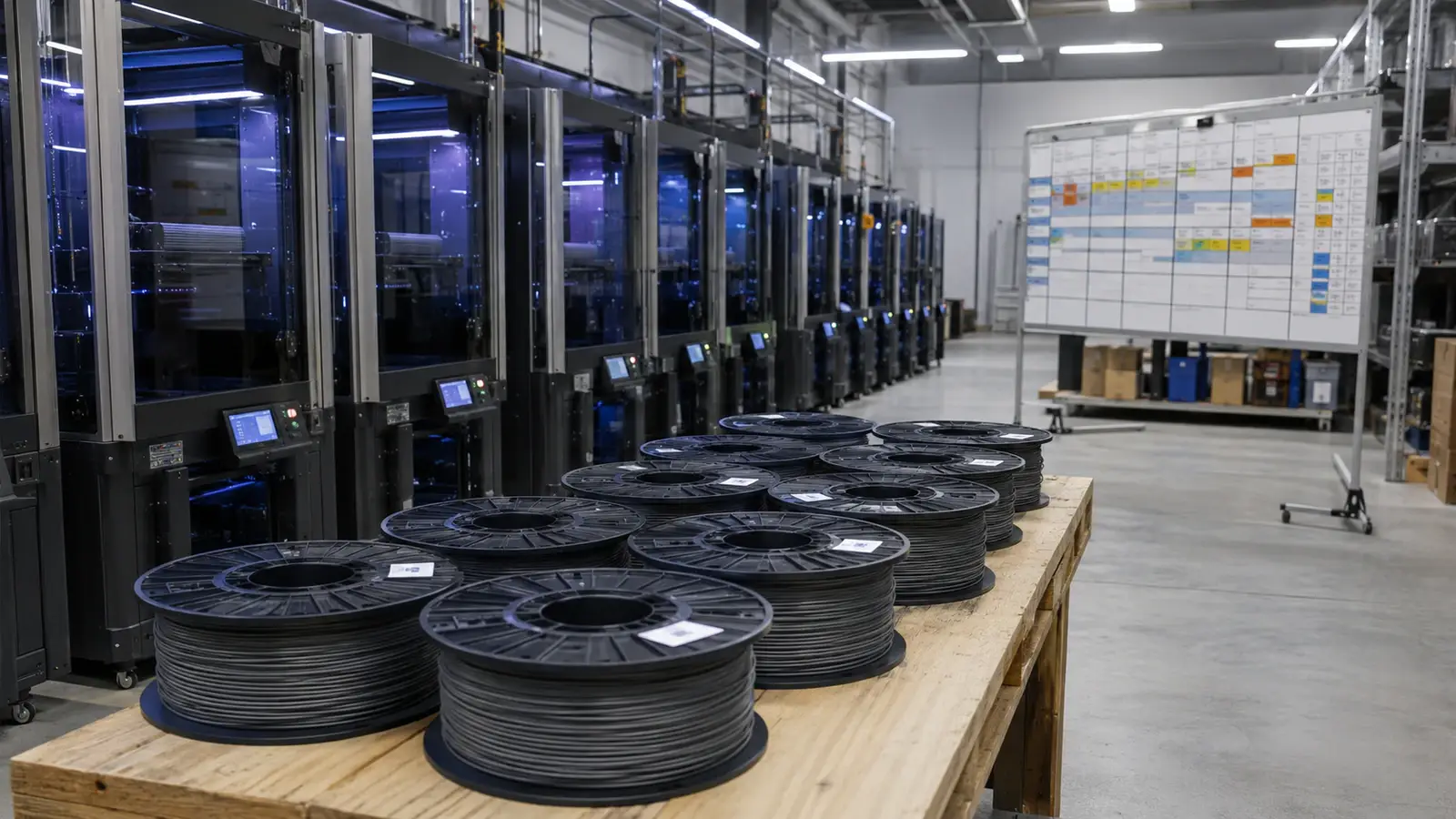
For a print farm, filament is not a one-off purchase or a consumable ordered after the shelf is empty. It is a continuous flow of production raw material. Equipment utilization, print profile stability, scrap rate, color repeatability, order lead times, and the number of recalibrations depend on it. When dozens or hundreds of machines work with the same profiles, every change in material is multiplied across the whole fleet.
Purchasing based only on spool price creates hidden costs: downtime from material shortages, profile recalibration, color differences between parts of the same product, additional test prints, and slow-moving leftovers. Therefore, purchasing for a farm should be built around three questions: what volume of material production actually consumes, when and in what portions it should arrive, and for which orders one production batch needs to be locked.
Calculate Demand from Actual Consumption
The simplest mistake is to calculate demand “in kilograms overall” or from the model mass in the slicer. Real farm consumption includes more components: material in acceptable parts, supports, brims, purge towers, purging during color or material changes, spool remnants, test and calibration prints, restarts after failures, and reserve for urgent orders. The basic logic can be described as:
period demand = planned part mass + process losses + forecast restarts + safety stock.
Loss factors should not be set arbitrarily. It is better to rely on the farm’s own statistics: how much material was issued to production and how many acceptable parts were obtained over a week or month. If the farm keeps this accounting, the previous 90 days of history by material and color translate almost directly into a purchasing plan for the next period. This is more reliable than an “eyeball” estimate because it accounts for real scrap, changeovers, and downtime.
Keep records separately for each item: polymer type and specific formulation, color, diameter, TPU hardness, presence of filler, spool mass and format, manufacturer, and batch number. Black PETG and PETG of another formulation should not be combined into one warehouse item, even if both formally belong to the same polymer class. Their print modes, appearance, and behavior on equipment differ. Track peak consumption separately from average consumption. A monthly average may look stable even though the entire farm prints one large contract in a specific color during a week, and it is exactly these peaks that most often cause shortages.
Spool Format Affects Volume and Logistics
Spool format also affects the purchasing plan. Large spools, for example 3 or 5 kg instead of the standard kilogram, reduce the number of printer changes and therefore downtime for reloading and manual operations. On a farm where spool changes are multiplied by the number of machines, this is a noticeable time saving. The other side is higher unit weight, requirements for holders and dryers, and the fact that an opened large spool remains in use longer. For hygroscopic materials, storage conditions therefore become more important.
Delivery Schedule and Reorder Point
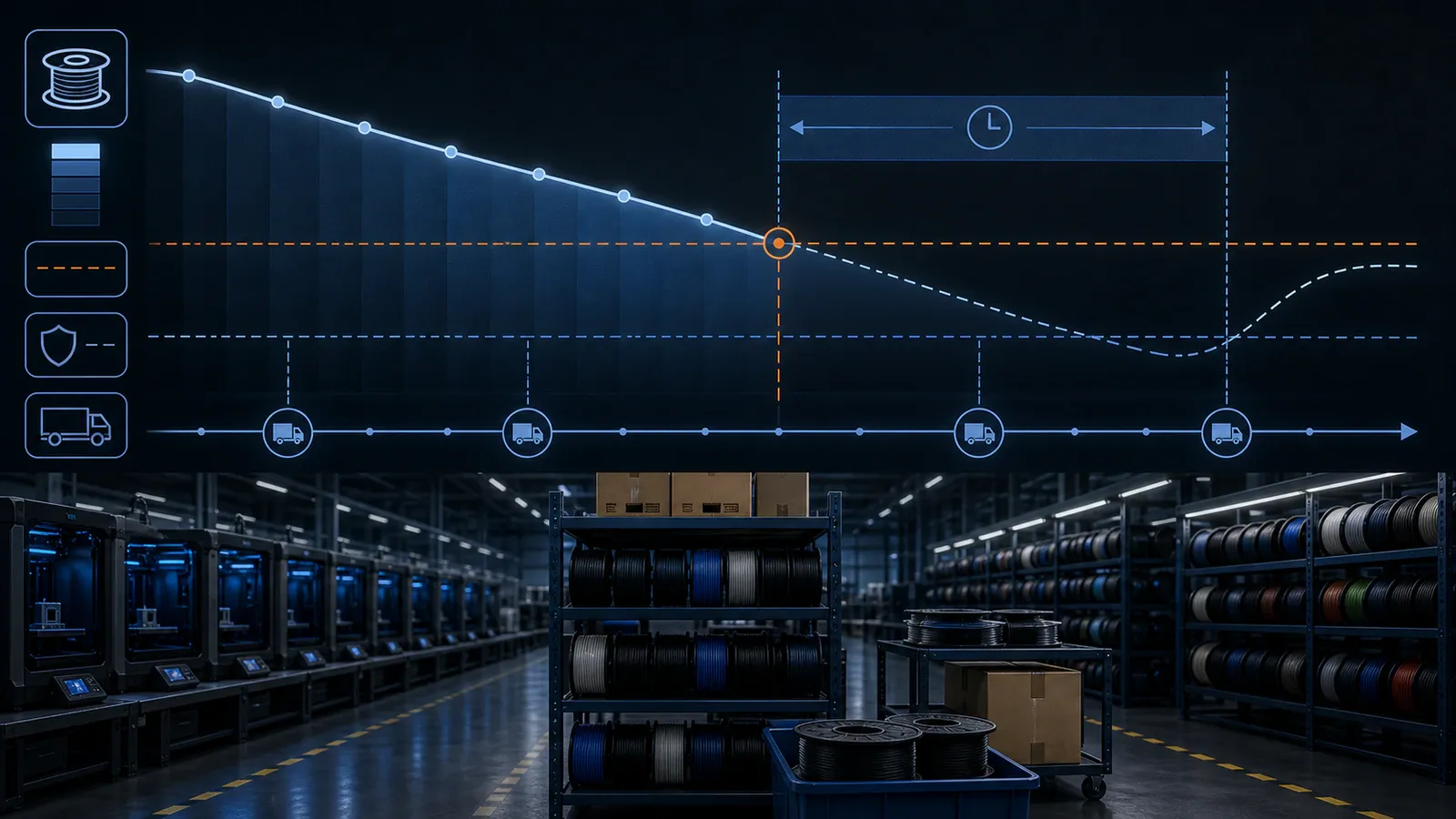
A delivery schedule is based on two variables: order lead time and material shelf life in the warehouse. The first determines how early you need to order; the second determines how much stock can be kept without quality loss. For each critical item, define a reorder point:
reorder point = consumption during replenishment lead time + safety stock.
Replenishment lead time includes more than transportation. It includes order confirmation, reservation or production of the required batch, winding and packaging, marking preparation, delivery, and incoming inspection at the farm warehouse. The same stock level in days is inefficient for all materials. It may be higher for core black PETG than for a color used in isolated projects, while PA or TPU also require storage conditions and drying capability to be considered.
Hygroscopicity matters here. Most polymers for FFF printing absorb moisture from the air. For PLA and PETG, manufacturers expect a longer period of stability, while PA, TPU, and some other materials absorb moisture quickly, sometimes within hours after unpacking. Moisture in the filament turns into steam in the melt zone, causing bubbles, popping at the nozzle, and defects in surface quality and strength. That is why “buying a year ahead” for sensitive materials is not always a saving. Part of the stock can be spoiled by storage conditions. A practical guideline is to keep filament in a cool, dry, dark place with controlled humidity; keep sensitive materials in sealed containers with desiccant or in factory vacuum packaging until use; and dry them before printing when needed.
Why Receiving the Entire Volume at Once Is Not Always Best
A large purchase in one delivery reduces logistics workload, but creates other costs: frozen working capital, need for warehouse space, risk of packaging damage, more difficult humidity control, accumulation of leftovers after order changes, and risk that the color or formulation becomes outdated. Small frequent purchases reduce warehouse stock, but increase the number of operations and dependence on supplier rhythm. The optimal solution is usually in the middle: the total volume is agreed in advance, and deliveries are made in parts according to a schedule. The manufacturer can reserve the agreed material or produce a single batch, after which the customer draws it down in several deliveries. This combines batch repeatability with controlled warehouse stock. Reservation terms are agreed separately: total volume, drawdown period, delivery sizes, spool format, marking, and responsibility for forecast changes.
Why Lock a Production Batch
Filament of the same name must comply with the specification, but that does not mean all batches are absolutely identical. Within allowable characteristics, diameter and its stability along the length, ovality, melt flow index, response to print speed and temperature, shrinkage, stiffness or elasticity, shade and gloss level, and actual moisture after transport may change. Each of these parameters can shift feeding, layer bonding, or part appearance. Color is especially visible: the same shade name does not guarantee the same physical color, and the batch number often matters for matching.
Batch locking means that material from an agreed production run is used for a specific order. This allows the material to be qualified once by selecting nozzle and bed temperature, cooling, speed, retraction, flow, and drying conditions, and then reproducing the result across the whole volume without repeated setup. In a series with tens or hundreds of machine hours, even a short adjustment is multiplied across the printer fleet, so batch discipline is cheaper than recalibration and rejected parts. The batch number also helps during problem analysis. If atypical stringing, unstable feeding, or changed adhesion appears, it narrows the search for the cause.
Batch locking is especially advisable when parts of one product are printed over several weeks; parts from different printers are assembled into one kit; the customer has approved a specific shade or texture; the print profile has passed internal validation; mechanical or dimensional characteristics are controlled; or products are supplied in regular series. For short prototypes and rough parts, it is less critical, but basic records should always be kept: material, date, batch, supplier, and settings. Batch locking reduces one group of variables, but it does not remove the influence of equipment. Nozzle wear, different hotends, feed calibration, chamber temperature, and dryer condition also affect the result.
Three Batch-Management Models
Three models are practical for farms. Full receipt of one batch means the entire volume is supplied at once. This simplifies traceability, but requires warehouse space and working capital. Batch reservation with staged deliveries means the manufacturer reserves an agreed volume and the farm receives it in parts. This is convenient for long contracts with predictable consumption. Controlled transition between batches means that when the previous batch is ending, the farm receives a sample of the next one, performs a test print with the existing profile, and releases it to series only after parameters are confirmed. This approach is useful when reserving the full volume is impossible or demand changes frequently.
Specification and Incoming Inspection
Writing “PETG, black, 1.75 mm” in the order is not enough. For repeatable deliveries, agree on the exact material or formulation name, color and how it is approved, diameter, net weight, spool type and dimensions, packaging requirements, batch marking, label format, need to reserve one batch, delivery schedule and delivery sizes, list of accompanying documents, procedure for approving a batch change, and procedure for handling nonconformity. For TPU, specify the agreed Shore hardness. For filled materials, specify the exact formulation type: a designation such as “carbon-fiber nylon” without product identification is not sufficient for a stable process.
Even when deliveries come from one reserved batch, they are checked on receipt: quantity, names and batch numbers, condition of boxes and vacuum packaging, spool weight and format, marking and documents, selection of a control spool, test print with the approved profile, and release to stock or quarantine in case of deviations. During transition to a new batch, it should not be distributed immediately across all printers. First run a control print on the reference machine, then a short check on several typical printers. Remnants of different batches are recorded separately and are not mixed within one customer order without verification.
Delivery Schedule as Part of the Production Plan
Effective purchasing starts not with a price request, but with a consumption forecast. It is useful to provide the manufacturer with two planning levels: an indicative forecast for several upcoming periods, which helps plan raw material, color, spool format, and capacity, and a confirmed order for the nearest period, which provides a basis for reserving volume and agreeing shipment dates.
The lowest price per kilogram does not always mean a lower part cost. For a farm, full costs matter: scrap, downtime, operator time, recalibration, color mismatch, order returns, and reprinting. Bokotech, as a Ukrainian manufacturer of engineering filament, works in exactly this logic of contract manufacturing and OEM / private label: material, color, TPU Shore hardness, spool format for your holders and dryers, marking, packaging, split deliveries, and repeatability requirements are agreed before launch so the farm receives predictable material series after series. In a stable print farm, filament should not be a random variable. It is planned, tested, marked, and supplied as systematically as any other production raw material.