
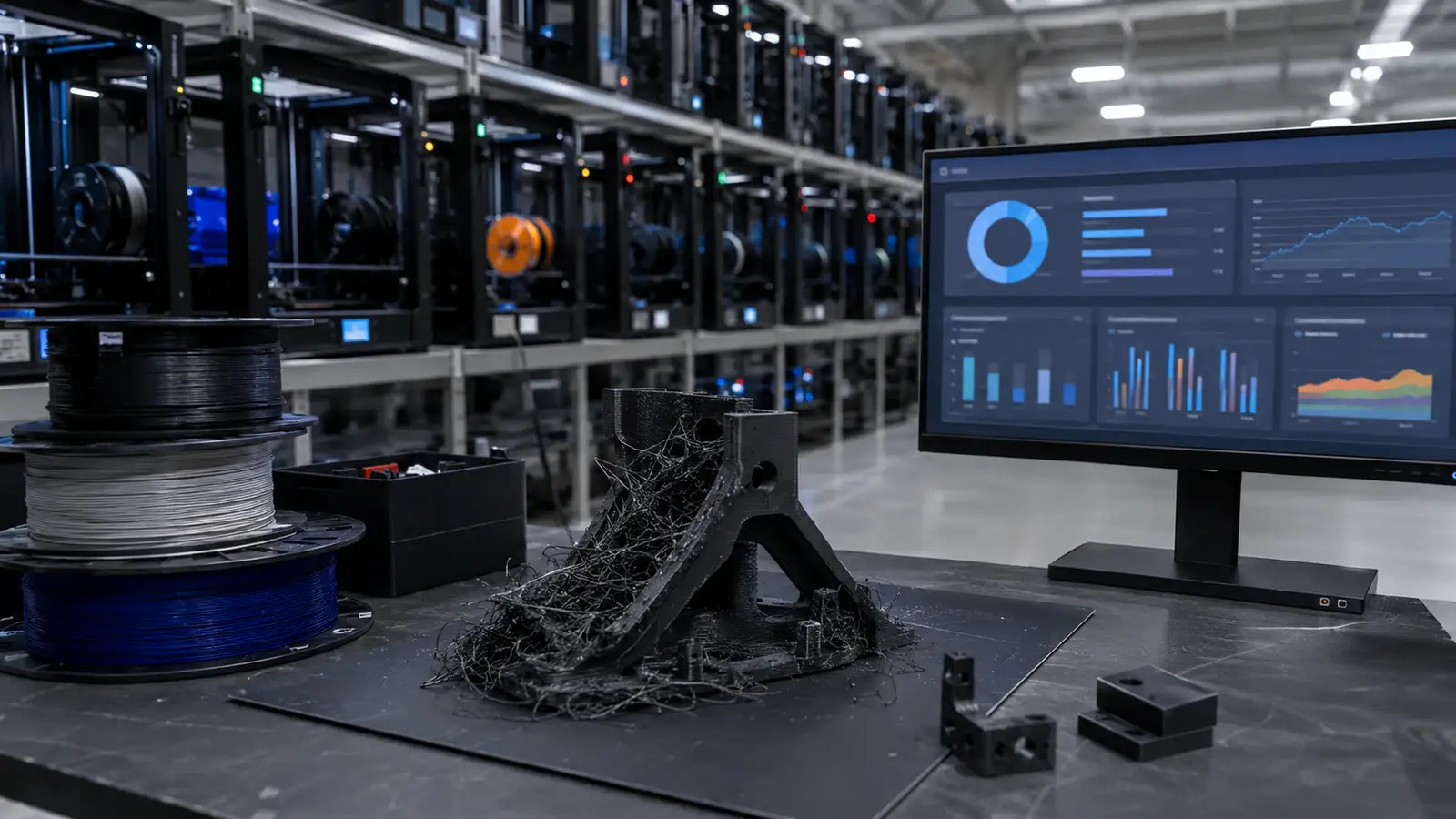
The simplest way to compare two filaments is to look at the price per kilogram. It is also the most misleading. The purchase price is only the visible part of the cost, while the real cost of a part is shaped by a set of factors that appear during production: scrap rate, printer downtime, operator labor for recalibration, and written-off material. This approach is called total cost of ownership (TCO).
For a brand, print farm, or series manufacturer, it is more accurate to answer not “how much does a kilogram cost,” but “how much does one part accepted by quality control cost.”
Why price per kilogram does not show the real economics
A supplier invoice shows the cost of material and logistics. A significant part of production cost remains hidden: time for incoming inspection and spool preparation, drying and sealed storage, creating or adjusting the print profile, test and calibration models, scrap during startup and production, downtime caused by feeding problems, hotend cleaning and nozzle replacement, additional inspection of parts, remanufacturing an order, claims, or late shipment.
For a short decorative print, some of these factors may go unnoticed. In long jobs or on a farm with dozens of printers, even minor instability scales across the entire batch.
What TCO consists of

A simplified model can be written as:
Batch TCO = purchase + preparation + setup + scrap + downtime + maintenance + quality losses
To compare suppliers, the result is divided not by the number of kilograms purchased, but by the number of accepted parts:
Cost of an accepted part = batch TCO / number of good parts
This makes situations visible where a more expensive material delivers a lower actual cost because the process is more stable. TCO counts the cost of a usable part, not the kilogram consumed: if some prints become scrap, all the material, printer time, and operator attention invested in failed parts are carried by the cost of the parts that passed inspection. That is why two filaments with a 20-30% price difference can produce the opposite result when recalculated per finished part.
| TCO component | What to record in production |
|---|---|
| Purchase | Price, delivery, payment terms, minimum batch |
| Preparation | Operator time, drying, repacking, inspection |
| Setup | Test models, consumed material, machine time |
| Scrap | Waste mass, number of restarts, failure stage |
| Downtime | Stop hours, lost production capacity |
| Maintenance | Cleaning the path, nozzles, tubes, feed drives |
| Quality control | Measurement, sorting, rework, and claims |
Where cheap filament creates hidden costs
A low price is not a problem by itself. The problem is uncertainty: whether the next spool will behave the same as the previous one and whether it can be printed with the same profile without additional tests.
Unstable diameter and ovality. The slicer calculates feed based on nominal diameter, while actual volume depends on cross-sectional area, which changes in proportion to the square of the diameter. If diameter or ovality fluctuates along the spool, flow becomes unstable: local under- or over-extrusion, uneven walls, changes in part mass and geometry, unstable interlayer adhesion, and increased resistance in the filament path. What matters is not only the average diameter, but also variation along the spool and repeatability between batches.
Moisture is a separate cost chain. Nylons, TPU, and some compounds are especially sensitive, but PLA or ABS should not be left open either. In the hotend, moisture turns into steam, causing hissing, bubbles, stringing, and weaker layer adhesion. The financial consequences are broader than electricity for the dryer: preparation time, dryer capacity, operator labor, risk of an incorrect drying mode, and the need to print from a dry box. A vacuum bag alone does not confirm the material condition. Polymer preparation, sealing, desiccant, and storage conditions after opening all matter.
Contamination and poor additive dispersion. Particles, unstable pigment mixing, gels, or contamination increase the risk of partial nozzle clogging. A partial clog is dangerous because it does not stop the print immediately: the part may look acceptable at the beginning, while defects appear after several hours.
Scrap costs more than it seems
The cost of scrap depends on which hour of the print it occurred. A failure on a one-hour part is a small loss; the same failure on a twenty-hour print means losing almost a full printer work cycle, a significant amount of written-off material, and a shifted schedule. Therefore two spools with the same scrap percentage can have different TCO: failure on the first layer and failure after an almost complete print are not economically equivalent.
When a print fails, only the mass of written-off filament is often counted, which understates the loss. In reality, the losses include the material of the part and supports, all printer hours occupied, energy and equipment life, operator time for diagnosis and cleaning, the production window for another product, time for restart, and schedule buffer before shipment. For functional parts, there is also a hidden defect: a product with unstable extrusion may pass visual inspection but fail under load in use. For housings, fasteners, dampers, or OEM components, this is a matter of process repeatability rather than cosmetics.
Recalibration is a hidden tax on instability
A material profile includes more than nozzle temperature: flow coefficient, nozzle and bed temperatures, maximum volumetric speed, pressure/linear advance, retraction, cooling, outer wall speed, chamber conditions, and first-layer adhesion. When a material behaves predictably from batch to batch, the profile is tuned once and used for series production. When properties drift, the validated process stops being validated, and every new delivery can require recalibration and test prints: skilled labor that creates no finished parts but still must be paid for. Costs rise especially quickly if the material is used on different printer models or nozzle diameters: one unstable SKU can force several profiles to be reviewed.
Winding should also be considered separately: the filament may meet material requirements but still cause stops because of damaged flanges, overly loose loops, or a spool that does not fit the holder. In unattended overnight production, such an event stops the job until the next inspection. What should be evaluated is not the visual neatness of the winding, but whether the spool unwinds without jerks throughout the entire cycle.
How to compare filament by TCO
A correct comparison requires identical conditions: both materials are tested on the same printers, models, nozzles, and acceptance criteria. For each batch, it is useful to record the first-attempt success rate, number of accepted parts per spool, actual consumption per good part, setup time after a batch change, number of unplanned interventions, drying duration, downtime hours, causes of scrap, and stability of color and geometry.
Testing one spool shows only the behavior of that specific sample. To evaluate a supplier, several consecutive batches should be checked. Repeatability is what determines whether the material can be scaled without constant involvement from a process engineer. Saving money on filament makes sense where parts are short, non-critical, and easy to rework; in series and contract manufacturing, the logic is the opposite.
Conclusion
TCO is not an argument that “more expensive is always better.” It is a way to see the full picture and make decisions based on the cost of the finished part rather than the label on the spool. Cheap filament is not automatically “bad”. It simply moves part of the cost from the purchase line into scrap, downtime, and recalibration, where it is harder to notice but does not disappear.
The best way to reduce TCO is to agree on material requirements before production, not after scrap appears. In B2B supply, it is worth agreeing in advance not only on polymer and color, but also on diameter, spool format, net weight, packaging, batch labeling, storage conditions, recommended print parameters, and acceptance criteria; for TPU, Shore hardness separately, and for ABS+, ASA, and PA, repeatability of formulation and stability of the processing window. Bokotech can discuss these parameters before contract manufacturing, OEM / private label production, and repeat batches, so an offer can be evaluated not by price per kilogram but by its suitability for a specific production process. A purchasing decision should be made based on controlled testing of several batches, not only on the price list.