
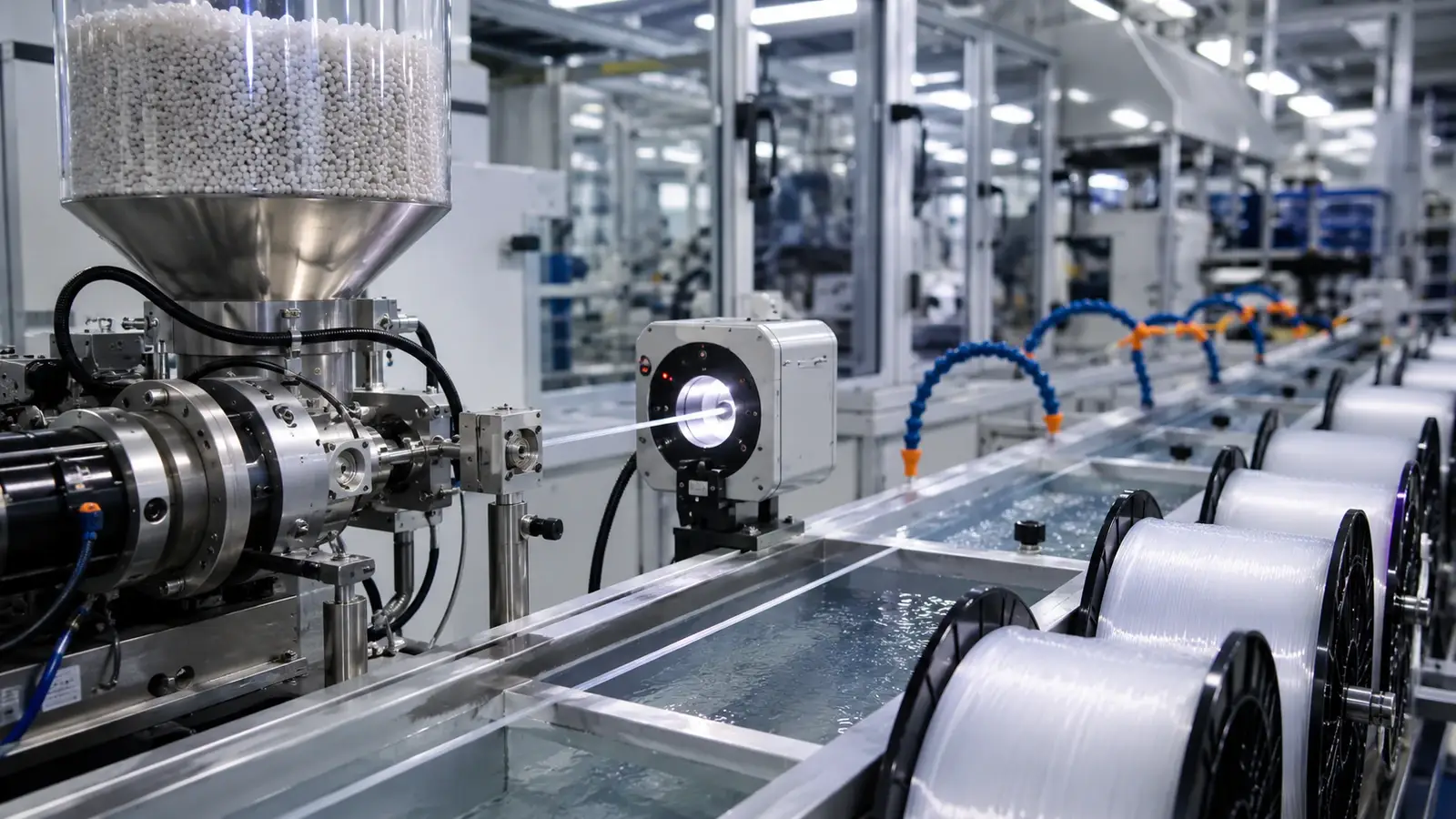
For a private user, the difference between two spools may mean slightly changing the nozzle temperature. For a 3D print farm, a manufacturer of series parts, or a filament brand, that difference turns into profile retuning, an unstable reject rate, and additional incoming inspection costs. In practice, this is what people mean when they say that “batches vary.”
This phrase usually does not refer to one problem, but to a combination of differences:
- a change in shade or gloss;
- different melt flow;
- unstable strand diameter or ovality;
- differences in flexibility, stiffness, or brittleness;
- bubbles, stringing, uneven feeding, or weaker layer bonding.
It is impossible to completely eliminate the natural variability of polymer raw materials. The manufacturer’s task is different: define critical parameters, set acceptable limits for them, and build the process so that every batch remains within the agreed specification.
Repeatability does not start with the extruder
Even polymer of the same grade is not identical in every delivery. Between production lots of pellets, melt flow index (MFI), moisture content, molecular weight and its distribution, residual monomer content, stabilizer concentration, and the natural color of the base polymer may change slightly.
Such changes may comply with the supplier’s documentation, but still affect extrusion. Material with different flow will behave differently at the same temperature profile and line speed: head pressure, melt output stability, and strand diameter will change. Therefore, names such as “PETG,” “ABS+,” or “TPU 95A” are not enough - repeatable production requires fixing the specific raw-material grade, formulation, additive type, and rules for working with alternative components.
How formulation and color affect differences between batches
Filament rarely consists only of pure polymer: the formulation includes pigments, stabilizers, impact modifiers, processing additives, or fillers. Even a small dosing deviation changes not only color, but also rheology, crystallization, shrinkage, and interlayer adhesion. Light and pastel colors, saturated colors with high pigment content, TPU with a specified Shore hardness, filled materials, and modified ABS, PLA, PETG, and PA are especially sensitive.
Coloring is usually performed with a colorant concentrate (masterbatch), and here not only dosing accuracy matters, but also compatibility: the flow index of the masterbatch must be aligned with the base polymer, otherwise uneven mixing and flow pulsations occur in the barrel, while an incompatible carrier polymer causes poor pigment dispersion. A change in pigment or concentrate lot is a typical source of shade differences. That is why production works not by the principle of “add about the same amount of colorant,” but by a fixed formulation with version control.
Moisture as a separate source of instability
TPU, PA/Nylon, PETG, and a number of other polymers absorb moisture from the air - to some degree this also applies to materials considered low-maintenance. During processing, moisture causes hydrolytic chain degradation, with consequences including changed melt viscosity, bubbles and porosity, a rough strand surface, unstable flow from the die, and increased brittleness.
Drying cannot be standardized with one temperature for all materials: the mode depends on polymer type, initial moisture content, drying-equipment design, and the time between drying and feeding into the extruder. It is important to control not only the cycle itself, but also subsequent handling: dried material absorbs moisture again in an open container or during extended time in the workshop.
Why identical settings do not always give identical results
Extruder zone temperatures are only part of the process. The strand is also affected by screw speed, actual feed throughput, pressure before the die, real melt temperature (not only heater readings), screw and die wear, equipment cleanliness after the previous formulation, residence time in the hot zone, and cooling stability.
Too long a residence time in the extruder leads to thermal degradation, while excessive shear load changes the material, especially when sensitive additives or fiber fillers are used. After line startup, the process needs time to stabilize, so production discipline requires separating the startup section and releasing product only after parameters reach the operating mode.
Diameter is not the only geometric characteristic
The slicer calculates feed based on the set diameter, and cross-sectional area depends on the square of that diameter, so even a small strand deviation noticeably changes the actual polymer volume in the hotend. In addition to average diameter, minimum and maximum values, short-term peaks, ovality, and gradual changes along the spool are considered. Measuring with calipers at a few points does not show the full picture: an oval strand may have the correct size in one plane and be out of limits in another. Production control requires continuous measurements, preferably in several axes, tied to the batch.
The final size is affected not only by the die and melt pressure, but also by pulling and cooling: a change in haul-off speed, water temperature, or tension before winding changes geometry even when the extruder is operating stably.
Winding and packaging are also part of quality control
Geometrically correct filament can be ruined by improper winding. Excessive tension deforms soft TPU, while chaotic laying creates the risk of crossed turns and jamming during printing. Winding must account for stable tension, even distribution across the spool width, spool suitability for the mass and material properties, and absence of strand damage from guides. After production, the material continues interacting with the environment, so for hygroscopic polymers timely packaging, a moisture barrier, and proper storage conditions are important.
How a repeatable production process is built
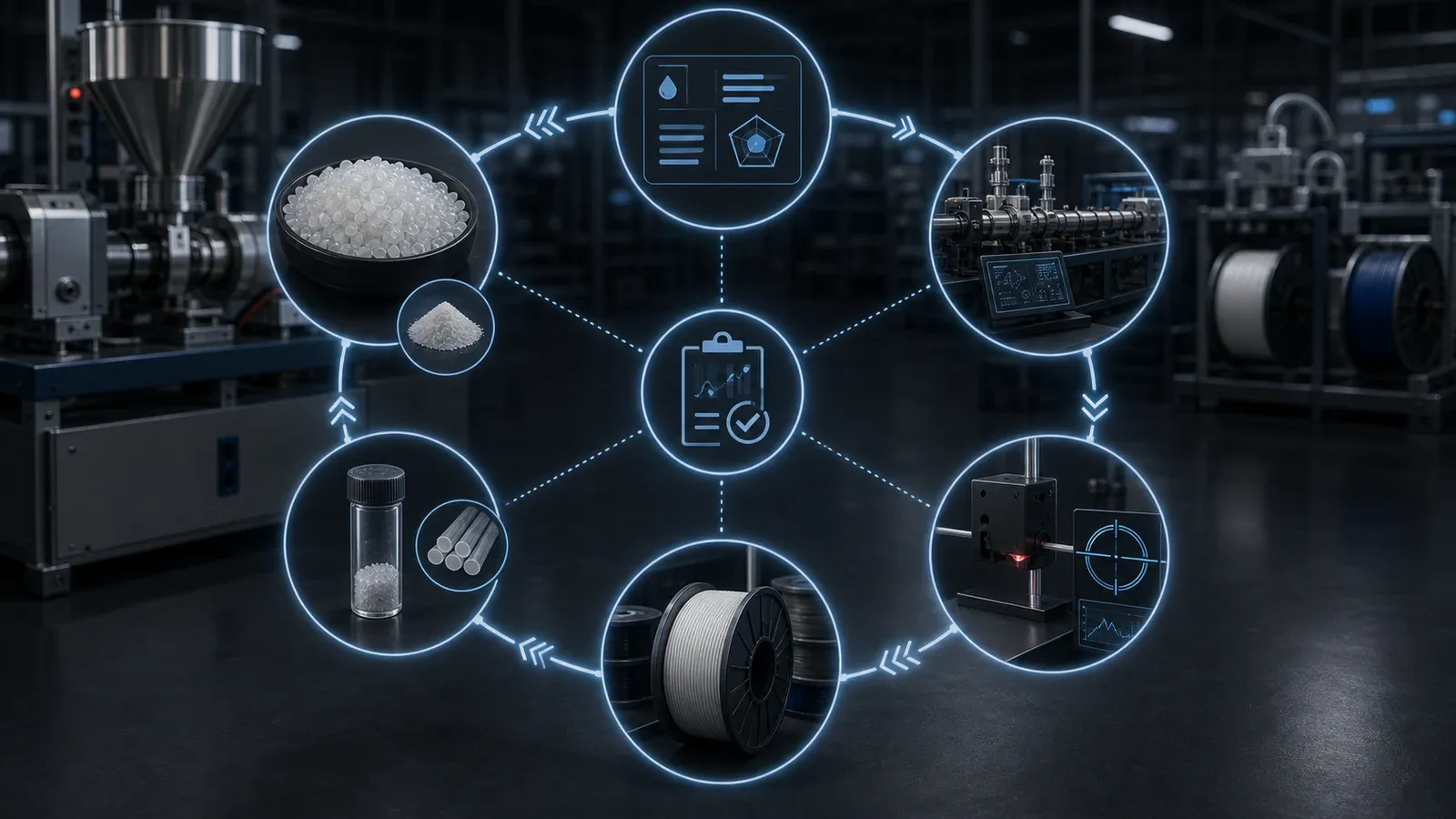
Stability is ensured not by one final check, but by a sequence of interconnected actions:
1. Specification definition
Base polymer and formulation, color or agreed reference, nominal diameter and acceptance limits, hardness for elastomers, net mass, spool type, packaging and labeling requirements, and list of control tests.
2. Incoming inspection of raw materials
Checking conformity to the ordered grade and retaining lot information: supplier documents, appearance, moisture, flow - depending on the material.
3. Formulation management
Every formulation has an identified version. Replacing the pigment supplier, polymer grade, or additive concentration is a product change, even if the label name remains the same.
4. Standardization of process parameters
Not only composition is reproduced, but also production conditions: drying, temperature profile, feed speed, pulling mode, cooling, and winding.
5. In-process control
In-process control makes it possible to track trends and adjust the mode before a significant part of the batch goes out of limits.
6. Finished-product inspection
Strand geometry, appearance, color, winding, mass, and behavior during printing - preferably on the same test model, printer, and profile.
7. Traceability
Batch labeling connects the spool with raw material, formulation, production date, and control results - without this, systematic analysis of claims is impossible.
What a B2B customer should agree
Repeatability does not depend only on the manufacturer. The customer should define in advance which characteristics are critical for the end application, which methods will be used to check them, which acceptance limits are realistic, whether control samples are needed, how changes in raw materials and formulation will be approved, and which data will accompany the batch. On the print-farm side, it is useful to record print profiles for the specific material and batch, keep drying and storage conditions, avoid mixing remains from different batches in critical orders without a test, and tell the manufacturer not just “it prints badly,” but the specific symptoms: under-extrusion, bubbles, color shift, brittleness, feed problems.
Two batches of a polymer product cannot be identical at the molecular level, but they can be equivalent from the customer’s point of view: print on the same profile, produce a predictable surface, and match the agreed color. This is practical repeatability - controlled raw material, fixed formulation, stable process, measurable acceptance criteria, and traceability for every batch.
Bokotech manufactures engineering filament in Ukraine and works with repeatable batches for the needs of brands, distributors, print farms, and production teams. Requirements for material, color, TPU hardness by Shore, spool format, or batch-to-batch stability should be discussed at the material selection stage - before production launch, not after receiving the first batch.