

The cost of launching a filament brand is not limited to the price of the first batch. A company finances not only the material on spools, but also assortment development, samples, packaging, logistics, content, sales, and a reserve of working capital. It is therefore more useful to ask how many SKUs will be launched, which product elements will be customized, what minimum run applies to each material, how much contribution margin remains per unit, and what sales volume will cover startup and monthly costs.
This is primarily an economics problem, not a printing problem
Filament is a consumable. Buyers return for the next spool if quality is stable from batch to batch. Repeat orders are what make the business attractive: the contribution from several batches can cover one-time launch costs if demand is sustained. The calculation should therefore extend beyond the first batch to several production cycles.
Cost structure: startup, period, unit, and batch
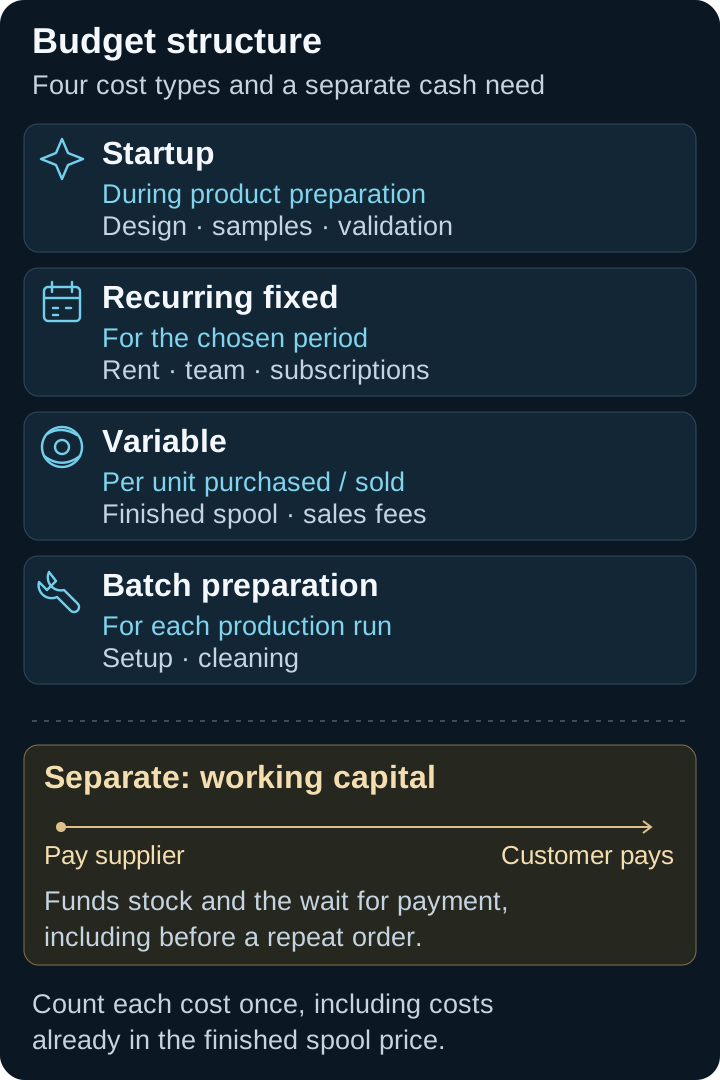
One-time startup costs relate to the initial preparation of the product and brand and do not recur with every unchanged production run:
- development of the product matrix: material and color selection, SKU positioning, compatibility with the target customers’ equipment;
- color selection or development and, if needed, a custom formulation;
- spool, label, and packaging design, plus prepress work;
- sample production and initial product validation;
- technical coordination before launch: agreement on material, spool format, and labeling;
- initial catalog setup, photography, and content for the sales launch.
A new SKU or a change in specification may require further development and validation costs.
Recurring fixed costs are planned for a defined period: warehouse rent, fixed staff pay, accounting, software, and service subscriptions. Within existing capacity, they do not change with every spool sold, but they may increase if an additional warehouse or employee is needed.
Variable costs depend on the number of units purchased or sold. For a brand ordering a finished product, the starting point is the purchase price per spool. It may already include:
- polymer, colorant, and additives;
- spool, bag, desiccant, box, label, and supporting documentation;
- drying, extrusion, winding, labor, and quality control;
- process losses included in the manufacturer’s price.
Do not add these components on top of the finished spool price. Account separately only for items you pay for in addition: inbound logistics, order picking, marketplace and payment processing fees, customer delivery paid by the brand, and expected return or replacement costs. Discounts reduce the selling price; they are not another expense on top of an already discounted price.
Preparation costs for each batch include line setup, cleaning when changing material or color, bringing the process into a stable operating condition, checking the first acceptable output, and batch documentation. They recur with each production run and depend on the number and complexity of runs, rather than directly on the number of spools sold. Establish whether they are included in the manufacturer’s price or billed separately.
An expense’s name does not determine how it behaves. Warehousing or logistics may combine a fixed fee with a charge per unit or shipment; advertising may have a monthly budget or a cost per acquired order. Separate these components according to the actual terms and do not count the same delivery in several budget lines. A distributor’s existing channels may reduce incremental costs, but staff time and other resources still need to be considered.
Different materials have different costs, but there is no universal price ranking for PLA, PETG, ABS+, ASA, PA/Nylon, and TPU: compare specific formulations, volumes, and included components. For TPU, Shore hardness defines a separate specification; for moisture-sensitive materials, drying and protective packaging need to be agreed. The assortment mix therefore directly affects the brand’s average unit cost.
What shapes MOQ
MOQ is the minimum order quantity under the agreed terms. It is influenced by production setup economics, raw-material and component purchase quantities, and supplier terms. Every production run carries costs that do not disappear even at low volume. More distinct setups mean more costs to recover through the batch.
Clarify both the unit of measurement and the scope of MOQ: the whole order, a material, a color, or a specific SKU—a combination of material, color, diameter, net filament weight, and included components. For TPU, also specify the hardness value and Shore scale. More SKUs do not necessarily increase the minimum for each item, but they may increase the total purchase quantity and the number of production runs.
A broad starting lineup looks convincing in a catalog, but ties up money in inventory. For each SKU, compare the minimum batch, forecast sales for the chosen period, and expected remaining stock. MOQ is neither evidence of demand nor the break-even point: quantities produced and sold can differ substantially.
Check the MOQ for packaging components—boxes, labels, and bags—separately: it may differ from the filament MOQ. Paid-for components may remain after the first batch. Agree who will own them, where they will be stored, and whether they can be used in a repeat order. Buying the full quantity requires cash now, but the current spool cost includes only the components used; unusable leftovers and write-offs are assessed separately.
How to calculate spool cost
For a management cost calculation, separate unit costs from separately charged batch costs. In simplified form:
Estimated cost per spool at your warehouse = finished unit price + unit packaging and component costs not included in that price + separately charged batch setup and delivery costs ÷ number of saleable spools in the batch
This is why the same formulation has different economics at different volumes: if the batch is small, each spool carries a larger share of preparation costs. Looking only at the factory price per kilogram is not enough; the business model needs the cost of a unit ready for sale, compared on the same basis for net weight and included components.
This calculation does not yet include all selling costs and brand overheads. Gross profit is revenue minus the cost of goods sold. Contribution margin deducts all variable costs, including variable selling costs, from revenue and shows the contribution toward fixed costs. Allocating setup costs to each spool does not make them variable: for break-even analysis, separate them out or account for them consistently within the agreed purchase price.
How to calculate the break-even point
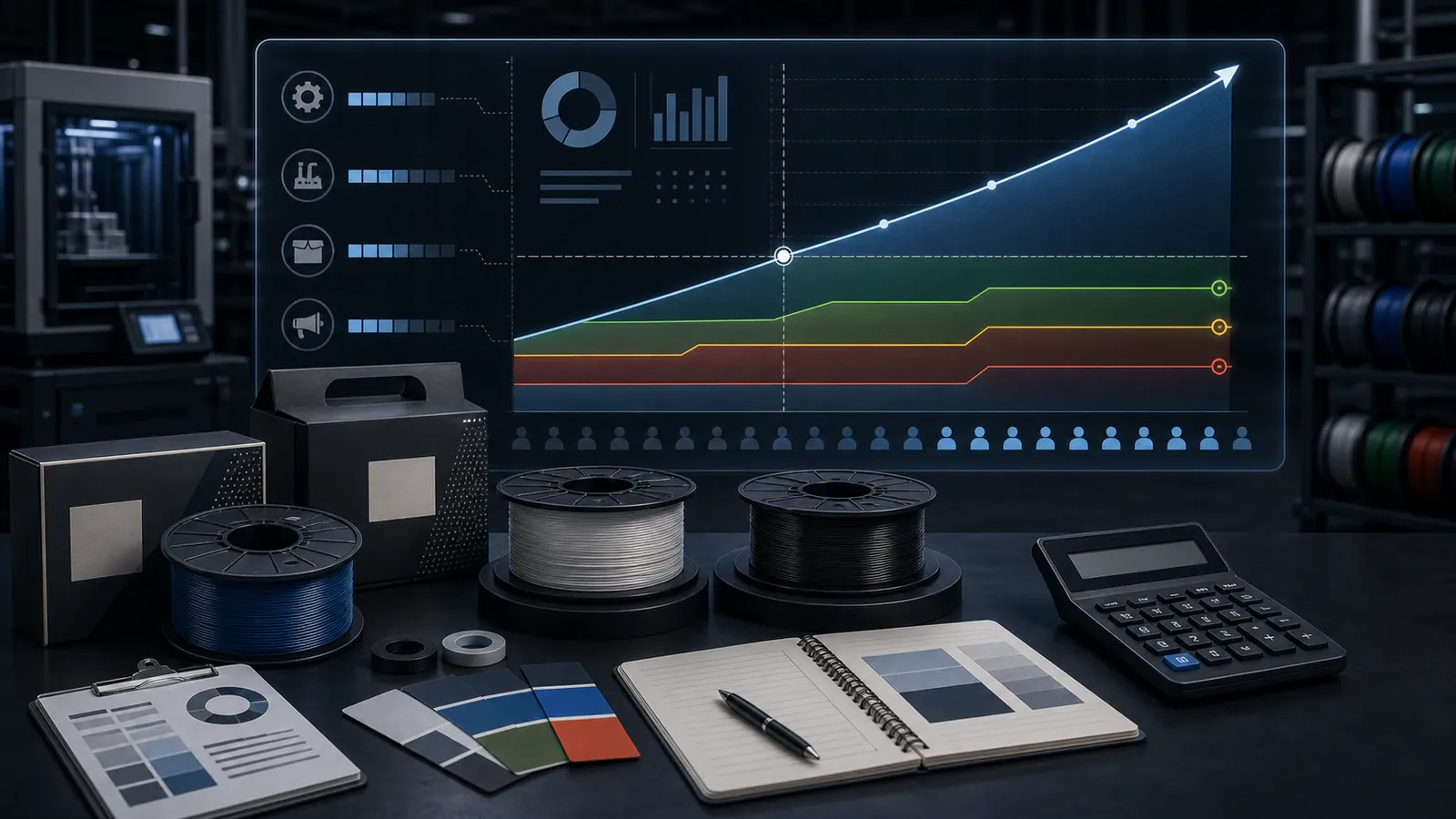
First choose a period, such as a month for an operating plan or a defined horizon for covering launch costs. All sales and fixed costs in the calculation must relate to that same period. Then determine the contribution margin from one spool sold:
Contribution margin = net sales price − variable costs per unit
Here, net sales price means revenue after discounts and bonuses. For a dealer channel, use your selling price to the dealer, not the recommended retail price. Include marketplace and payment processing fees in variable costs; if they have already been deducted from revenue, do not count them again. Compare prices and costs on a consistent VAT basis appropriate to your tax status. Then:
Break-even point (in units) = fixed costs for the chosen period ÷ contribution margin per unit
Round the result up to a whole spool. If contribution margin is zero or negative, increasing sales under these conditions will not cover positive fixed costs.
In a simplified plan, separately charged setup for the planned batches can be included among the costs to cover during the period. In that case, exclude its allocated share from variable unit costs. If setup is already included in the agreed purchase price, do not add it again to the numerator. The number of batches must match the plan: if the calculated volume requires another production run or a new quotation, recalculate the model. This cost-coverage plan does not replace the accounting allocation of product costs between sold spools and remaining inventory.
Separate two calculations:
- Monthly operating break-even: contribution margin covers recurring fixed costs and any separately charged batch costs included in this plan.
- Covering launch costs over a chosen horizon: add one-time design, layout, sample, website, and photography costs if they have not already been included, together with recurring costs for the entire horizon. Dividing startup costs alone by contribution margin ignores the cost of running the brand during that time.
Contribution margin is not profit: the financial result can only be assessed after accounting for all costs of the relevant period. This model alone does not determine net profit or the time needed to recover the cash invested.
For several SKUs and channels, use a weighted average contribution margin based on their shares of units sold, not a simple average or their shares of revenue. Treat spools of different weights as separate items. A more reliable check is to calculate the total directly:
Sum of (units sold of each SKU in each channel × corresponding contribution margin) ≥ costs to be covered during the period
The weighted average contribution must be positive; a change in sales mix changes the threshold. A higher contribution from an engineering material does not automatically compensate for slow sales. Check both a base and an adverse scenario: larger discounts, higher purchase and logistics costs, returns, and a greater share of less profitable items. Slower sales at unchanged prices and costs do not change the threshold itself, but may prevent you from reaching it within the planned time. One-time development does not have to be repeated for every batch, but setup, prices, and recurring costs remain in the model.
What financial reserve to plan
The initial budget should cover not only production, but also the period between paying for the batch and receiving money from customers, especially in distribution with deferred payment. Plan funding separately for repeat orders of popular items before the first batch is fully sold. A reserve beyond the plan is needed for packaging or labeling corrections, additional samples and tests, fluctuations in logistics costs, unexpected replacements, and a longer-than-expected sales cycle.
Do not record the entire first-batch purchase as a fixed cost on top of the cost of spools sold. Unsold goods remain inventory; their cost is generally recognized as an expense when they are sold, while losses or write-downs are accounted for separately. Yet the cash for that inventory may already have gone to the manufacturer. Likewise, a shipment sold on credit may generate revenue before any cash is received.
Build a payment schedule for preparation, production, packaging, logistics, recurring costs, and repeat orders, alongside customer receipts. A guide to total funding needs is the largest cumulative cash shortfall before owner contributions or loans, plus a contingency reserve. Do not add the first batch or packaging again if their payments are already in the schedule. Customer prepayments and supplier payment terms change cash needs, but do not themselves create profit.
Assess investment recovery using the project’s cumulative cash flow, including inventory replenishment, rather than simply the number of spools sold. Even an operationally profitable brand may need additional working capital to grow.
The organizational steps from the technical brief to a pilot batch are covered in the filament brand launch plan.
How to reduce launch risk
A rational approach is to start with a limited lineup: a few materials and colors with clear demand, a standard spool and packaging, test validation separate from the commercial run, and assortment expansion once repeat-order data is available.
Before requesting a quotation, prepare the product matrix, sales and repeat-order forecasts, and requirements for material, color, TPU Shore hardness, spool, label, and box. Ask the supplier to separate one-time work, setup for each batch, the finished unit price, and MOQ for each configuration and its packaging. This makes it possible to assess the economics of a specific order.
Bokotech can discuss contract manufacturing and private label, material selection, color, TPU hardness, spool format, labeling, packaging, and quality control before series production starts. For a B2B buyer, this reduces the number of undefined parameters and allows the calculation to focus on the real economics of the product.
Conclusion
The cost of launching a filament brand is determined not by one price per spool, but by the entire project configuration: number of SKUs, customization level, component MOQs, sales channel, and inventory turnover speed. The lowest-risk approach is to calculate unit economics and the break-even point first, test demand with a limited lineup, and only then scale the assortment.