
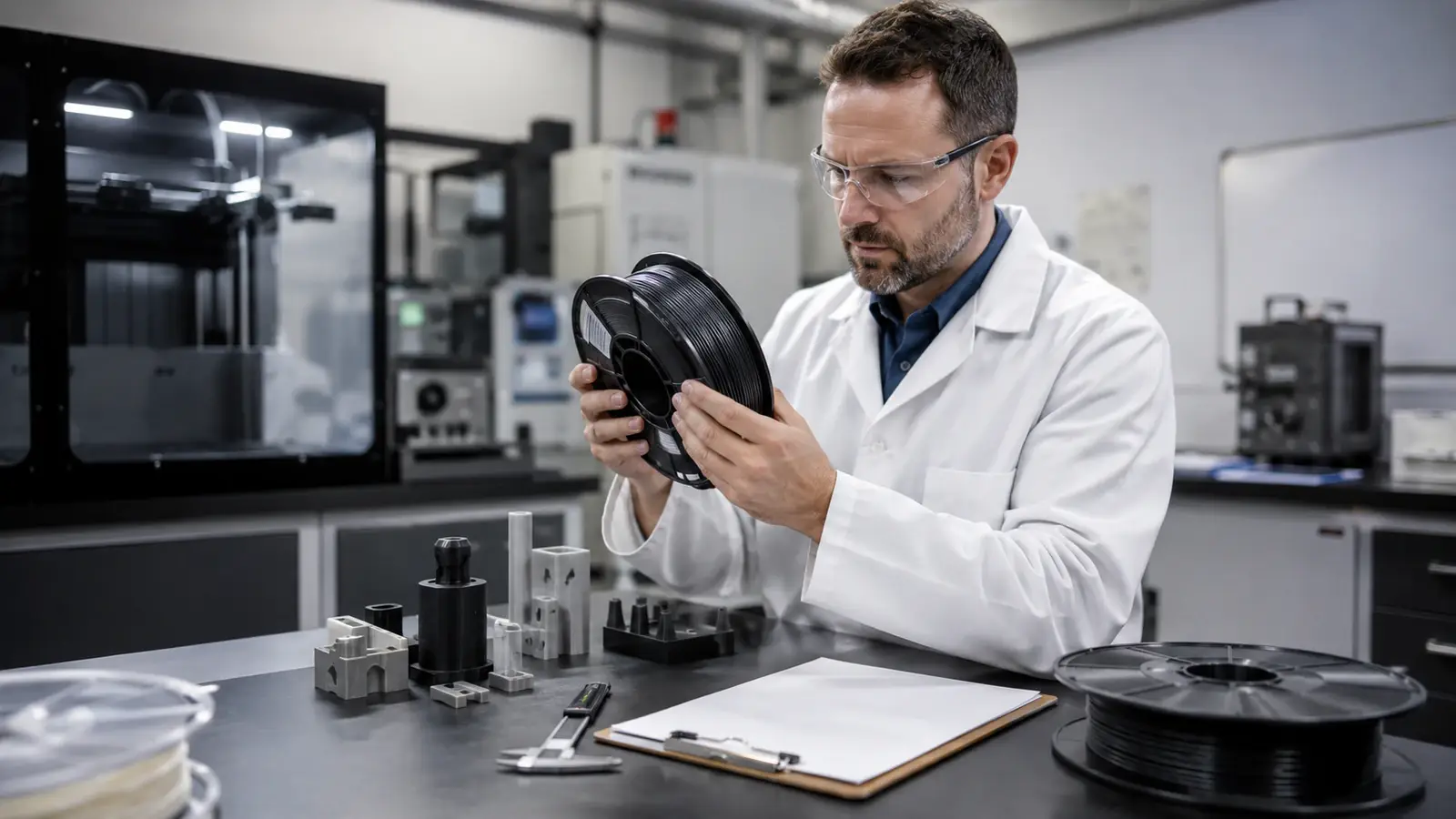
A filament claim is not a conflict, but an engineering task. The same ABS+, ASA, TPU, PA/Nylon, PETG, or PLA can behave differently depending on the printer, print profile, nozzle condition, material moisture, part geometry, and storage conditions. Until the cause is determined, it is premature to speak about a “defect.” Therefore, professional claim handling is not an argument about whose side the problem is on, but a sequential separation of possible causes: the manufacturer’s task is to identify the material, check the actual nonconformity, and determine whether it is connected with a specific spool, batch, use conditions, or a combination of factors.
For a B2B client, a well-prepared claim is no less important than it is for the manufacturer: it helps separate a batch defect from a settings, logistics, or open-storage problem faster. This is especially critical for print farms, contract manufacturing, OEM / private label batches, and series use of filament in technical products.
Why the cause is not always the material
The same visible defect can have different origins. Under-extrusion, skipped layers, part brittleness, or nozzle clogging are typical symptoms attributed to filament, but the symptom alone does not identify its cause.
Moisture is one of the most common and least obvious factors. Most engineering materials are hygroscopic: PETG, nylon (PA), and TPU actively absorb moisture from the air, and even PLA degrades in a humid environment. Moisture-saturated filament produces characteristic crackling at the nozzle, becomes brittle, causes under-extrusion and clogging - while the material itself may have left production in normal condition and absorbed moisture only after unpacking.
Settings and equipment on the print side are the second large group: too low or too high a temperature, excessive speed, uncalibrated e-steps (extruder steps), a contaminated or worn nozzle. If the symptom also occurs with a known-good spool of the same material under comparable conditions, that is a reason to inspect the equipment. A successful control print does not by itself rule out an equipment or profile issue. Therefore, correct claim review is a reproduction of the situation: the manufacturer tries to repeat the defect and separate the influence of the material from the influence of the process.
How review starts
The first stage is precise product identification. The material name and color are not enough, because the same SKU can be supplied in different production batches. The manufacturer usually needs:
- material name, color, and diameter (1.75 or 2.85 mm), and for TPU, Shore hardness;
- mass or spool format;
- batch/lot number, production code, or other marking on the label;
- order number, delivery note number, or date received;
- number of spools with a similar manifestation and approximate amount of material already used;
- photos of the spool, label, packaging, and defect.
The batch code makes it possible to connect the request with production records, raw materials used, formulation, color composition, and internal-control results. Without this, the claim often turns into general print tuning rather than a check of a specific product. Until analysis is complete, it is advisable not to discard the spool, box, label, remaining material, and failed printed sample - without a physical sample, some checks cannot be performed.
Why “it prints badly” is not enough
One symptom can have several causes. For example, extrusion skips may be connected with partial nozzle clogging, insufficient temperature, excessive speed or volumetric flow, incorrect filament idler pressure, worn drive gears, strand deformation in the feed path, moisture, or geometry deviations in the material itself. Stringing is also not unambiguous proof of a defect: it is affected by moisture, temperature, retraction, travel speed, and extruder design, while the acceptable stringing level differs for PETG or TPU compared with PLA. Likewise, warping of ASA or ABS+ may result from drafts, unstable chamber temperature, insufficient build-plate adhesion, or part geometry, not from the batch.
A useful description answers three questions: what exactly is happening, at what stage of printing it appears, and under which parameters and on which equipment the symptom repeats. For example: “After two hours of printing, irregular extrusion skips begin, the extruder clicks, the defect repeated on two spools from one batch and did not appear with material from the previous batch.” Such a description is far more informative than a photo of a failed part without context.
Which print parameters to provide
For technical analysis, the manufacturer should preferably receive not only nozzle temperature, but the full context:
- printer model and configuration, extruder type (direct drive or Bowden);
- nozzle material and diameter, its actual condition, and approximate service time;
- nozzle and bed temperature, print speed or maximum volumetric flow;
- layer height and extrusion width, flow factor, retraction parameters, cooling intensity;
- chamber temperature, if controlled;
- slicer name and profile used.
For ABS+, ASA, PA/Nylon, and other materials with noticeable shrinkage, part size, the presence of an enclosed chamber, ambient temperature, and the build-plate preparation method are also important: lifted corners on a large ASA part printed on an open printer cannot be evaluated the same way as unstable extrusion on a small sample. The best format is the slicer project file or saved profile together with the G-code of the problematic print, which reduces the risk of accidentally missing an important parameter.
What the manufacturer checks
With data and a sample, the manufacturer goes through several levels of checks - from simple to complex.
Labeling and traceability. The spool code is matched with the production batch, formulation, and control records. If similar requests have come from several clients or involve several spools from one batch, this increases the priority of checking the whole batch.
Filament geometry. Diameter along the length and ovality (the difference between diameters in perpendicular planes) are checked. Local thick sections create additional friction and clogging, while thin sections cause skips and weak layers. What matters is not one point, but stability over a segment; a single caliper measurement is not always representative. The diameter and ovality guide explains how these measurements relate to an agreed tolerance.
Winding and feeding. The manufacturer assesses whether the strand unwinds freely from the spool and whether there are damaged turns, jamming, or flange deformation. A real knot does not appear by itself inside a continuously wound strand, but the loose end after unpacking can pass under a neighboring turn - so photos of the turn position before unwinding are especially important.
Material condition. Depending on the request, signs of moisture, melting and extrusion stability, color and color-uniformity, odor, or visible inclusions are evaluated. For TPU, it is considered that the Shore designation does not describe all feeding characteristics, which are affected by path geometry, speed, and roller pressure.
Defect reproduction. The most valuable check is an attempt to reproduce the problem under known conditions on reference equipment with recommended parameters. For materials such as PA, TPU, or PETG, comparative printing before and after correct drying is useful in order to separate moisture from other factors. If the defect does not reproduce, this does not mean automatic rejection of the claim - differences may be created by equipment, nozzle condition, or calibration - but without repeatability, the root cause is harder to establish.
How moisture and storage are checked
The mere presence of silica gel in the package does not prove that the spool remained dry after opening. Therefore, the manufacturer clarifies when the package was opened, how long the spool was outside sealed packaging, at what humidity it was stored, whether a dry box was used, whether drying was performed (at what temperature, for how long, and on what equipment), and whether the result changed after control drying. Drying at an unsuitable temperature can deform the filament or spool, so the mode is selected for the specific material.
How to distinguish a material defect from a process problem
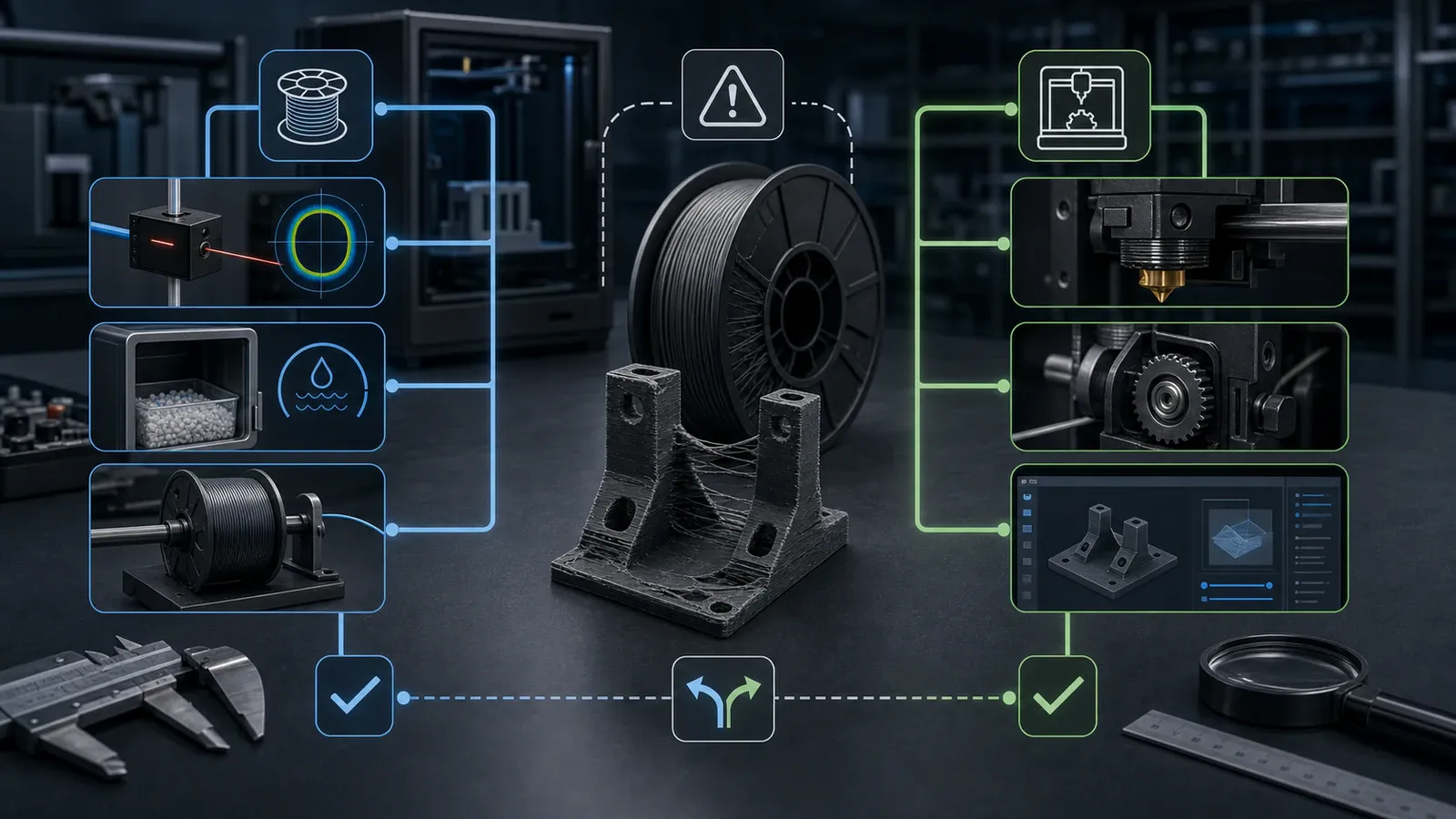
A batch problem is more often indicated by: the same defect on several properly functioning printers; repetition with different nozzles after equipment checks; stable printing of a known-good spool of the same material under comparable preparation and printing conditions; a defect on several spools with the same batch code; measurable deviations from the agreed specification; no change after drying and parameter correction.
A process problem is more often indicated by: a defect only on one printer; extrusion normalizing after nozzle cleaning or replacement; dependence on a specific model or G-code section; temperature, speed, or volumetric flow outside the working range; long open storage of the spool; stabilization after drying or profile changes. In real work, the cause can be combined - material with elevated moisture may print acceptably on a slow printer, but produce skips at high volumetric flow.
Records from incoming inspection help establish the condition of the batch on receipt, before storage and printing introduce further variables.
Review result and request checklist
Based on the analysis, the manufacturer may confirm spool nonconformity, expand the check to the batch, request a sample for additional analysis, provide a corrected profile or material-preparation recommendations, identify the cause on the equipment or application-conditions side, offer replacement, return, or other compensation, and introduce corrective actions in production, packaging, or control. The specific decision depends on the nature of the nonconformity, product volume, contract, and ability to objectively confirm the problem.
To process a claim without lengthy correspondence, it is worth sending immediately: photos of the label and batch code; order number; number of problematic spools; a clear symptom description; photos and video of the defect; printer, extruder, and nozzle model; slicer profile or G-code; temperatures, speed, flow, retraction, and cooling; storage and drying information; comparison result with another spool and on another printer; confirmation that the remaining filament and sample have been preserved. For contract manufacturing and private label, add the agreed specification - material, color, TPU hardness, spool format, labeling, packaging, and acceptance criteria: the more precisely requirements are fixed before series launch, the more objectively the claim can be evaluated.
Bokotech runs production in marked batches, which makes it possible to retrieve the history of a specific cycle and review a request substantively - confirm a material problem if there is one, or help localize the cause on the process side. For B2B clients working with repeat orders, contract manufacturing, or private label, this transparency is no less important than the material properties themselves: it reduces downtime, makes printing more predictable, and makes supply more reliable.