
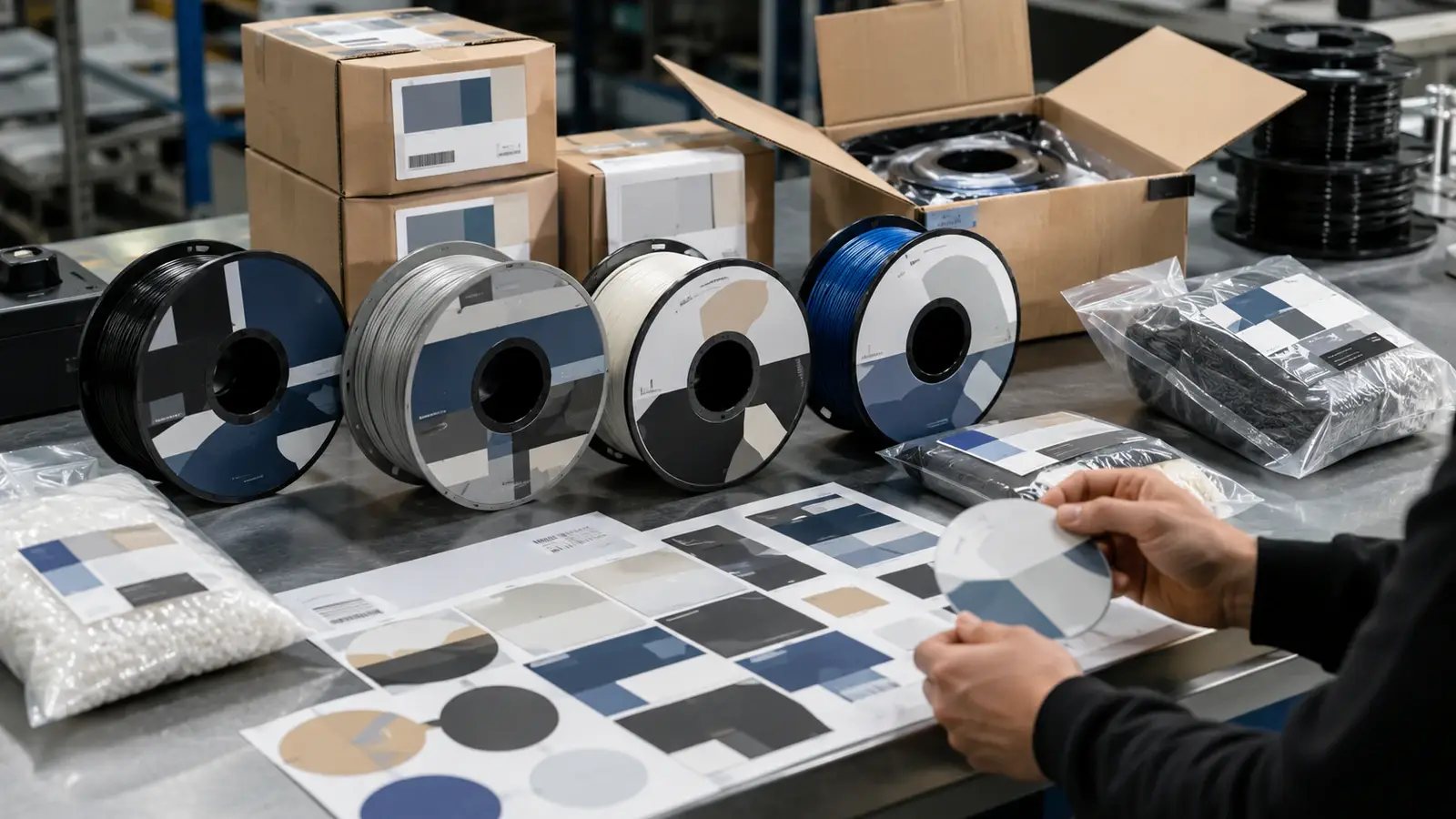
In private label and OEM projects, filament customization does not end with polymer and color selection. For the buyer, the finished product is the entire system: spool, winding, label, protective bag, box, barcode, and transport packaging.
These elements affect more than appearance. They determine compatibility with printers and automatic feed systems, warehouse handling convenience, material protection from moisture, order-picking speed, and the number of support requests. Packaging should therefore be designed as part of the product, not as a final decorative operation.
Spool: geometry matters more than design
Color and logo on the spool are noticed first, but for a B2B project its dimensions and mechanical behavior are more important. Usually the parties agree on:
- outer spool diameter and width;
- diameter and shape of the central hole (fit on the holder);
- flange geometry and seating surfaces;
- spool material;
- nominal filament mass;
- method for securing the free end;
- winding direction and density;
- color, embossing, sticker, or another branding method.
There is no single format that is equally convenient for all printers, holders, dryers, and multi-material systems. Even similarly sized spools can behave differently in enclosed bays or automatic feeders. The important factors are not only dimensions, but also edge flatness, flange stiffness, surface friction, and shape stability. If the product is aimed at 3D print farms or a specific equipment ecosystem, it is advisable to define the target printer list in advance and test sample spools in real conditions. For TPU, keep in mind that not every automatic feeder is designed for flexible material.
Plastic, cardboard, or reusable
A plastic spool usually provides stable geometry and moisture resistance, as well as an even surface for the label. Cardboard reduces the share of plastic, but is more sensitive to moisture and requires checks of stiffness, edge quality, and feeder-roller compatibility. A refill format (winding without a spool for a reusable “master spool”) saves weight and volume during shipping, but requires the customer to already have a compatible spool, so it is more logical for an audience that has deliberately chosen this system.
Sustainability should not be assessed by appearance alone. Material composition, the ability to separate components, real recycling channels in the target market, and the mass of the entire package all matter.
Label: marketing, identification, and technical documentation
The label must quickly answer three questions: what material it is, how this specific spool differs from others, and how to work with it. The basic dataset usually includes:
- brand and product name;
- polymer type and series or formulation designation;
- color and internal part number;
- filament diameter;
- net weight;
- batch number;
- production or packaging date;
- recommended print temperature range;
- storage recommendations;
- manufacturer or brand contact details and country of origin;
- barcode and, if needed, QR code.
For TPU, it is useful to state Shore hardness if it is part of the specification. The batch number is a critical element for brands that work with repeat orders and support: it connects a specific spool with the order and color standard, simplifying claim analysis and consistency control between batches.
A small label should not be overloaded with every print parameter: nozzle and bed temperatures depend on the printer, part geometry, speed, and ambient conditions. It is better to provide a starting range or move extended recommendations to an up-to-date web page.
Fixed and variable data
It is practical to divide the label into two layers:
- Fixed layout: logo, brand colors, product line name, information structure.
- Variable data: material, color, mass, batch, date, part number, and product code.
This approach simplifies assortment management and reduces the risk of a label from another modification ending up on the box. For warehouse work, it is important that material, color, and part number remain readable in the position in which boxes are stored on the shelf.
A separate area of attention is label claims. Avoid writing “industrial strength”, “food safe”, “biodegradable”, or “UV-proof” unless it is confirmed for the specific material and application. For export markets, language requirements, labeling rules, and origin and manufacturer or importer responsibility data are also checked.
Barcode and QR code perform different functions
A linear barcode is used for checkout, warehouse operations, and accounting systems. GTIN identifies a separate trade item, so the variant structure must be planned before launch: different materials, colors, diameters, or packaging formats may be separate SKUs.
A QR code is useful for information that changes more often than the printed layout: slicer profiles, drying and storage instructions, technical characteristics, a specific material page, a support form, or packaging disposal information. Before series printing, codes are checked with several scanners and phones on the actual label material; small size, low contrast, glossy coating, or placement near the edge can impair reading.
Protective packaging: more than a sealed bag
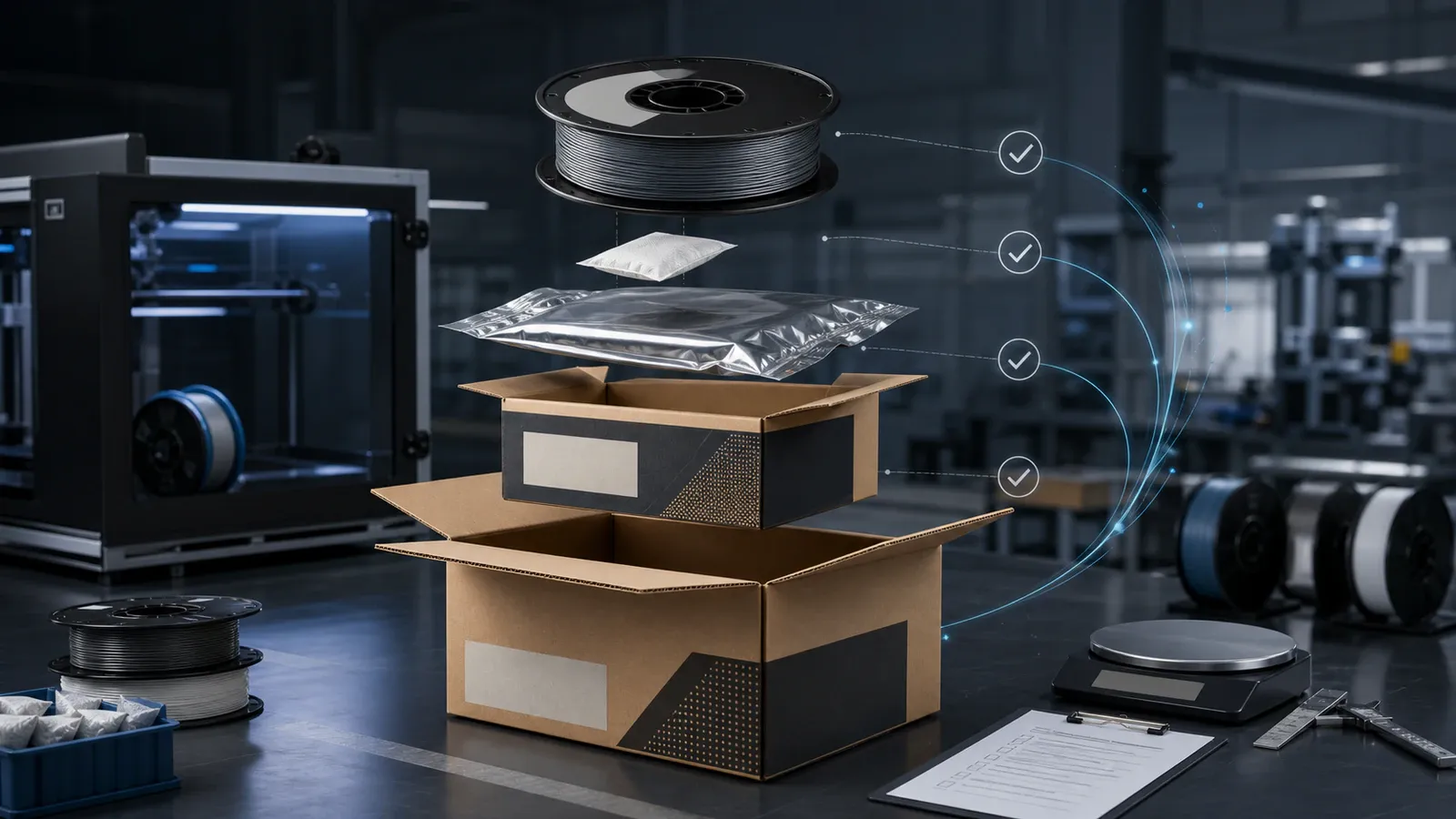
Most engineering plastics are hygroscopic. Polyamides (PA/Nylon) and TPU are usually the most sensitive, ABS/ASA and PETG react noticeably, and PLA absorbs moisture the slowest. Moisture worsens printing: bubbles, hissing during extrusion, uneven surface, stringing, and weaker interlayer adhesion. Packaging is therefore part of technical quality, not cosmetics.
The basic protective loop is a sealed or vacuum barrier bag with desiccant (silica gel), and, if needed, a humidity indicator. Important: a bag with desiccant does not dry already wet filament; it only slows moisture reabsorption, so material condition must be controlled before packaging. When choosing a bag, evaluate barrier properties, seam strength, resistance to punctures from spool edges, resealability, label space, and convenience for manual or automated packing.
The outer box protects the spool from impact, compression, and contamination, and creates the main surface for the brand. Its size is selected for the spool without excessive empty space, while accounting for tolerances, the bag, and transport loads.
Retail, wholesale, and transport packaging
Retail and wholesale packaging should be distinguished. For 3D print farms and manufacturers that buy material by the pallet, a complex retail box is often unnecessary; stable labeling, warehouse convenience, and moisture protection matter more. For brands that sell to end users, the box design works on the shelf. These scenarios can be combined within one product line.
For a distributor or large farm, agree on the number of spools in a shipping carton, box orientation, external labeling, cargo unit weight, and palletization logic. A shipping label may include the part number, material name, color, unit count, batch number, and a code for warehouse scanning. If one batch is shipped in several cartons, traceability must be preserved at every packaging level.
What to approve before series production
The later packaging changes, the more related elements have to be reworked. Before the first series batch, it is advisable to approve:
- the SKU list and naming rules;
- spool type and geometry, filament mass;
- final label layout and variable-data structure;
- barcodes and QR code URLs;
- inner bag and desiccant type;
- box construction and shipping-carton marking;
- languages and mandatory markings for target markets.
A screen mockup does not replace a physical sample. It is worth checking trial packaging, small-text readability, code scanning, spool fit in the box, and the product’s appearance after transport.
A practical rule: first define who you sell to and how, and only then choose the format. A distributor more often needs neutral labeling and reliable packaging; a retail brand needs full presentation; a 3D print farm needs traceability, stable winding, and minimal excess.
In Bokotech contract manufacturing, material and color, TPU Shore hardness, spool format, label, box, protective packaging, and batch marking can be discussed separately. The final configuration depends on volume, component design, printing method, number of SKUs, and requirements of the sales market.