
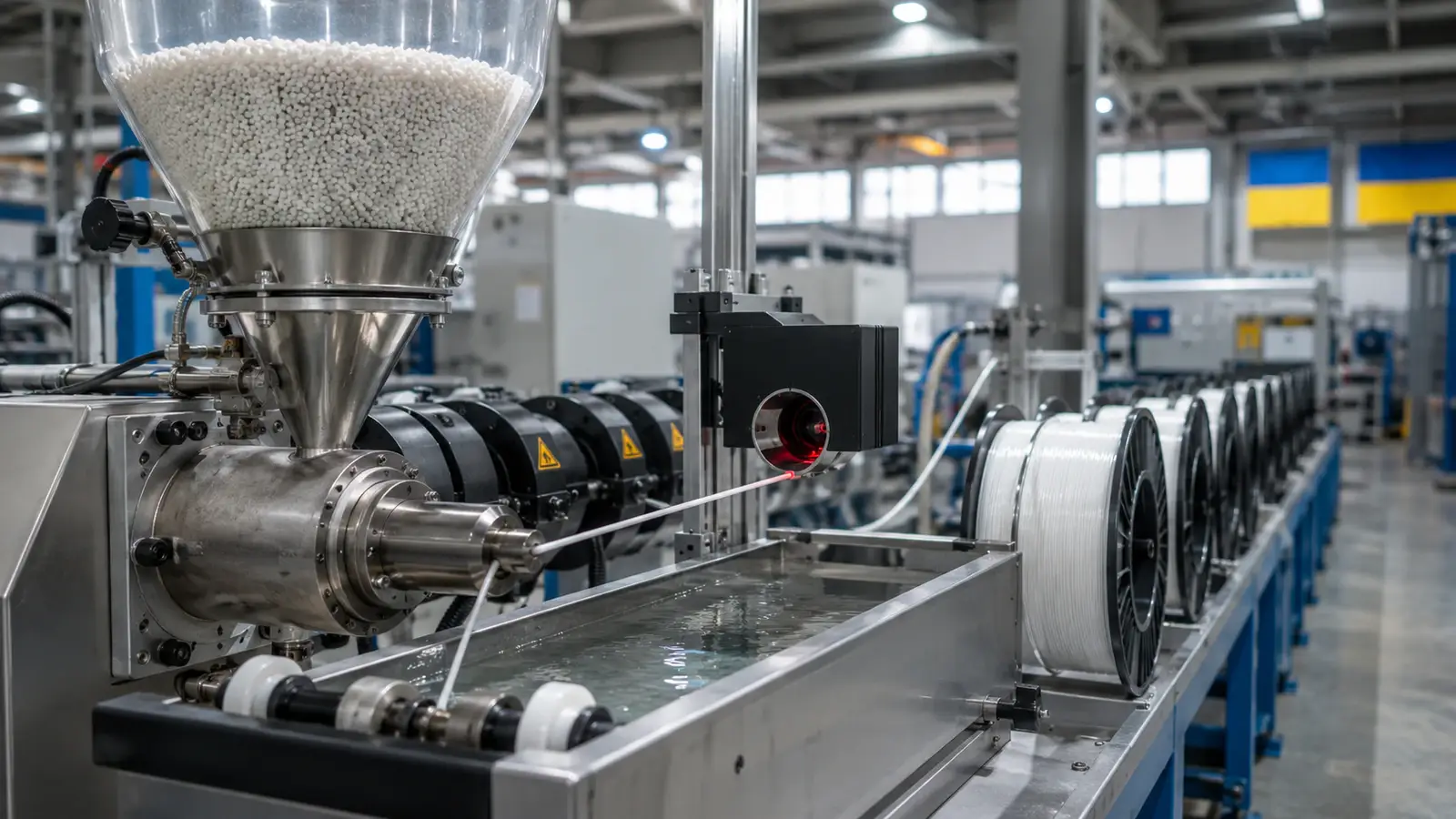
Filament production is often described in a simplified way: polymer pellets are fed into an extruder, melted, and wound as filament onto a spool. In reality, an industrial extrusion line is a sequence of interconnected operations where a deviation at any stage appears later during printing as unstable feeding, a change in extrusion width, an uneven surface, or differences between batches.
For brands, distributors, 3D print farms, and manufacturing teams, these details directly affect repeatability. Even if the material has the right name, such as TPU, ABS+, ASA, PA/Nylon, PLA, or PETG, its behavior in a printer is determined not only by the polymer, but also by exactly how it was processed into filament. For a B2B buyer, it is important to understand not only the material composition, but also how the manufacturer controls raw material, temperature, line speed, cooling, filament geometry, and winding.
An Extrusion Line Is Not a Single Machine
A typical filament production line includes several sequential units:
- a pellet storage and preparation system;
- a dryer;
- dosing of polymer, colorant, and functional additives;
- an extruder, single-screw or twin-screw;
- a melt filter and extrusion head, or die;
- an air or water cooling system;
- a non-contact diameter gauge;
- a pulling mechanism, or puller;
- a filament compensator or accumulator;
- a winding station;
- production control and parameter recording tools.
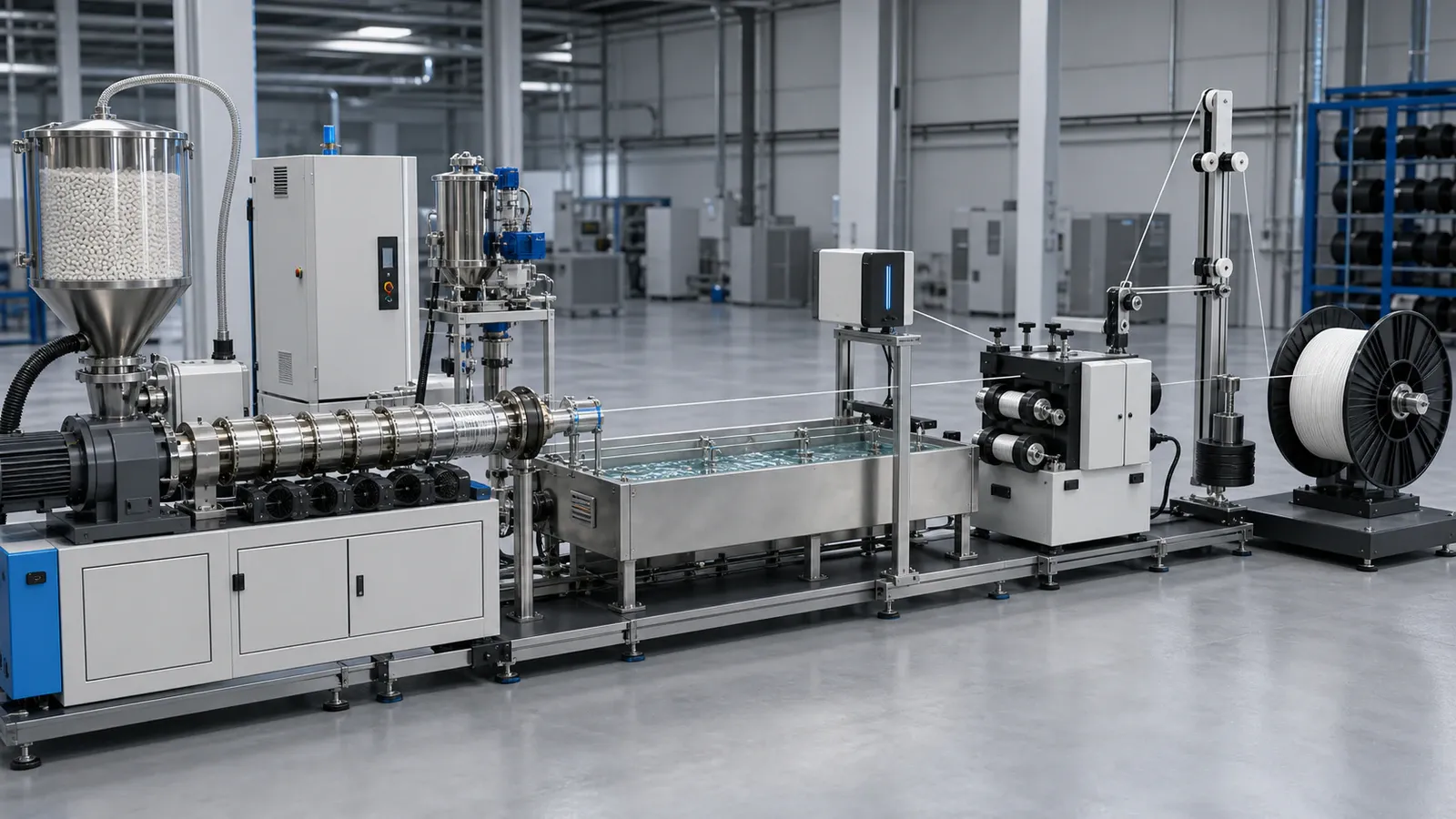
The exact configuration depends on the material, output, target diameter, spool type, and finished product requirements. A line for rigid PLA or ABS+ requires different settings than production of soft TPU or hygroscopic polyamide.
Incoming Inspection of Pellets
The process starts not with heating, but with raw material identification: polymer grade, batch number, color, packaging condition, storage conditions, and conformity with the agreed formulation. The consistency of incoming pellets directly determines what the customer receives on the spool.
Even materials with the same generic name differ in melt viscosity, molecular weight, stabilizer package, and behavior during extrusion. Two TPU grades with the same Shore hardness may require different temperatures and produce different shrinkage after leaving the die. That is why, for a repeatable production material, the specific base polymer grade, supplier and raw material batch, colorant type and percentage, functional additive composition, rules for using recycled material, and processing sheet are fixed. Replacing one component without revalidating the process can change the color, stiffness, filament surface, or diameter stability.
Drying: Preparing the Polymer for Melting
Most engineering polymers are hygroscopic: they absorb moisture from the air. Polyamides, TPU, and polyester materials require especially careful control, but depending on the grade and storage conditions, drying may also be needed for PLA, PETG, and ABS/ASA. If wet material is extruded, steam forms in the melt, causing bubbles and pores, a matte or rough surface, unstable flow through the die, diameter fluctuations, and reduced mechanical properties due to hydrolytic breakdown of polymer chains.
The drying regime should not be defined from a universal table. Temperature, duration, dew point, and allowable residual moisture depend on the specific raw material grade and its technical documentation. Drying is not a matter of “the longer and hotter, the better”: an overly aggressive regime causes yellowing, property changes, or problems with additives. It is not only the base pellets that need drying. Color concentrates and functional additives may also contain moisture, and after drying the material must be protected from renewed contact with humid air.
Dosing and Mixing the Formulation
Prepared pellets are fed into the extruder. If the filament is colored or contains additives, masterbatch, stabilizers, modifiers, or fillers are introduced at this stage. Dosing accuracy and stability determine color repeatability between batches. For brands and distributors, this is often critical because shade differences between spools from different orders are visible to the naked eye. Fluctuations in modifier percentage can affect TPU hardness, ABS+ impact strength, or the processing behavior of the compound. Volumetric or gravimetric dosing, premixing, or a combination of methods may be used. The method is selected according to the formulation, required repeatability, and output.
What Happens Inside the Extruder
In the feed zone, pellets enter the barrel, where they are captured by the rotating screw. A typical screw has several sections: the feed zone moves solid pellets, the transition (compression) zone compacts them and provides gradual melting, and the metering zone homogenizes the melt and creates a stable flow toward the head. The polymer is heated not only by external barrel heaters. Part of the heat is generated by friction and shear inside the material, so the set temperatures of the zones and the actual melt temperature do not always match.
There is an important process choice here. Single-screw extruders provide uniform pressure and stable flow, which is usually sufficient for relatively simple materials. Twin-screw extruders mix better and are suitable for compounding: combining several components into a homogeneous mixture, for example for filled or custom formulations. Flow stability depends on the screw design, feeding, material, and operating conditions. A melt pump may be used to reduce pressure and output fluctuations; it is not a required feature of every twin-screw line.
The goal of the process is not simply to melt the pellets, but to obtain a homogeneous melt without unmelted particles, excessive overheating, or significant pressure fluctuations. Too low a temperature worsens plastication and increases drive load. Excessive temperature or long polymer residence time in the barrel causes degradation, color change, odor, or loss of properties.
Melt Filtration and Filament Formation
Before the extrusion head, a screen pack or another filtration system may be installed to retain foreign particles, pigment agglomerates, and residues of insufficiently dispersed components. Degassing is used for some materials to remove residual moisture and volatiles. Filtration must be balanced: a filter that is too fine or contaminated increases pressure and disrupts flow stability.
The melt then exits through the die as a continuous strand. The die opening is not equal to the final diameter: after exiting, the polymer may swell, be drawn by the pulling mechanism, and change size during cooling. The final geometry is a balance between extruder output, melt viscosity, head temperature, pulling speed, and cooling method.
Cooling and Shape Stabilization
The newly formed filament strand is still soft. If it is pulled or wound too early, it can flatten, stretch unevenly, or pick up marks from rollers. Depending on the polymer, a water bath, air cooling, or several sequential zones are used. Important variables include the temperature of the cooling medium, distance from the die, line path length, and line speed.
Cooling that is too abrupt is not always optimal. It affects shrinkage, internal stresses, crystallization, and shape stability, while cooling that is too slow leads to sagging and cross-section deformation. For flexible materials, especially TPU, low residual tension and correct roller contact are additionally important because soft filament stretches more easily.
Continuous Diameter Control
After initial stabilization, the filament passes through a non-contact measurement module, most often laser-based, whose measurement rate depends on the instrument. The sampling rate and line speed determine how closely spaced the measurements are along the strand. Standard diameters are 1.75 mm and 2.85 mm. A single manual measurement does not characterize the whole spool. What matters is statistics along its length: average value, minimum and maximum, variation, frequency of short-term deviations, and any excursions outside the specification. Industrial systems measure the filament in several directions, which makes it possible to control not only average diameter, but also ovality: how close the cross-section is to a circle. Filament may have the correct average diameter but be oval, which worsens feeding stability, especially on farms with multi-hour jobs.
The data enters a control loop that adjusts draw speed. The ratio between feed and drawing sets the final filament thickness. At constant extruder output, increasing the pulling speed reduces diameter, while decreasing it increases diameter. However, automation does not compensate for unstable raw material, moisture, or significant melt pulsation. It works best when the previous stages are already under control.
Pulling Mechanism and Winding
Puller rollers set the linear speed of the filament and maintain controlled tension. A compensator may be installed between them and the winding station to smooth tension changes or allow spools to be changed without an abrupt process stop. The winding unit with traverse lays even turns without overlaps, while the tension control system maintains consistent winding force.
Winding quality is just as important as diameter. Tangled turns or excessive tension lead to breaks and print stoppages. Excessive tension deforms soft TPU or creates unwanted stresses; insufficient tension results in loose winding, turn displacement, and a risk of tangling. Winding parameters depend on spool width, flange geometry, core diameter, and product weight. The spool format is defined at this stage as well: its size, weight, spool type, and wound length of material.
Finished Batch Control, Marking, and Packaging
After winding is completed, inspection covers more than the external appearance of the spool. A control program may include conformity of diameter and ovality with the specification, filament surface condition, color uniformity, net weight, quality of turn placement, absence of contamination and local necking, a test print according to an agreed procedure, and production batch identification.
Packaging is especially important for hygroscopic materials. A sealed bag, desiccant, correct storage, and clear marking are part of product quality, not cosmetics, because improper storage can nullify good extrusion. For B2B supply, traceability matters: batch number, material, diameter, and for TPU, Shore hardness. This makes it possible to repeat an order with the same characteristics and respond correctly if questions arise about a batch.
The extrusion-line quality-control guide explains what to record for geometry, moisture, winding, and batch acceptance.
From a Stable Line to a Repeatable Series
Filament quality is determined not by a single die, sensor, or dryer, but by the entire technological sequence: from selecting pellets to placing the last winding turn. Batch cost also depends on more than pellet price. It is affected by polymer type, formulation complexity, color, drying needs, line speed, changeover time, cleaning after the previous material, spool format, packaging, quality control, and start-up losses. A non-standard color, special TPU Shore hardness, or custom formulation requires more technical coordination than a standard material.
Bokotech, as a Ukrainian manufacturer of engineering filament, provides this technical coordination within contract manufacturing and OEM / private label projects: material, color, TPU Shore hardness, spool format, marking, packaging, and control criteria are agreed before the line is started, and the validated formulation and process window are fixed as the basis for subsequent series. Geography alone does not guarantee the result. The decisive factors remain process control and parameter repeatability from batch to batch, and this is what makes filament suitable not only by polymer name, but also by its real behavior in printing.