
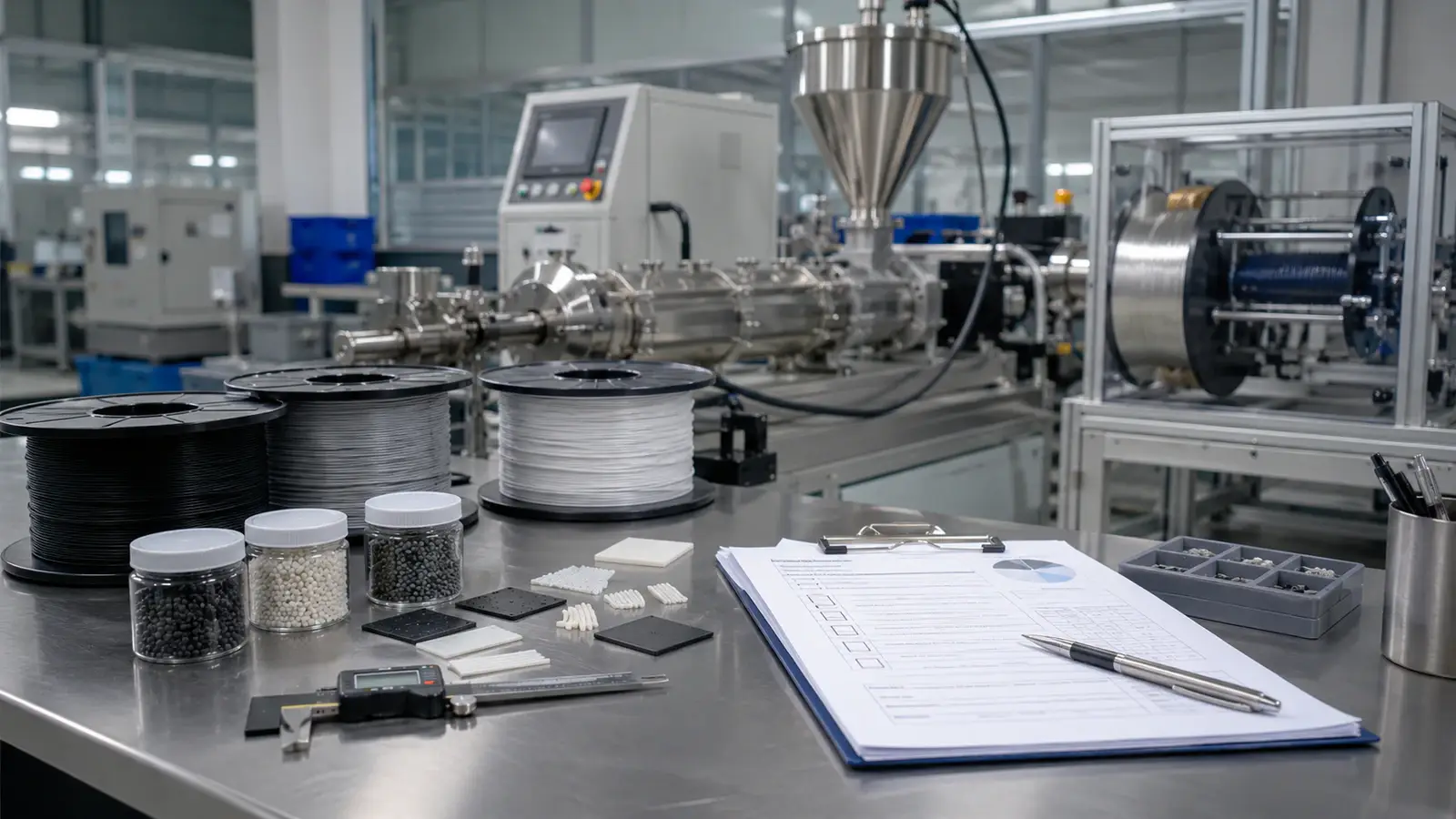
A filament test batch is not simply “a few spools to try.” For B2B cooperation, it serves as the first artifact by which the customer evaluates not an individual spool, but the manufacturer’s ability to reproduce an agreed result consistently. If it is treated as a scaled-down version of the future series, with the same materials, the same line settings, and the same control logic, it becomes the basis for further agreements. If it is made in a rush, both sides risk approving something that cannot later be repeated at volume.
For a brand or distributor, color, spool, label, and packaging may be important. For a 3D print farm, stable feeding, long prints, and repeatability between printers matter. For a parts manufacturer, the key issues are properties of the printed product, compatibility with the process, and change control. Therefore a test batch with the same mass can have a completely different verification program.
Start with the purpose of the test
Before production, it is necessary to define what decision should be made from the test results: approve the base material for regular purchases, approve an OEM product under the customer’s trademark, select a color or degree of matte finish, test TPU of a specific hardness in a specific mechanism, confirm operation on a fleet of different printers, or evaluate a new spool, label, or transport package. The phrase “make a few spools to try” is not enough: without acceptance criteria, the manufacturer and customer will evaluate different things, such as extrusion stability on one side and part shade or behavior during high-speed printing on the other.
Agree on requirements first, not the material
The most common mistake is to start with the question “which material should we print,” although the starting point should be what exactly the customer intends to do with it. The technical brief for a test batch should record more than the polymer name.
Material and application. Describe which parts the filament is intended for, what loads are expected, whether the product will operate outdoors, contact lubricants, moisture, or elevated temperature. This helps choose between PLA, PETG, ABS+, ASA, PA/Nylon, TPU, or a special formulation. If the customer already uses a certain material, it is useful to obtain a sample, technical description, and typical models: comparison is better based on results in the same application rather than on abstract polymer names. For TPU, Shore hardness is agreed separately because softer grades provide the required elasticity but are harder to feed and require lower speeds.
Customer equipment. Printer models and extruder types, nozzle diameter and material, presence of an enclosed or heated chamber, automatic feeding systems (boxes, AMS), typical speeds, layer height and job duration, and restrictions on spool dimensions and weight are recorded in advance. These data are especially important for soft TPU, abrasive filled materials, polyamides, and materials with increased shrinkage.
Commercial configuration. Net weight, spool format, color, label, barcode, batch number, box, and storage instructions are agreed separately. Testing only the filament strand and developing the packaging after material approval is risky: the spool may not fit the customer’s equipment, and the label may lack data required for warehouse processes or claims.
The test batch should repeat the future series
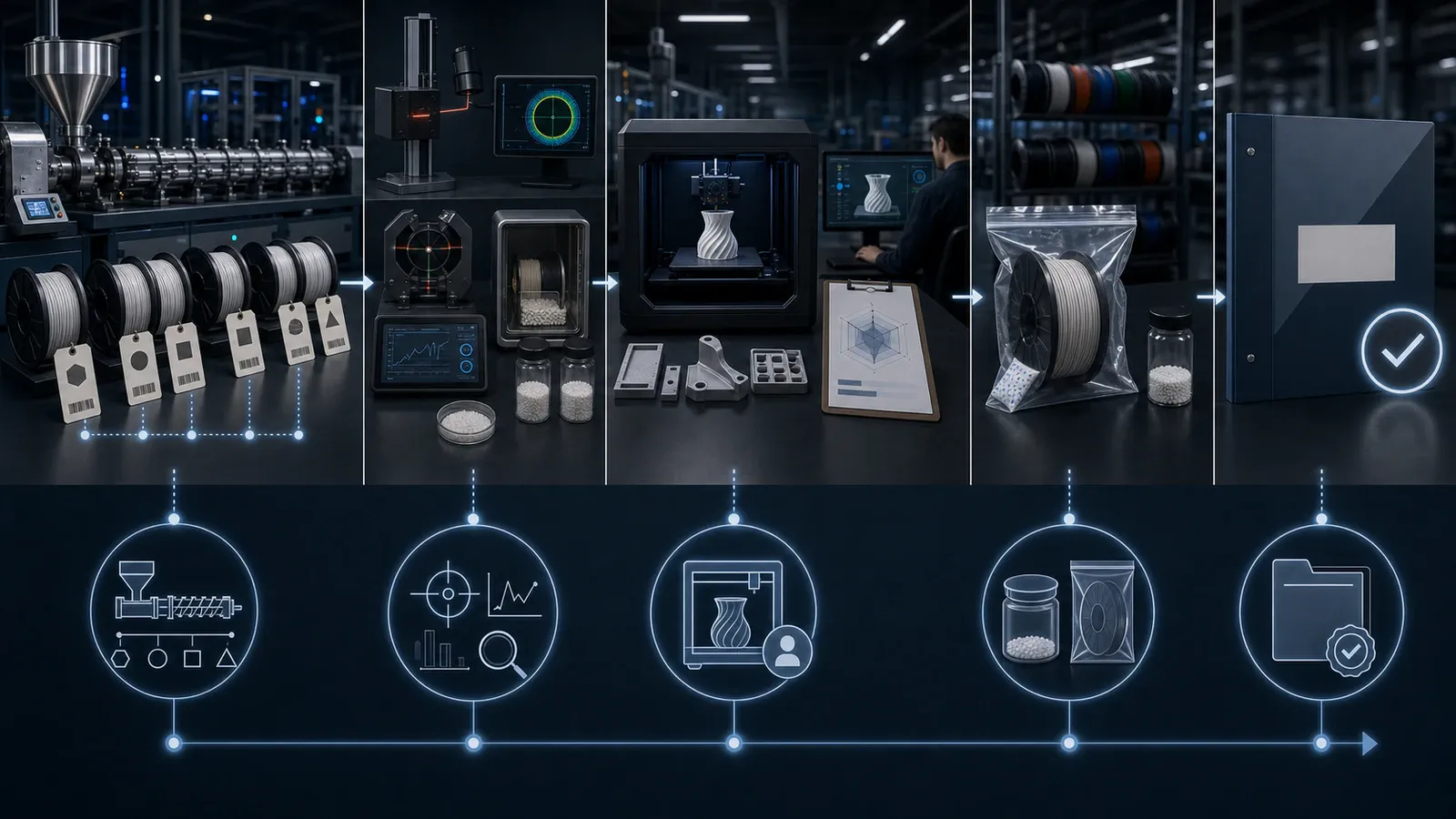
The purpose of the test is to predict series behavior, so the sample is manufactured on the same line, from the same raw materials, and with the same extrusion parameters as the planned batch. If the test spool is made with different settings or from a different compound, the result stops being representative. The customer will evaluate something that cannot later be reproduced.
Every test batch must have unambiguous identification: material, color, formulation version, batches of base raw material and additives, production date, and packaging parameters. This is the same principle as first-article inspection in other industries: the approved sample becomes the reference against which subsequent batches are checked, and records make it possible to trace the reason for a discrepancy rather than guess. If the customer tests several variants, each is marked with a clear code (for example, PETG black variant A / variant B, TPU 95A blue / TPU 90A blue), and only the parameters related to the specific problem are changed in one cycle. Simultaneous correction of the polymer, colorant, extrusion mode, and print profile makes root-cause analysis harder.
Define volume by more than “as little as possible”
Batch size depends on the goal: small samples may be enough for initial color selection, while a 3D print farm needs full spools and enough material for repeat and long prints, and an OEM project needs winding, labeling, and packaging to be tested. The volume should be sufficient to obtain material after process stabilization, take samples from different parts of the run, perform internal checks, deliver the required number of spools to the customer, and keep reference samples for comparison and possible claims. The smallest volume is not always the cheapest: if there is not enough material for a representative test, the run will have to be repeated.
What exactly to control in the sample
Control should be divided into geometry, material, and printability.
Geometry primarily means diameter and its stability along the length. For most tasks, a tolerance around +/-0.05 mm is used as a reference, and stricter limits are used for demanding applications and fine nozzles. Measurement is not taken at a single point but across a series of cross-sections throughout the spool, and ovality is also checked: the filament must not only be within diameter tolerance but also round in cross-section. Uneven diameter directly affects extrusion stability because melt volume starts to drift. Winding quality is evaluated separately. Crossovers and uneven laydown cause feeding jerks and breaks during long prints on farms.
Material means moisture and basic mechanical characteristics relevant to the application. Hygroscopic materials, especially nylon and some TPU, actively absorb moisture, which appears as crackling during printing, poorer layer adhesion, and even diameter change due to swelling. Therefore moisture condition, drying conditions, and packaging are part of control. For TPU, compliance with the declared Shore hardness is checked according to an agreed method on a properly prepared sample, not by squeezing the strand with fingers.
Printability means checking the sample in real printing under representative settings: feed stability, absence of clogs, surface quality, layer adhesion, and color behavior. Before sending the material to the customer, an internal test helps identify obvious problems, such as unstable feeding, moisture, contamination, incorrect winding, strong color deviation, or surface defects.
The list and frequency of checks are agreed according to the material and application risks. A test batch should not create an illusion of control through a random measurement of one strand section.
Color, spool, and print program
For colored filament, a reference is defined, such as a physical sample, approved printed product, or numerical color coordinates, and the material, surface texture, wall thickness, and lighting for comparison are fixed. One colorant is perceived differently on a smooth strand, matte part, and thin translucent wall.
The spool is checked physically rather than by a screen mockup: compatibility with holders and feeding systems, smooth unwinding, strength of the filament-end fixation, label readability and durability, correctness of SKU, color, weight, and batch number, and moisture protection during transport. The barcode is scanned with a real scanner, and the box is evaluated after assembly with the spool, bag, and desiccant.
The print program should reproduce the future use rather than consist only of a demonstration model: a standard calibration sample, the customer’s typical part, a model with long travels, bridges, overhangs, thin walls and retractions, a long print, repetition on several printers, and testing after storage or drying. For each test, the printer, nozzle, profile, temperature, speed, cooling, material condition, and result are recorded. Without this, phrases such as “prints well” or “too much stringing” do not provide information for correction. First, printing is done with the agreed starting settings, and then one parameter is changed at a time.
Documentation and approval protocol
A sample without documents forces the customer to rely on trust, while B2B decisions are built on data. A supporting package is added to the batch: technical description of the material, results of key measurements for this specific sample, identification of the raw material and masterbatch batches, and fixed production parameters. When the customer confirms the sample, the agreed parameters and results become the specification by which the series will be accepted. This moves acceptance from subjective “similar / not similar” into “conforms / does not conform to the agreed criteria.”
After testing, one of several outcomes is recorded: the configuration is approved for series production; a controlled adjustment with a repeated test is needed; or the material does not match the application, so the formulation or polymer class should be changed. The approved configuration is linked to a reference sample, formulation version, color, spool format, labeling, packaging, and starting print recommendations. It is also defined which future changes will require re-approval: raw material replacement, color correction, a new spool, or a change in product characteristics.
Most often, a test does not produce a clear result because of an unclear technical brief, absence of acceptance criteria, too little material, simultaneous changes to many parameters, or testing on only one printer when the series is planned for an entire farm. A successful test is not a full guarantee for all future batches. It confirms the workability of a specific configuration and creates a basis for controlling repeatability.
In contract manufacturing, Bokotech builds preparation for such a launch around an agreed technical brief: material and formulation, color, TPU Shore hardness, spool format, labeling, packaging, control checks, and a test program under the customer’s conditions. Technical coordination at this stage costs little compared with reworking a poorly agreed series, and the result should be not a set of trial spools, but a documented configuration that can reasonably move into regular production.