
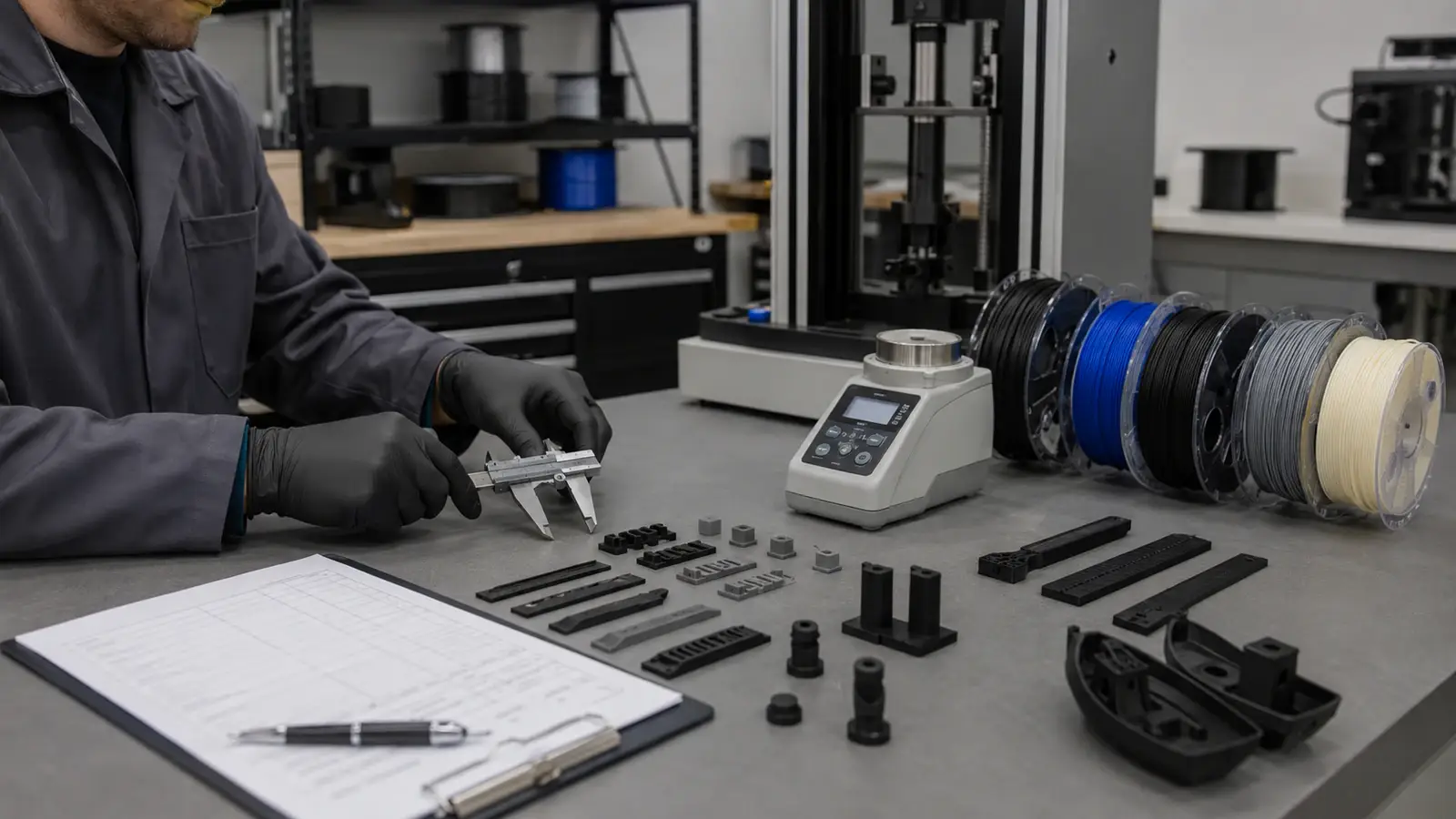
One successfully printed model does not yet prove that a filament is ready for series purchasing. For a distributor, parts manufacturer, or private-label owner, the key questions are not only the properties of one spool, but also repeatability between spools and batches, print stability on different equipment, packaging condition, and conformance to the stated characteristics. The purpose of testing is not to answer “is this filament good?”, but a harder question: “will it be the same in every batch, on our printers, and for our application?”
That is why verification should be built as a short material qualification protocol with defined conditions, acceptance criteria, and recorded results.
Start by defining acceptance criteria
The test set depends on the future application: filament for decorative models, series housings, flexible seals, and parts used outdoors requires different criteria. Before testing begins, document the following:
- material type and target application;
- printer models and extruder types, nozzle diameter, and whether an enclosed chamber is available;
- target diameter and tolerance, spool format and weight, winding pattern;
- expectations for color, gloss, and texture;
- for TPU, Shore hardness;
- labeling and packaging requirements;
- acceptable signs of defects during printing.
This list becomes the basis of the specification used to accept each batch later. Without it, the result is easy to judge subjectively: one team may consider the spool suitable, while another rejects it because of stringing, warping, or a shade difference.
Incoming inspection and sample condition
Each test sample should be linked to a specific batch: record the material, color, batch number, receipt date, and storage conditions. During incoming inspection, check:
- integrity of the vacuum or barrier packaging and presence of desiccant;
- absence of spool damage;
- uniform winding, no crossed turns, and no trapped filament end;
- match between the label, color, and stated material;
- spool compatibility with holders and automatic feeding systems.
For private label, this stage is just as important as printing: the end customer evaluates the whole product - the spool, labeling, package opening, filament feeding, and clarity of the recommendations.
Geometry: diameter and ovality
A typical FDM/FFF printer calculates feed based on the declared diameter and does not automatically compensate when the filament strand is thicker or thinner in places. Diameter variation therefore directly affects extrusion stability, surface quality, and part dimensions.
Check diameter with a caliper at several points along the filament and in two mutually perpendicular planes in the same cross-section; the second measurement shows ovality. A tolerance of about +/-0.05 mm is generally considered an acceptable industry reference, while +/-0.02-0.03 mm indicates more stable production. More important than the number itself is how consistently it is maintained along the full spool length and between spools, not only on a convenient section. Evaluate both the average value and the spread. For soft TPU, do not compress the strand with excessive tool pressure, and keep the method the same for all samples.
Moisture: what can spoil even good material
Most thermoplastics for FFF printing are hygroscopic, but their sensitivity differs: polyamides (PA/Nylon) are the most sensitive, followed by TPU, then ABS/ASA and PETG, while PLA absorbs moisture the slowest. Moisture appears as crackling or bubbles during extrusion, a rough or porous surface, stronger stringing, unstable feeding, and worse interlayer adhesion and overhang quality.
Factory vacuum packaging does not automatically guarantee dryness. It is useful to run two control prints: one with the material as received and one after drying under the mode recommended for the specific compound. Do not apply the same drying mode to PLA, PETG, TPU, PA, and ASA. This filters out false conclusions about “bad filament” when the actual issue is moisture or storage, and shows whether the problem is related to the formulation or the filament geometry.
Standardized test print
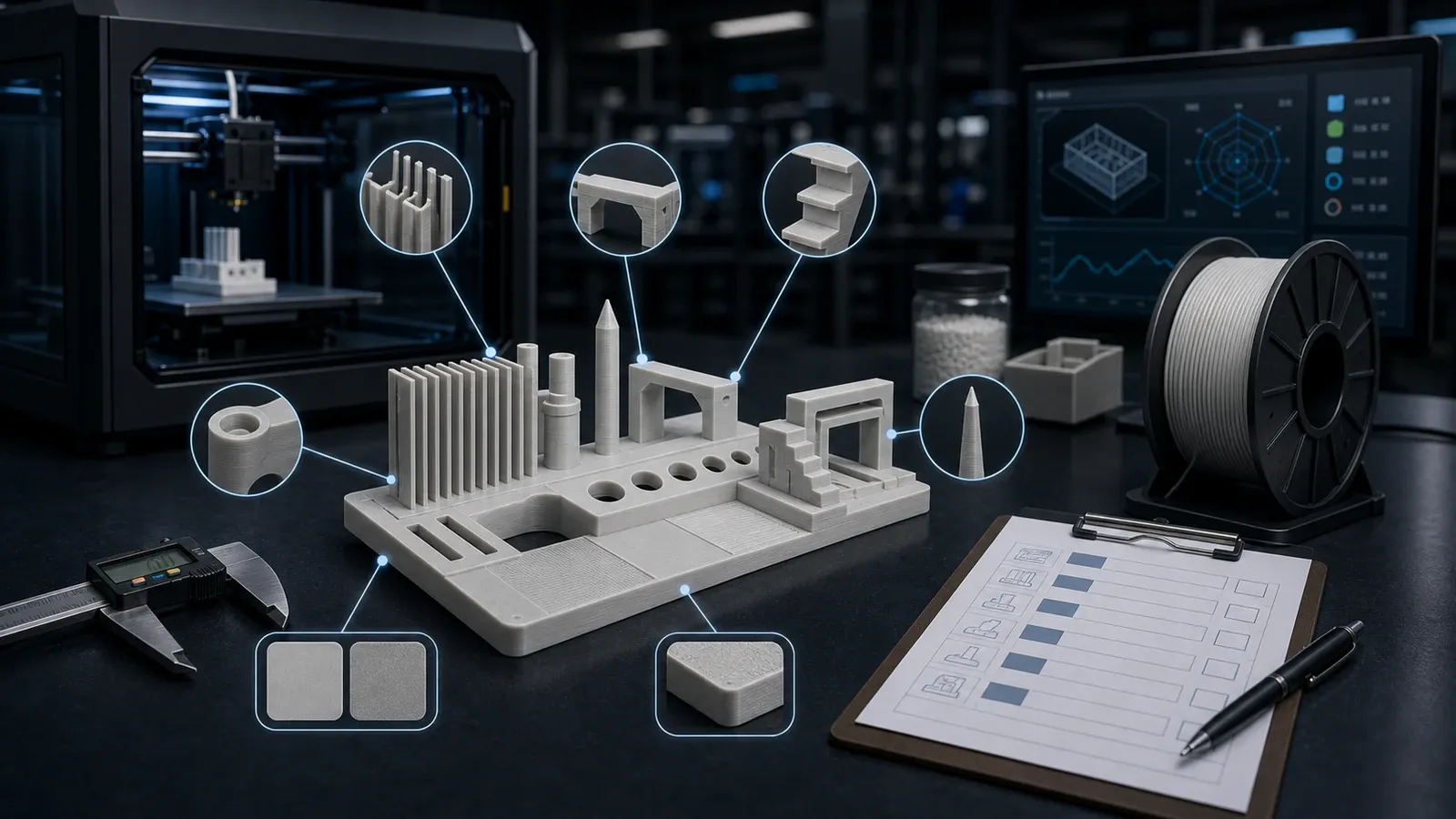
To compare suppliers or batches, use the same model, printer, nozzle, build plate, surface preparation, and slicer profile version. The test program should include simple geometry with controlled dimensions, thin and thick walls, holes and fitting features, overhangs and bridges, retraction-heavy areas, a tall narrow feature, a large flat part for warp evaluation, and a long print to check feed stability.
First test the material on the baseline recommended profile, then explore the working range for temperature, speed, cooling, and flow coefficient. Do not change many parameters at once: if temperature, speed, retractions, and cooling are changed together, it becomes difficult to identify the cause of improvement or degradation. During printing, record first-layer stability, extrusion uniformity, skips, stringing, seam quality, corner warping, interlayer adhesion, dimensional and hole accuracy, color and gloss, ease of support removal, and spool behavior during unwinding. Take photos under consistent lighting, especially when approving a brand color.
When mechanical testing is needed
For decorative products, geometric control and a trial print may be enough. For functional parts, add mechanical testing: tensile strength (ISO 527 / ASTM D638 methods), impact strength (Charpy/Izod), heat resistance (HDT), and for elastomers, Shore hardness and bending behavior. A functional test that simulates the real load on the finished part is often sufficient.
Technical data sheet values are often obtained from injection-molded samples or from one favorable orientation, while an FDM part is anisotropic: strength along the layers and across them differs. Therefore, test in the orientation and with the parameters that match the application, and compare only samples made and prepared by the same procedure. For TPU, measure Shore hardness on a suitable specimen using an agreed method; a reading on a thin printed wall does not necessarily match the hardness of a standard test sample.
Check repeatability, not one spool
Qualification of one demonstration sample does not confirm stable series supply. Request samples from different batches and compare them using the same criteria: diameter and tolerance, color, mechanics, and printing behavior. Check stable feeding from the beginning to the end of the spool, consistent color across different spools, absence of inclusions and contamination, and end-to-end traceability: batch number, date, and spool-to-production run linkage. For each batch, you can keep a control filament segment, a test part, photos, diameter measurements, drying and print parameters, slicer profile number, and a short acceptance protocol. It is especially important to recheck the material after any change in color, TPU hardness, additive type, spool format, or packaging.
Make a decision based on the test results
The outcome should not be a general assessment such as “prints well”, but one of three decisions:
- The material is accepted for a pilot or series purchase.
- The material is conditionally accepted after adjustments to the profile, packaging, or technical requirements.
- The material needs refinement and retesting.
Attach the agreed parameters to the decision: material, color, hardness for TPU, spool format, packaging requirements, control models, and acceptance criteria. Most of these parameters can be agreed with the manufacturer in advance, and this kind of early technical coordination is what separates a one-time purchase from stable series supply.
Before contract manufacturing starts, Bokotech can agree with the customer on the material application, printer types, color, TPU Shore hardness, spool format, labeling, packaging, and pilot-batch verification procedure. A documented testing protocol helps move from a successful trial spool to a repeatable series purchase or a stable private-label product.