
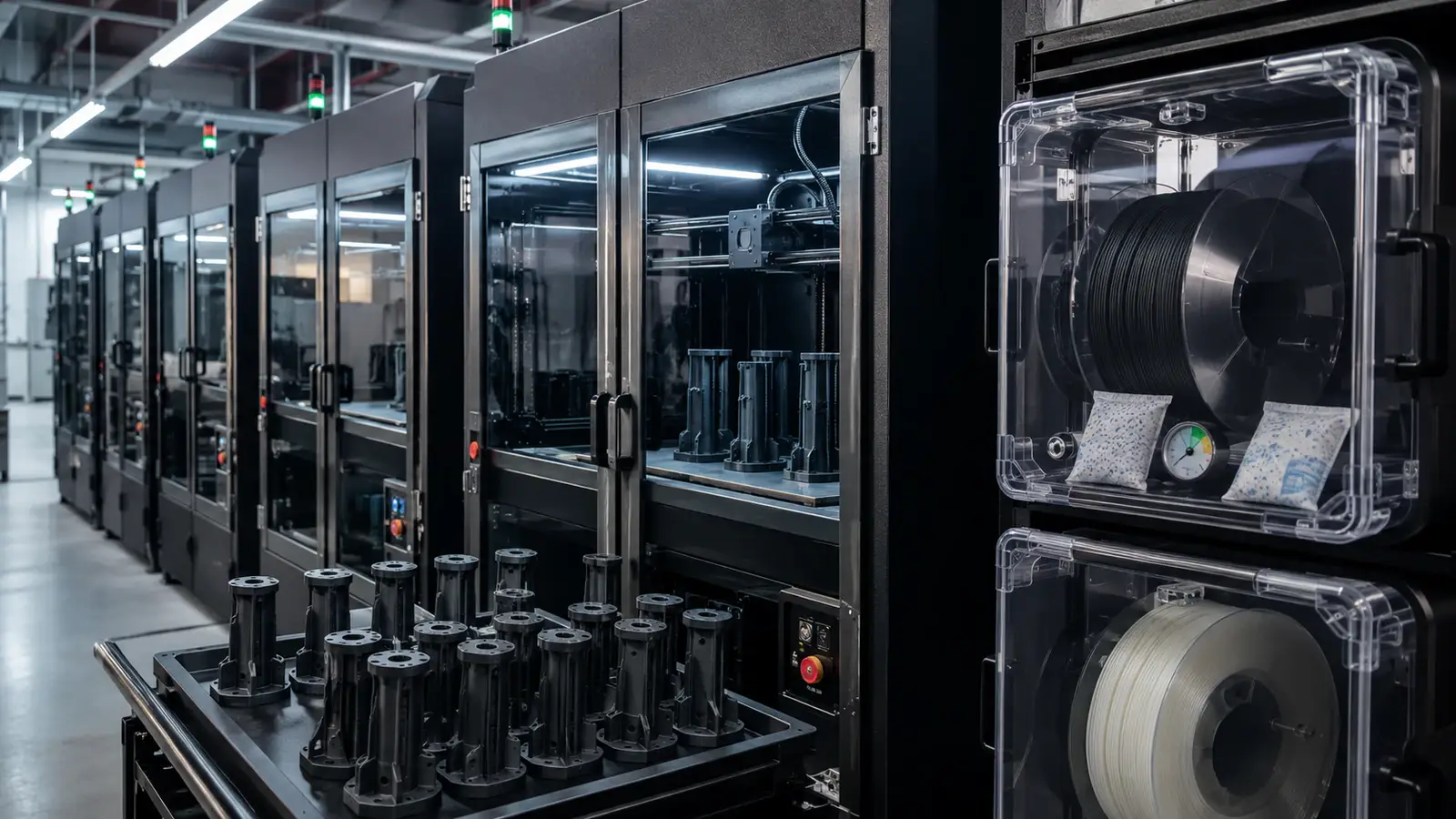
Nylon PA is chosen for functional parts when wear resistance, impact toughness, fatigue resistance, low friction, or operation under mechanical load is required: gears, bushings, clips, jigs, housings, guides, brackets, and small series of end-use products. But PA should not be treated as “ordinary plastic on a spool.” In series FFF production, its advantages are realized only when the material is handled under controlled conditions, and the main risks are connected with three interdependent processes: moisture absorption, shrinkage and deformation during cooling, and unstable adhesion to the build plate and between layers.
For a one-off prototype, these issues can be compensated for by adjusting printer settings. At series volumes, a repeatable route is needed - from spool receiving to final part inspection.
PA is not one material
The designations Nylon or PA cover several polyamide systems: PA6, PA12, PA11, PA66, PA612, copolyamides, as well as grades filled with carbon fiber (PA-CF) or glass fiber (PA-GF). They differ in moisture absorption rate, drying temperature, nozzle and bed temperature, shrinkage level, stiffness, abrasiveness, and behavior after conditioning.
The difference in moisture absorption is significant: unfilled PA12 at equilibrium in air humidity of about 50% absorbs roughly 0.25-0.3% water, while PA6 absorbs about 2.5-3%; under full immersion, PA6 can absorb more than 10% by mass, while PA12 absorbs about 1.4%. For this reason, PA6 and composites based on it require much stricter moisture control. Fiber filling increases stiffness and reduces warping, but increases wear on the nozzle and feed mechanism. For series production, a generic “Nylon” profile is not enough - the process must be tied to a specific grade, color, formulation, and batch.
Why moisture is so critical
Polyamides are hygroscopic: they absorb water not only on the surface, but also into the structure. In the hot zone of the extruder, water turns into steam, which causes crackling at the nozzle, bubbles and pores in the extrudate, a rough surface, excessive stringing, unstable line width, and weaker interlayer adhesion. Visible defects may begin at a moisture content of about 0.5% by mass. Moisture also accelerates hydrolytic chain degradation - in that case, retract or temperature settings only mask the symptoms, not the root cause, and a visually acceptable part does not mean stable mechanical properties.
This is especially critical in series production: a spool that printed well yesterday can produce rejects after a night in an open workshop. It is also worth remembering the other side of the issue - a printed PA part also absorbs moisture, which can increase ductility and impact toughness, but change stiffness and dimensions. For this reason, critical parts are tested not only in the “fresh dry” state, but also under conditions close to real operation.
Drying before a series run
There is no universal mode for all PA filaments: the primary document should be the technical description of the specific material, not a general rule for “nylon.” The indicative range for most polyamides is 70-90 degrees C: PA12 is usually dried at about 75-85 degrees C, PA6 at about 80-90 degrees C, and filled composites often need a longer cycle. Duration depends on the condition of the spool - from 6-8 hours for material that has been open briefly, to 12 hours or more for heavily moisture-loaded material. The temperature must be below the softening temperature, otherwise turns will stick together or the spool will deform; the limit here is not only the heat resistance of the polyamide, but also the heat resistance of the spool itself.
For series volumes, manufacturers use dryers with dehumidified air, vacuum systems, or specialized dehydrators with controlled temperature and circulation; a household oven with temperature fluctuations is not a reliable solution. For repeatability, it is useful to record the grade and batch number, spool identifier, package opening date, equipment, set and actual temperature, cycle duration, time until printing begins, and subsequent storage conditions. Checking spool mass before and after drying is also useful: it is not a complete guarantee of quality, but it shows whether the material actually lost moisture. In critical production, the material condition is checked by determining water content; in a less formalized process, it can be checked with a standardized extrusion test using a fixed sample geometry and acceptance criteria.
Storage after drying
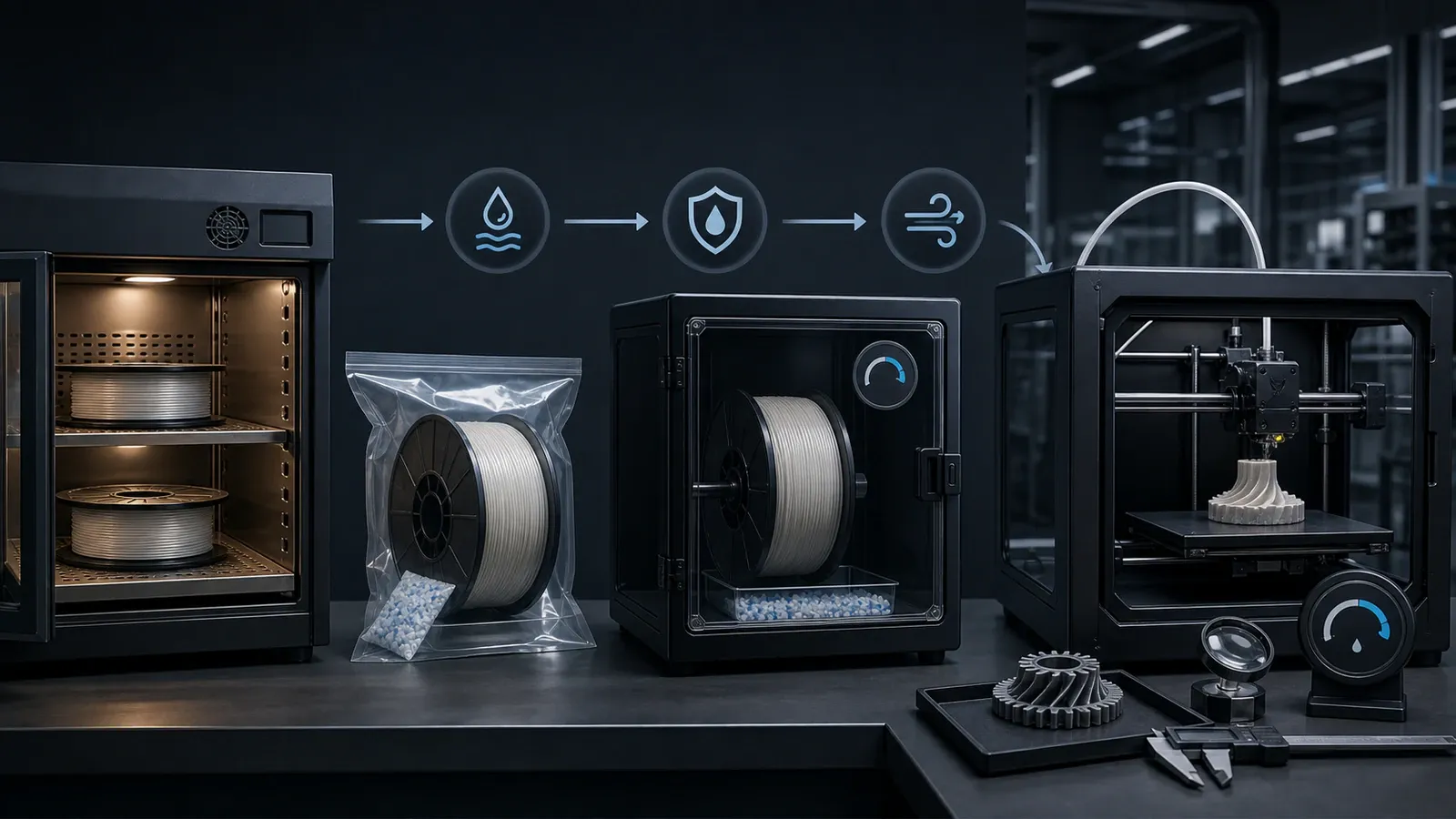
PA begins absorbing moisture again very quickly - effectively within minutes in high-humidity conditions. Therefore, drying a spool in the evening and leaving it on the printer until morning means undoing the previous work. A working route for series production is:
- Drying according to an approved mode.
- Cooling without open contact with humid air.
- Transfer to an airtight container with desiccant.
- Feeding filament to the printer directly from a dry box.
- Returning the remaining material to sealed storage immediately after work.
The desiccant (indicator silica gel) must be checked and regenerated regularly - otherwise the container only looks “dry.” A humidity indicator inside the box is useful when the acceptable range and the action plan for exceeding it have been defined for the material. Drying and storage are not interchangeable: a dry box slows reabsorption of moisture, while an active dryer removes water that has already been absorbed. One additional detail is condensation: if the material was stored in a cold room, the package should not be opened immediately after transfer to a warm area; the spool should first equalize in temperature.
Adhesion to the build plate
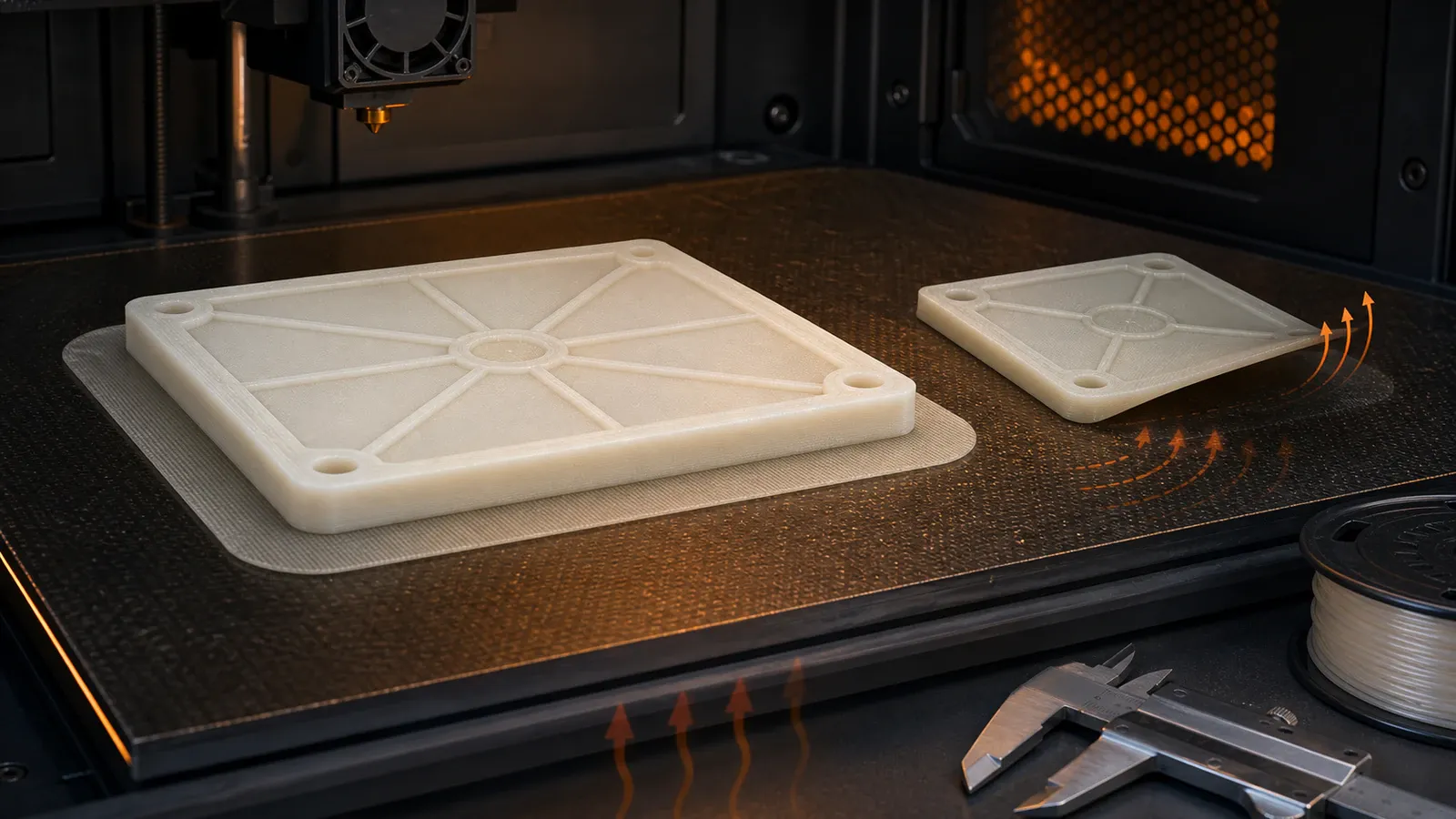
Polyamide is semicrystalline and shrinks significantly during cooling, creating stress between the lower layers and the build plate - this causes lifted corners, plane distortion, and part detachment (roughly as with ABS). First-layer stability depends on the type of build surface, a PA-compatible adhesive, cleanliness and bed temperature (typically 70-90 degrees C), chamber temperature, first-layer height and width, print speed, and contact area. Garolite (G-10/FR4) sheets and PEI combined with specialized adhesives have proven effective for nylon; ordinary PVA glue is used, but in series production it is less convenient because of unevenness.
It is important not to automatically transfer settings from PLA, PETG, or ABS+. An adhesive can not only strengthen bonding, but also act as a release layer that protects the surface during removal, so the principle “the stronger it sticks, the better” is unacceptable for series production. A production profile includes the build-plate cleaning method, adhesive application procedure, number of cycles before re-preparation, and removal conditions; a brim, raft, or design-based hold-down features reduce the risk of corner lifting, but should not compensate for uncontrolled chamber temperature or a contaminated build plate. A calibrated Z gap and repeatable surface condition produce a predictable result across the whole batch - “heroic” adjustment for each print is unacceptable in production.
Interlayer adhesion
The strength of the layer bond depends on how well a new line of melt heats and wets the previous layer. The result is affected by filament dryness, melt temperature, actual hotend throughput, print speed, layer height, cooling, ambient temperature, and pauses between passes. Excessive cooling or too low a temperature reduces strength; too high a temperature increases the risk of oozing, geometry deterioration, and thermal degradation. Parameters are verified not only on a visual model, but also on samples that reflect the real load orientation of the part.
Part condition after printing
For PA, three different processes must be distinguished: drying the filament before printing, thermal annealing of the printed part, and moisture conditioning of the finished product. They have different purposes and do not replace one another. Moisture in the finished part acts as a plasticizer: compared with the dry state, stiffness, impact behavior, and dimensions change, so test results from dry and conditioned samples should not be compared without accounting for condition.
For series production, the state in which dimensions are measured, mechanical tests are performed, and products are packaged and transferred should be defined in advance. Otherwise, one batch will be checked immediately after printing and another after several days in a humid room, making the results incomparable.
Control route for series production
A stable process should be built as follows: grade and batch identification -> quarantine of spools with damaged packaging -> drying according to a separate instruction -> closed feeding from a dry container -> checking build-plate and adhesive condition -> printing a control sample before launch -> recording printer and chamber parameters -> controlling the first layer and early signs of deformation -> cooling according to the established procedure -> measuring and testing in the defined conditioning state.
PA can be a very strong material for functional printing, but only with proper preparation: its stability begins not with the start button, but with a dry spool, controlled storage, agreed adhesion, and disciplined parameter recording. The most important point is to tie the process to the specific polyamide grade, not to the generic name Nylon.
Bokotech manufactures engineering filament in Ukraine and works with PA and other materials (TPU, ABS+, ASA, PLA, PETG, custom formulations) in a contract manufacturing format. Before launching a batch, we agree on the PA type and filling for specific loads, color, spool format and labeling, packaging, storage conditions, and printing recommendations - so batches remain predictable across different printers and production sites. If you have regular nylon volumes, it is better to discuss the technical details in advance - it costs less than rejects in series production.