
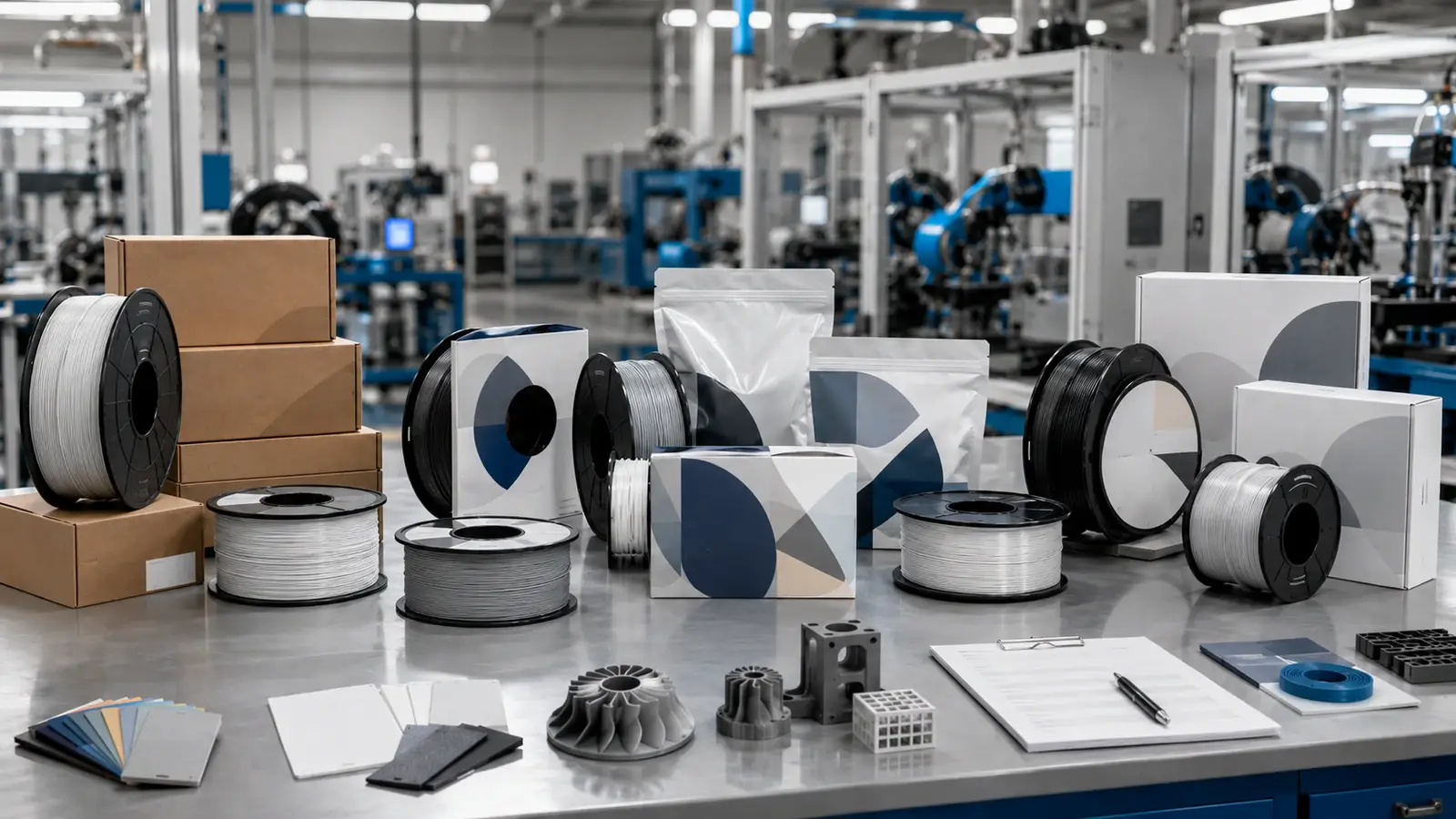
A company can launch its own filament line without building extrusion production from scratch. For this, three cooperation formats are usually considered: white label, private label, and OEM. In commercial offers, these terms often overlap, so relying only on the service name is risky. It is more important to understand who defines the product, which parameters can be changed, and what exactly is fixed in the technical specification.
Why the terminology is confusing
White label, private label, and OEM are not strict standards, but established business models. In different industries, and even among different manufacturers, the same words can mean slightly different things: some call any production under another brand OEM, while others use OEM only for material development according to the customer’s specification. The term ODM also appears nearby, when the manufacturer develops the formulation itself and the client sells it under its own brand.
So the practical rule is this: focus not on the format name, but on what exactly you receive - the level of formulation customization, branding, packaging, batch repeatability, and scope of quality control.
White label: a ready-made product under your brand
White label is a manufacturer’s standard product sold under the customer’s brand. The base material, formulation, and production parameters are already defined; mainly presentation elements change: label, box, instructions, barcode, or supply kit. The spool and labeling may also be neutral, with only technical information.
In filament manufacturing, this could be, for example, ready-made PLA, PETG, or ABS+ from the current range, wound onto an agreed spool and packaged under the client’s trademark. The format is suitable when you need to quickly add filament to your assortment, test demand, or focus on sales rather than product development.
The main limitation is low product differentiation: the same or a very similar material may also be supplied to other brands. Competition is mainly through price, availability, service, and content.
Private label: a branded line with agreed settings
Private label is also manufactured by a third-party company and sold under the customer’s brand, but it provides more opportunities for adaptation. The manufacturer uses a proven technology platform, while the client agrees on a combination of characteristics and configuration for its own line.
For filament, the items for agreement may include:
- material type and class (PLA, PETG, ABS+, ASA, PA/Nylon, TPU);
- color or color series;
- TPU hardness by Shore;
- winding mass and spool format;
- label, box, vacuum packaging, and inserts;
- SKU names, batch labeling, and user information;
- a basic set of recommended print modes.
This is a compromise between launch speed and controlled product difference: the material remains standard and predictable, while the brand is yours. At the same time, the phrase private label by itself does not guarantee exclusivity. The contract must separately define whether the manufacturer may offer the same formulation, color, or configuration to other clients.
OEM: manufacturing to the customer’s technical requirements
In contract filament manufacturing, OEM (and in some industries, ODM) most often means manufacturing a product according to the customer’s specification. The customer may define the material’s functional purpose, requirements for raw materials, formulation, color, mechanical behavior, printability, supply format, or compatibility with a specific process. Sometimes the client provides its own compound, colorant concentrate, or approved component list; in other cases, the formulation is developed jointly with the manufacturer.
This is the highest level of control and differentiation: you get a material that others do not have. But the requirements are also higher. An OEM project requires more technical coordination: requirements analysis, trial extrusions, samples, test printing, approval of a reference, and rules for making changes. For hygroscopic materials such as PA/Nylon or some TPU, raw-material preparation, moisture control, and protective packaging are especially important; for stable printing, diameter uniformity, ovality, surface quality, and even winding are critical.
OEM is worth considering when the product must perform a specific technical task, not only be sold under a separate trademark.
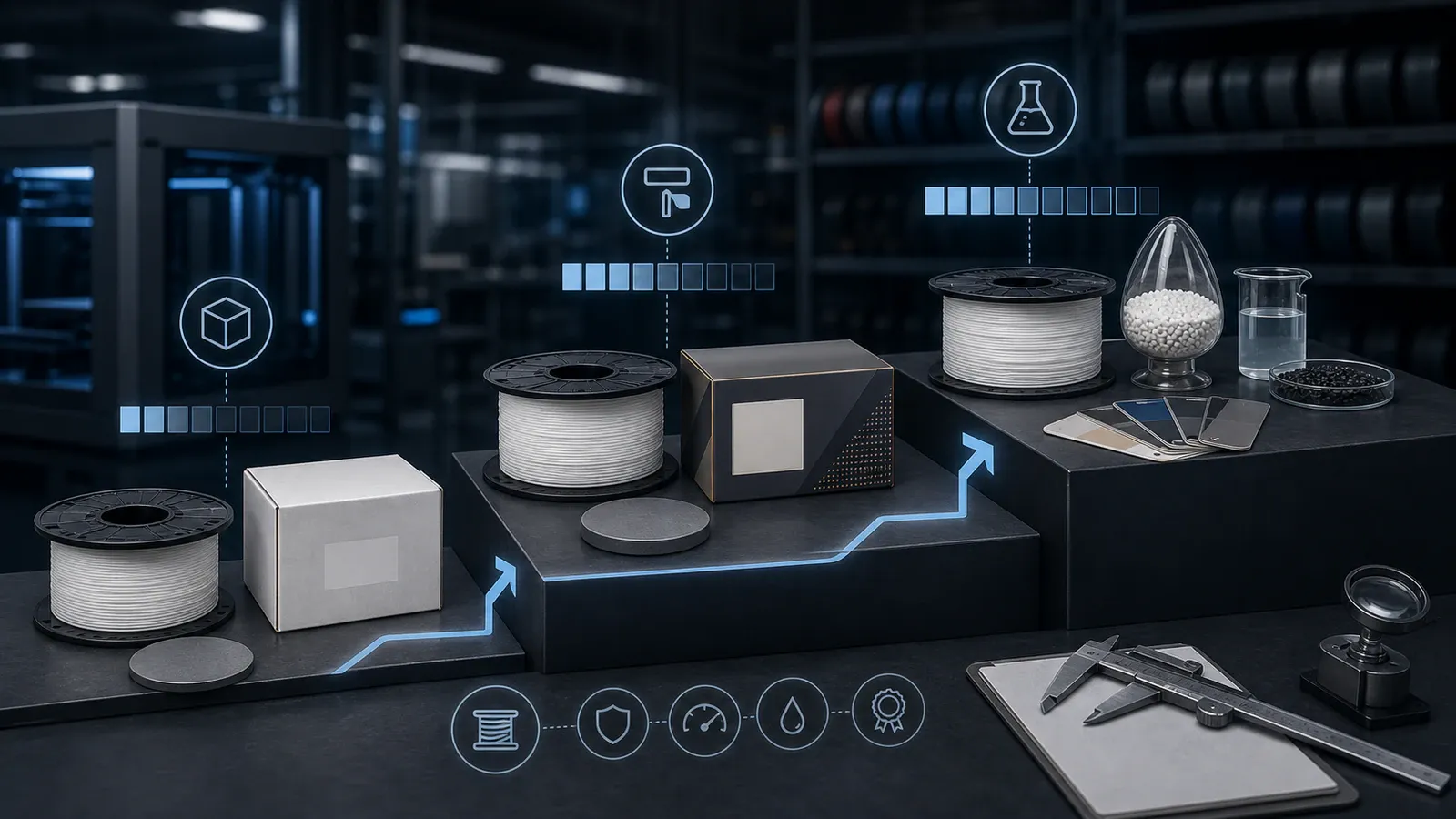
Short comparison of formats
| Criterion | White label | Private label | OEM / custom |
|---|---|---|---|
| Product basis | Manufacturer’s standard product | Proven base with adaptation | Customer specification |
| Level of changes | Mainly branding and packaging | Material, color, hardness, spool, packaging | Formulation, raw materials, functional and production requirements |
| Technical coordination | Minimal | Moderate | Extended |
| Differentiation | Low | Medium (brand) | High (material and brand) |
| Launch speed | Highest | Medium | Lowest because of development |
| Typical scenario | Market test or fast catalog expansion | Own branded line | Specialized material or industrial program |
These are not universal legal definitions. A specific manufacturer may call private label what another supplier describes as white label or OEM. Therefore, the commercial name of the format should be supplemented with a list of work, specification, and areas of responsibility.
What MOQ, cost, and preparation time depend on
There is no rule that OEM is always more expensive, while white label is available at any volume. Batch economics are affected by:
- the number of materials, colors, and SKUs;
- availability of the required raw materials and additives;
- the need for color matching or formulation selection;
- changeover, line cleaning, and trial runs;
- separate spools, boxes, labels, or printed inserts;
- the scope of testing and number of approval cycles;
- requirements for raw-material reservation and repeatability of future batches.
A small batch with many colors and custom packaging may be more complex than a larger run of one standard material. Therefore, offers should be compared not only by spool price, but also by service scope and preparation costs.
What to agree before launch
Regardless of the format, before ordering a series batch it is worth fixing:
- Product specification. Material, color, nominal diameter, mass, spool, packaging, and other controlled parameters.
- Approval procedure. Which sample or test batch is the reference and who confirms the transition to series production.
- Change rules. Whether the manufacturer may replace a raw material, pigment, additive, spool, or packaging component without approval.
- Rights and exclusivity. Who owns the formulation, packaging design, and technical documentation, and whether use of the solution for other brands is restricted.
- Batch identification. What information is applied to the spool and box, and how claims are handled.
- Repeat orders. Which parameters must remain unchanged and what happens if a certain raw material becomes unavailable.
Which format to choose
The choice comes down to several interconnected factors:
- Speed to market. White label is the fastest; OEM is the slowest to launch because of development and validation.
- Required level of differentiation. If the product must differ in properties, not only in logo, this argues for OEM; if your own brand on a proven material is enough, private label is suitable.
- Volume and regularity. Custom formulations, colors, and packaging involve preparation costs that are justified by stable repeat volumes.
- Technical risk and validation. The more specific the application, the more important it is to test the material on your processes and equipment before scaling.
A common scenario is staged: start with white label or private label, test demand and the sales channel, and later move to a proprietary formulation when volumes justify it.
For Bokotech, the conversation about contract manufacturing starts not with the format name, but with product requirements: material, color, TPU hardness by Shore, spool format, labeling, packaging, batch control, and technical coordination should be agreed before launch. This level of detail is what makes it possible to choose the cooperation format based on the real business task, not the service name.