
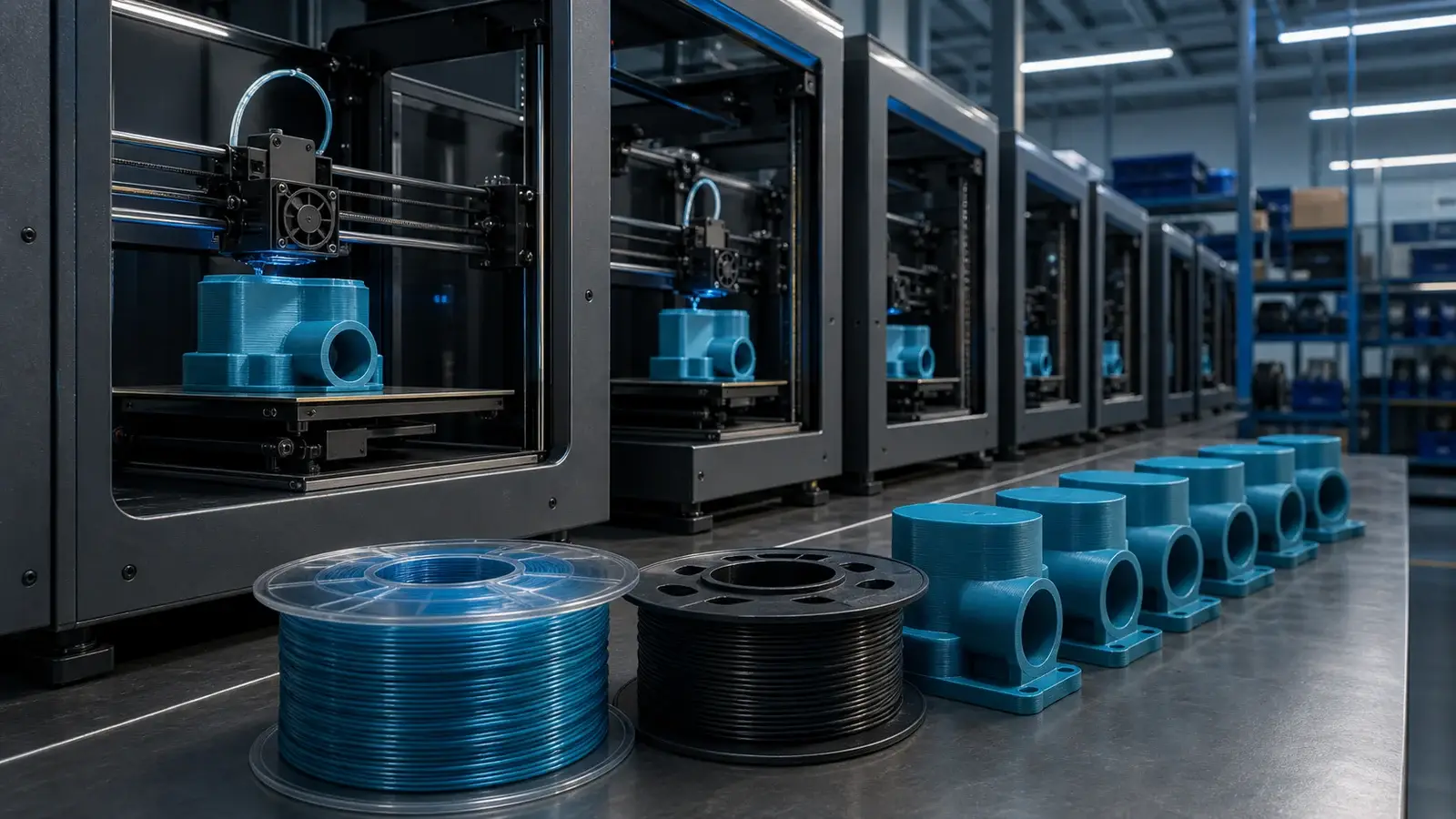
The question of replacing ABS+ with PETG usually arises not during prototyping, but when printing becomes a series process: dozens of printers, repeat orders, and shipping schedules. At that scale, a material is judged by more than the strength of one specimen or its price per kilogram. Geometric stability, scrap rate, equipment preparation time, color repeatability, and spool-to-spool behavior all matter. This is why PETG is often considered as an alternative to ABS+: it is less prone to shrinkage and warping and is generally easier to scale across a printer fleet.
PETG, however, is not simply “ABS+ without shrinkage.” The materials differ in heat resistance, stiffness, long-term load behavior, and post-processing options. The decision should be based on the requirements of the finished part and the results of a pilot run, not just the polymer name or kilogram price.
Compare specific formulations, not two generic names
PETG is a glycol-modified polyester. In FFF/FDM printing, it is valued for low shrinkage, strong layer bonding, and more ductile behavior than many rigid materials. ABS+ belongs to the styrenic material family, but the plus sign does not identify one standardized composition: each manufacturer modifies base ABS differently to reduce warping, improve impact behavior, or adjust melt flow and surface appearance.
There is no single universal PETG either. High-flow, impact-modified, matte, transparent, and filled formulations can behave very differently. Pigment also affects printability and properties. For series production, compare specific grades, colors, and formulation versions—preferably using technical documentation and tests on printed parts.
In practical terms, the differences are as follows:
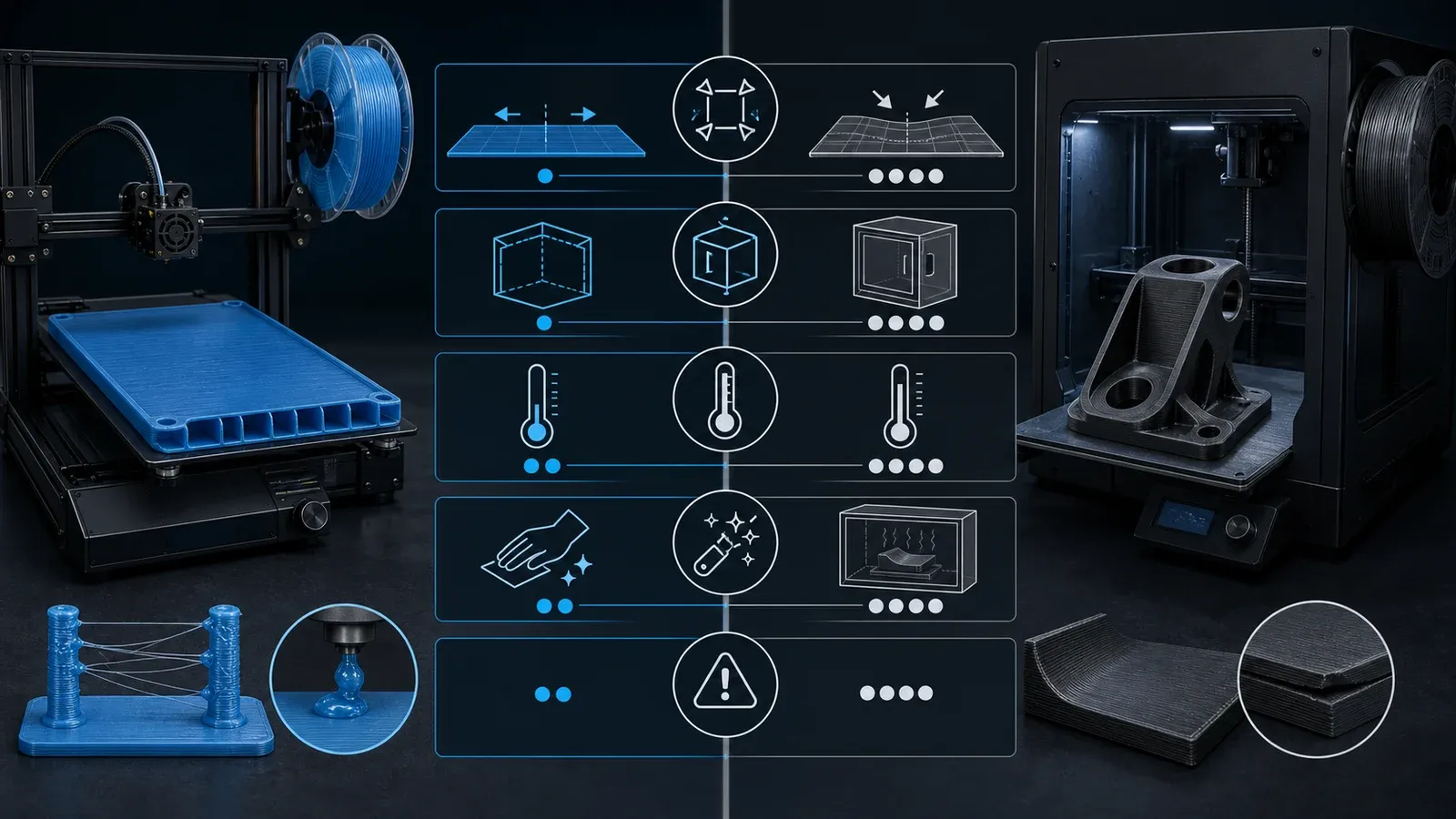
- Print stability: PETG generally warps less and often does not require a heated chamber; ABS+ is more sensitive to drafts and uneven cooling, especially in large parts.
- Heat resistance: ABS+ usually provides more thermal headroom, but HDT or Vicat values should be compared for specific grades using the same test method, followed by testing of the finished part.
- Mechanical behavior: PETG often delivers strong layer bonding and a more ductile part, while ABS+ may be stiffer; the actual result depends on the formulation, build orientation, and print profile.
- Post-processing: Compatible ABS+ formulations can be smoothed with acetone vapor and solvent-bonded; these are not typical processes for PETG.
- Typical defects: PETG is associated with stringing, blobs, material buildup on the nozzle, harder-to-remove supports, and excessive adhesion to some build surfaces; ABS+ is more associated with warping, bed detachment, shrinkage, and layer splitting.
When PETG can replace ABS+
The change is most often justified in the following scenarios.
The part operates at a moderate temperature. Housings, holders, brackets, guards, assembly tooling, and internal mounting components do not always use the extra heat resistance available from ABS+. If the measured part temperature—including peaks and applied load—remains within the allowable range of the selected PETG, the switch may be technically sound.
ABS+ shrinkage is the main source of scrap. PETG often produces more stable geometry on long walls, large footprints, and parts with sharp corners. On a print farm, a failed multi-hour job wastes not only material, but also machine time and a production slot.
The printer fleet does not have equally stable chambers. PETG generally tolerates differences between open and enclosed machines better. The profile must still be qualified on every printer model: actual hotend temperature, cooling, filament path, and available volumetric flow can differ.
A tough part with reliable layer bonding is required. PETG is often suitable for parts expected to withstand impacts, localized bending, or drops without brittle failure. High tensile strength, however, does not automatically mean high stiffness or creep resistance.
Acetone-based post-processing is not required. If the surface will not be vapor-smoothed and parts will not be solvent-bonded, one of the practical advantages of ABS+ is no longer relevant.
When ABS+ should remain in use
PETG should not replace ABS+ by default in parts near motors, heaters, lighting modules, warm electrical cabinets, or other elevated-temperature zones. A part does not need to melt to fail: it may lose stiffness, change its fit, or gradually deform under load.
Threaded joints, tightened fasteners, snap fits, spring tabs, and parts carrying a constant load for months require separate testing. All thermoplastics creep, but in a particular design PETG may lose shape or clamping force sooner than a short static test suggests.
ABS+ should also remain in use when acetone smoothing, solvent bonding, a particular surface texture, or an already qualified post-processing workflow is critical. Extra caution is required for products subject to flammability, food-contact, electrical-safety, or other compliance requirements: the generic PETG designation confirms none of these special properties.
PETG should not automatically be treated as weather-resistant for long-term outdoor use. UV resistance depends on the base resin, stabilizers, pigment, and color. If retaining properties and color in sunlight is the primary requirement, PETG should be compared separately with ASA.
In practice, the decision does not have to mean moving the entire product range to one material. Large parts for moderate temperatures can be qualified in PETG, while heated, continuously loaded, or acetone-dependent items remain in ABS+; ASA can be evaluated separately for outdoor products. This allocation can reduce total cost without compromising critical parts, but each group needs its own locked profile and acceptance criteria.
What to check before purchasing a large batch
1. Finished-part operating conditions
Define the continuous and peak temperatures, load type and duration, allowable deformation, contact with water, oils or cleaning agents, UV exposure, and assembly method. Chemical compatibility must be checked with the actual substance, concentration, temperature, and contact duration.
2. Specific formulation, color, and technical data
The qualification sample must match the intended production formulation. Request the available TDS and SDS documents and establish how the reported values were obtained: on molded or printed specimens, in which orientation, and after what conditioning. Strength, modulus, HDT, Vicat, MFR, and MVR values can only be compared when the test methods are comparable.
3. Process window on the actual equipment
Test nozzle and bed temperatures, cooling, retraction, maximum stable volumetric flow, bridges, overhangs, supports, and adhesion to the intended build surface. PETG can bond too strongly to smooth sheets, so a release layer or a different surface may need to become part of the series process.
4. Moisture, drying, and packaging
Moist PETG can cause crackling in the hotend, bubbles, stringing, a rough surface, and unstable extrusion. Drying time and temperature should come from the recommendations for the specific grade, not from a universal table. Before purchasing, agree on barrier packaging, desiccant, storage conditions for opened spools, and—where necessary—printing directly from a dry box.
5. Filament geometry and spool format
The nominal diameter and tolerance are not enough: minimum and maximum values, ovality, surface quality, and consistency along the spool also matter. An automated print farm should additionally verify winding quality, spool outer diameter, width and hub bore, tare weight, and compatibility with feeders, dry boxes, and multi-material systems.
6. Batch repeatability and traceability
Identification should link every spool to its production lot. Agree in advance on the color and surface reference, acceptance criteria, and the notification procedure for changes to raw material, pigment, formulation, spool, or packaging. In series production, predictability of the next batch matters more than a record result from one specimen.
How to qualify PETG before series production
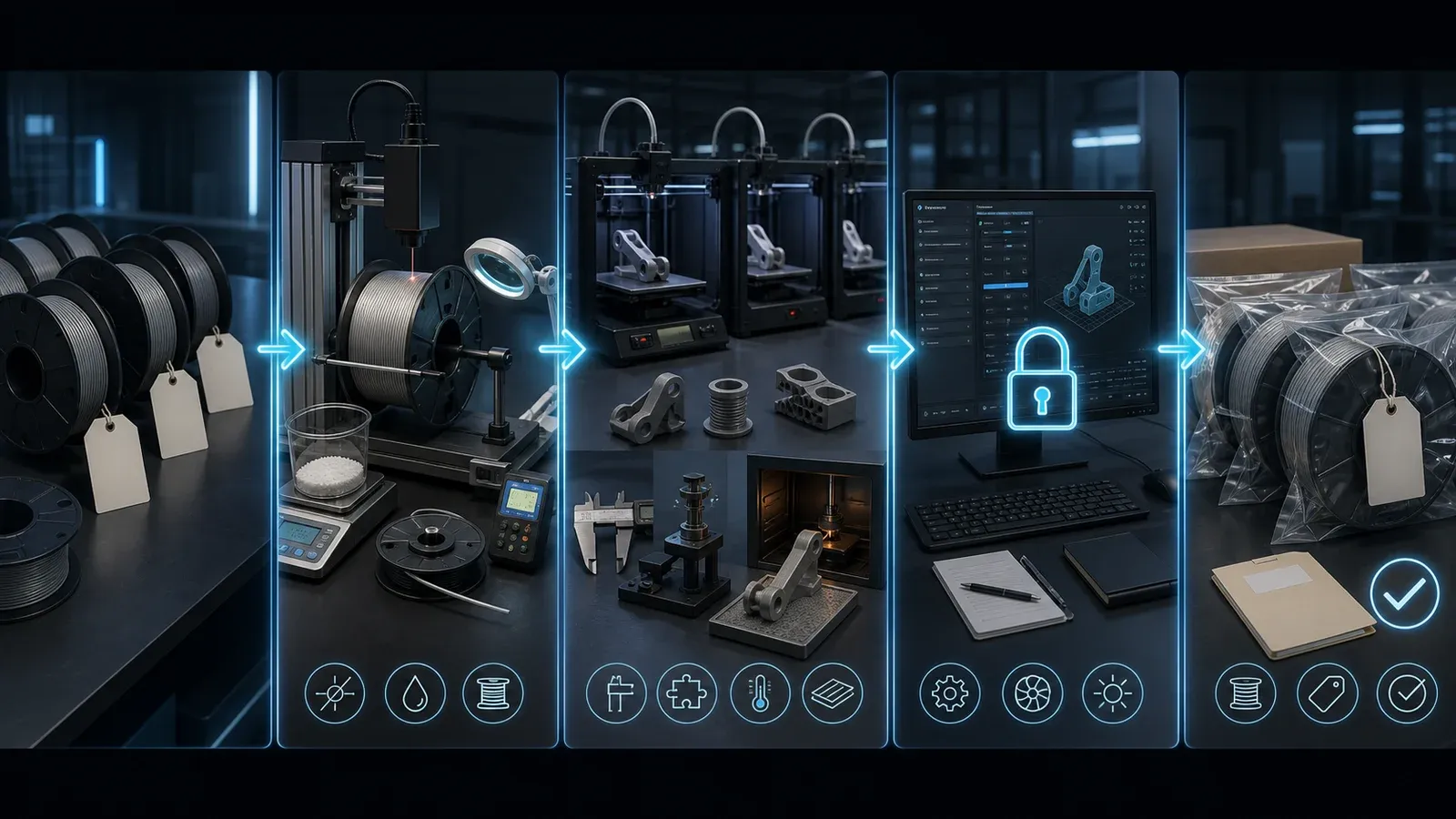
One successful part or calibration cube is not enough. The pilot should cover several spools, representative printers from the fleet, and an actual product with the most demanding geometry: a large footprint, thin walls, bridges, supports, and critical fits.
Acceptance criteria should be defined before testing begins. Depending on the product, these may include:
- flatness and critical dimensions;
- weight, appearance, and color stability;
- successful-print rate and causes of stoppages;
- cycle time, support removal, and other post-processing;
- strength of the assembled part, threaded inserts, snap fits, and bonded joints;
- deformation during and after a thermal test under the working load.
Run a long job at the intended production speed as a separate test, not just a short print. It reveals flow stability, material buildup on the nozzle, behavior after many retractions, winding quality, and the risk of defects near the end of a spool. Once approved, lock the material grade and version, color, drying rules, slicer profile, and acceptance criteria for subsequent batches.
Calculate the cost of an accepted part
A comparison based only on price per kilogram does not show the economics of the change. Full cost includes material for the part and supports, scrap rate, machine time, heating and cooling, drying, operator labor, post-processing, wear on build surfaces, and requalification after a batch change.
PETG may be more economical than ABS+ if it reduces warping and allows the existing printer fleet to run reliably. ABS+ may remain the less expensive solution when its profile is already mature and its extra heat resistance or compatible post-processing prevents failures in the finished product.
Do not assess safety by smell
The milder odor of PETG does not eliminate ventilation requirements. During FFF/FDM printing, polymers can release ultrafine particles and volatile compounds, and odor is not a reliable indicator of exposure. Ventilation, local extraction, or filtration for a production area should be designed around the number of machines, the materials used, and operating duration.
Summary
PETG can replace ABS+ where low shrinkage, reliable layer bonding, and stable high-volume printing are the priorities, while requirements for temperature, stiffness, creep resistance, and acetone post-processing remain moderate. A change requires particular caution for heated assemblies, continuously loaded joints, and processes already built around the properties of ABS+.
A reliable procurement strategy combines a technical specification, a pilot batch printed as real parts, a locked process profile, and agreed acceptance criteria. Bokotech manufactures PETG, ABS+, and other engineering filaments in Ukraine and provides contract, OEM, and private-label manufacturing. Material and color, spool format, labeling, packaging, test program, and batch-repeatability requirements can all be agreed before series production begins.