
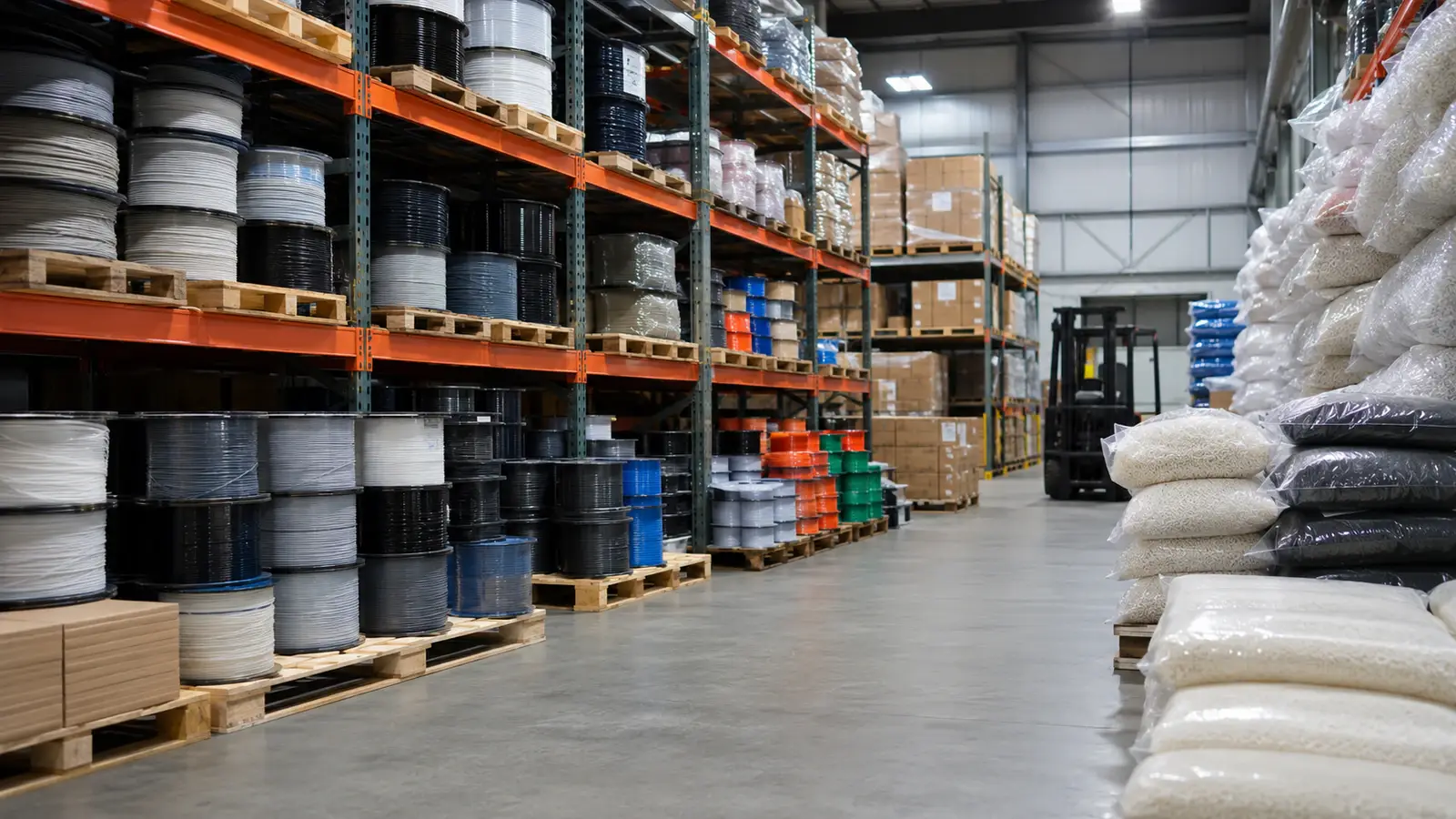
The choice between one supplier and several is often presented as a simple dilemma: one means convenience and better commercial terms, while several supposedly provide automatic protection against disruptions. In practice, neither model is safe by itself. One reliable manufacturer can provide more stable batches than three random resellers, while even a strong partner cannot protect against a shutdown caused by a logistics failure, raw-material shortage, or sudden increase in demand.
So the question is not “one or several,” but “where does purchase concentration help manage quality, and where does it create critical dependence?” This is not a choice between “cheap or reliable,” but a deliberate compromise between management cost, material price, and resilience to disruptions. The procurement task is to remove critical points of failure without losing control and economic efficiency.
What makes one supplier attractive
Concentrating purchases with one partner has practical advantages: larger volume simplifies negotiations, there are fewer contracts and documents, characteristics are easier to agree, batches are easier to track and defect causes easier to investigate, fewer materials need to be qualified on equipment, and color, packaging, labeling, and production settings remain more stable. For OEM / private label, this is important: the buyer expects that material with the same name will behave predictably in every delivery.
For 3D printing, this is especially significant. Materials with the same designation (PETG, ABS, TPU) do not necessarily behave the same way - the process is affected by formulation, colorant, moisture, stiffness, melt flow, strand geometry, and winding. Switching to another manufacturer may require adjustment of temperature, speed, retract, or drying mode, and for series production this means additional testing and a temporary drop in productivity. Therefore, a single supplier is justified if the material is non-critical, easy to replace, has a short replenishment lead time, and has sufficient safety stock.
Where single-source risk appears
The problem with single sourcing appears when a supply stop immediately stops production. The reasons vary: shortage of base polymer or additives, line maintenance, power-supply problems, transport restrictions, import delays, supplier financial difficulties, formulation changes or discontinuation of an item, or nonconformance of the next batch.
It is especially dangerous when a material can formally be replaced, but the alternative has never been tested. A supplier contact in a spreadsheet is not yet a backup channel: without an agreed specification, control sample, print results, and commercial agreements, the actual transition time will turn out to be much longer than the procurement department expects.
Why several suppliers also do not guarantee resilience
Multi-sourcing reduces dependence on a single company, but creates new costs: every source requires manufacturer verification, requirement agreement, material testing, separate print profiles, incoming inspection, batch tracking, and change control. Excessive fragmentation of volume worsens cooperation terms - suppliers receive smaller and irregular orders, so production of special colors, TPU hardnesses, or private labeling becomes harder to plan.
There is also a risk of imaginary diversification: two sellers may receive material from the same plant, use the same raw material, or depend on a shared logistics route. In that case, the number of contracts grows, but the critical point of failure remains. It is necessary to evaluate not only the direct counterparty, but also the origin of the material, the production site, and alternative delivery methods.
Which materials need a backup source
Not all items require the same level of protection. Each material should be assessed by several parameters:
- Impact on production - what happens if the material is unavailable for a week or a month?
- Replaceability - is there a verified equivalent without changing the design or customer requirements?
- Replenishment lead time - how long do manufacturing, transport, and receiving take?
- Consumption stability - is volume predictable, or are there sharp demand peaks?
- Specification complexity - special color, modified formulation, certain hardness, nonstandard packaging?
- Storage conditions - can stock be built without risk of moisture absorption or property deterioration?
- Transition cost - how much time and material are needed for requalification?
For standard PLA used for prototypes, several available alternatives may be enough. For a series part made from PA/Nylon, ASA, technical TPU, or a custom compound, replacement may require a full test cycle.
Practical model: primary supplier and qualified backup
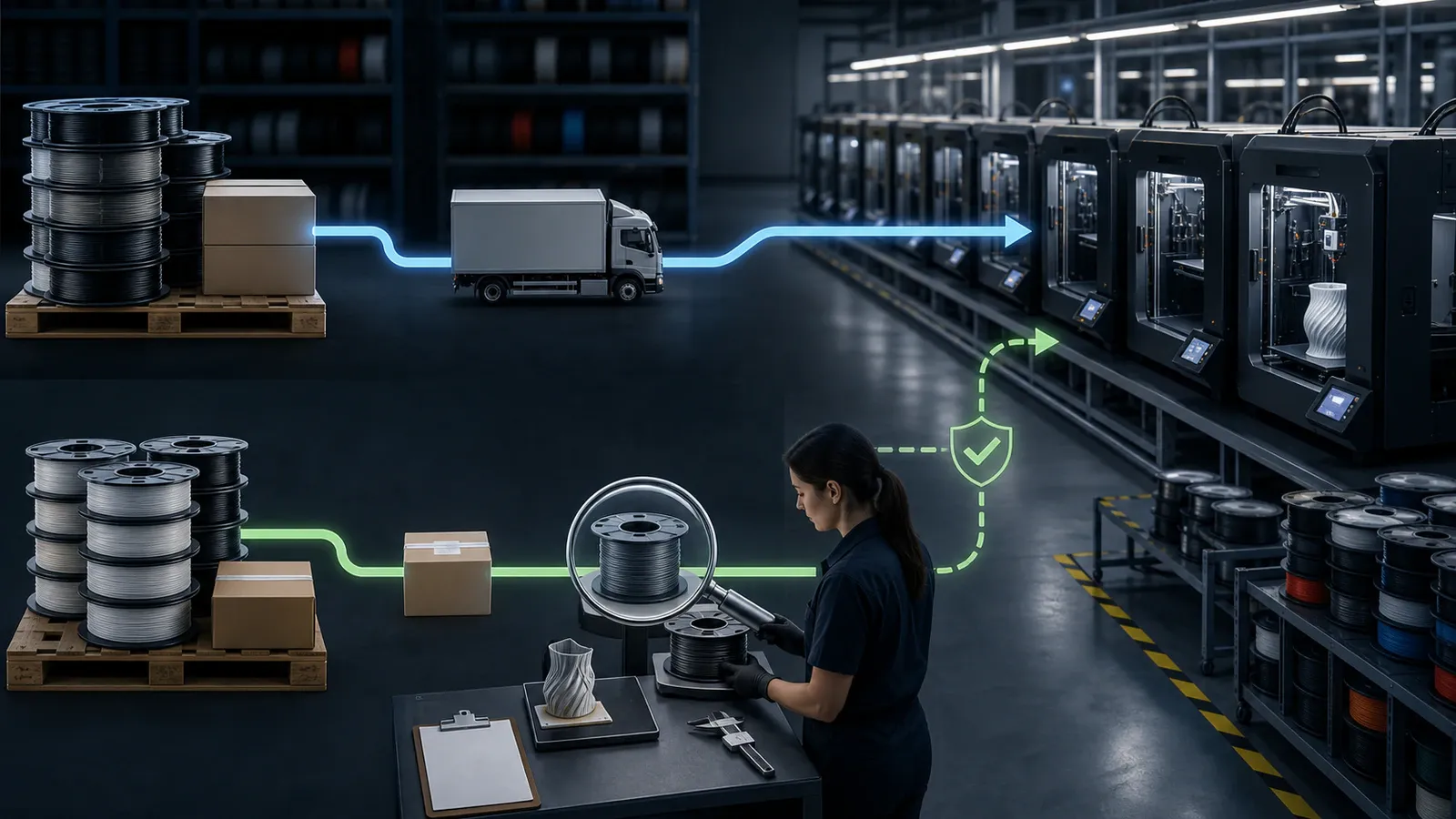
For many manufacturers, the balanced solution is not an even split of purchases among many companies, but a model with two prepared sources. The primary partner receives most of the regular volume - this preserves predictability and makes it possible to work on batch repeatability. The backup supplier passes technical qualification and periodically receives real orders.
This matters for two reasons: the backup channel does not lose relevance, and the company sees whether it can actually meet requirements for quality, lead time, and packaging. Keeping a backup only “in case of a problem” is risky - over a few years, its equipment, formulation, raw materials, or personnel may change. A “second supplier” works only when it has been qualified in advance: a backup whose material has not been tested on your parts is not insurance, but a deferred problem.
What to qualify for filament
The polymer name and color are not enough. The specification should describe the polymer type and modification, nominal diameter and geometric stability of the strand, color or agreed reference, hardness for TPU, net mass, spool format, winding quality, batch labeling, packaging and moisture protection, list of supporting documents, and change-notification procedure.
During qualification, the material is tested on real equipment with typical models and modes, recording the print profile, drying and storage conditions, results of control parts, acceptable surface signs, feed stability, layer adhesion, shrinkage, and mechanical properties if they are critical. After that, switching between suppliers becomes a controlled procedure, not an experiment during an urgent order.
Stock does not replace a backup supplier
Safety stock helps survive short delays, but does not solve long-term problems; its level is tied to replenishment lead time, consumption fluctuations, material criticality, and the speed of transition to an alternative. Excess stock also has a cost: frozen working capital, warehouse space, risk of packaging damage, humidity control, aging labels, and accumulation of unused colors. For hygroscopic polymers, storage conditions directly affect printing, so stock must be not only sufficient, but also usable.
Supply-chain resilience cannot be assessed only by kilogram price. For primary and backup partners, it is worth regularly tracking actual lead time, the share of deliveries without rescheduling, number of nonconformities, batch repeatability, response speed to problems, document completeness, and dependence on a single route or imported raw material - and also defining in advance the events after which stock is increased or requalification is launched.
Conclusion
A reliable supply chain does not necessarily contain many suppliers - it contains a sufficient number of alternatives that actually work. For standard and easily replaceable materials, a simple model can be kept. For items that affect production continuity, an agreed specification, batch traceability, safety stock, qualified backup, and clear switching procedure are needed. For filament, redundancy is planned at the level of the specific formulation, color, hardness, spool format, and print profile.
For Ukrainian manufacturers, brands, and distributors, a local manufacturer can be part of a risk-reduction strategy - as the main partner for repeatable batches or as a qualified backup alongside existing supply. Bokotech manufactures engineering filament in Ukraine (TPU, ABS+, ASA, PA/Nylon, PLA, PETG, and custom formulations) and discusses parameters before launch: material selection for the application, color, TPU hardness by Shore, spool format, labeling, packaging, and quality control. The point is not slogans about reliability, but prior technical agreement: what exactly is being produced, by what parameters, and how it is checked.