
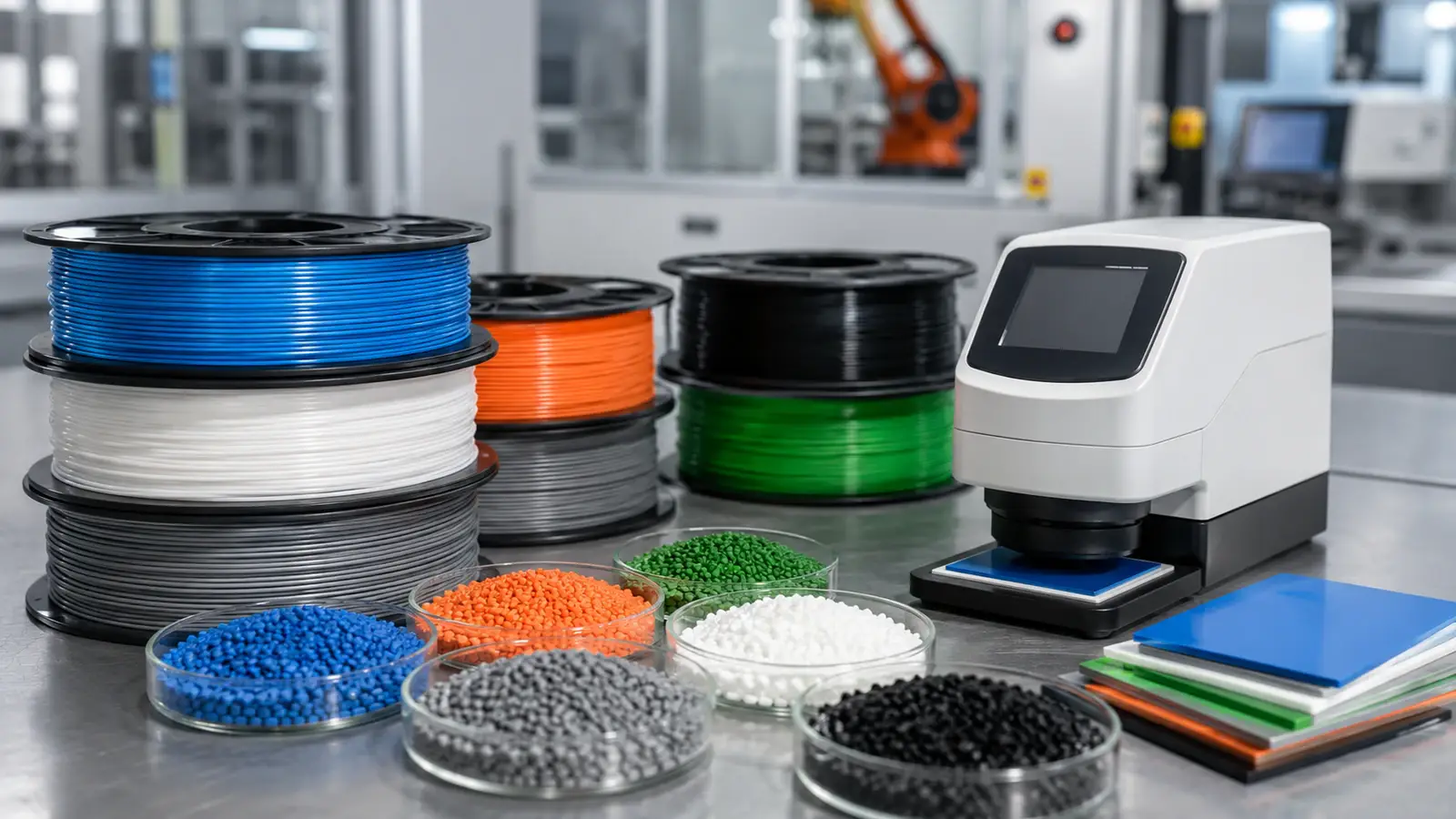
For a retail buyer, filament color is often a matter of taste. For a brand, distributor, 3D print farm, or series manufacturer, it is already a controlled product parameter. A spool produced several months later must match the previous one not only by color name: the shade should remain recognizable after printing, combine with parts from previous batches, and not require photos, catalogs, or specifications to be adjusted.
If a part is visible in the finished product or the color is part of the brand identity, shade differences between batches lead to claims, rejection, and rework. Stable color is not created by a single pigment. It is built across the whole chain: from selecting the polymer base and pigment system to dosing, dispersion, extrusion, cooling, sample storage, and control of subsequent batches.
What is used to color filament
Color is introduced into a polymer using pigments, dyes, or a combination of both. Pigments are solid colored particles that do not dissolve in the polymer but are dispersed through its volume; they provide opacity, saturation, and better resistance to temperature, light, and migration. Dyes dissolve in the polymer matrix at the molecular level and are used more often for transparent or translucent effects, but they require careful checking for compatibility, heat resistance, and migration tendency.
Dosing pigment powder directly into an extruder is difficult: it cakes, distributes poorly, and creates dust in production. That is why series production most often uses masterbatch, a concentrated mixture of pigments or dyes pre-dispersed in a compatible polymer base (carrier) in pellet form. Masterbatch is added to the base polymer in a small fraction and is distributed evenly by the melt during extrusion. This simplifies accurate and repeatable dosing, uniform pigment distribution, automated feeding, and dust reduction.
However, using masterbatch by itself does not guarantee a stable result. Its carrier, concentration, heat resistance, and compatibility with the specific polymer and processing temperature matter. A concentrate that works well in PLA is not necessarily suitable for PETG, ABS+, ASA, PA/Nylon, or TPU: an incompatible carrier worsens dispersion, causes non-uniformity, affects the strand surface, or changes the processing behavior of the melt.
Organic and inorganic pigments: a compromise, not a choice of the “best”
Organic and inorganic pigments offer different combinations of color strength, opacity, heat resistance, and lightfastness. Organic pigments can provide vivid shades, and some grades also offer high heat and light resistance. Inorganic pigments often provide useful opacity and durability, but the family name alone does not establish suitability. Select the specific pigment using its technical data for the base polymer, processing temperature, concentration, and intended exposure.
For filament this has direct significance. Materials print at different temperatures: PLA is comparatively low-temperature, while ABS+, ASA, and nylon require much higher nozzle temperatures. A pigment that holds color perfectly in PLA may behave differently in nylon at higher temperature. That is why a color formulation is always tied to a specific base polymer and does not exist “on its own.”
Why one formulation produces different shades
The color of the final filament depends not only on the amount of masterbatch. It is affected by several factors.
- The inherent color of the base polymer. Natural pellets are not always colorless: different grades and batches can have a slight yellow, gray, milky, or blue undertone. This is especially visible in light, pastel, white, and translucent colors, where even a small change in the base resin requires formulation adjustment even within the same polymer type.
- Opacity and sample thickness. The color of a thin strand, a thick wall, and a solid printed part is perceived differently; with insufficient opacity, the background, number of perimeters, infill, and layer height affect the result.
- Gloss and surface texture. A smooth strand reflects light differently from a matte printed surface. Two samples with close spectral color can look different because of different gloss or relief.
- Moisture and thermal history. Moisture and excessive residence time of the melt at high temperature contribute to polymer degradation; signs can include yellowing, darkening, or reduced transparency. The risk is higher for hygroscopic polymers, including some polyamides and TPU.
That is why RAL, Pantone, or an image on a screen should be treated as a starting point rather than a production standard. Precise approval requires a physical reference in the same material that will be manufactured in series.
Dispersion matters more than simple mixing
For a stable shade, the pigment must not simply be present in the mixture, but evenly distributed in the polymer. Poor dispersion appears as dark or light dots, stripes along the strand, local changes in saturation, spots on the printed surface, or unstable color at the beginning and end of the spool. The result depends on masterbatch quality, dosing accuracy, and mixing conditions in the extruder; the ratio of pellet size and shape also matters so the mixture does not segregate during transport. For low concentrate doses, even a small dosing deviation can be visible, so the shade is linked to a specific formulation, feeding system, and operating mode, not only to the masterbatch name.
How extrusion temperature changes color
Every pigment has its own thermal stability range. If the temperature or melt residence time exceeds permissible conditions, the pigment can shift tone, lose saturation, or interact with other components; the base polymer can degrade at the same time. Because of this, a batch made with the same weight-based formulation can sometimes differ in color after a change in temperature profile, line throughput, screw speed, equipment stop time, startup and cleaning conditions, or the actual moisture content of the raw material. Color is not only a formulation characteristic, but also an indicator of process stability.
How shade is controlled between batches
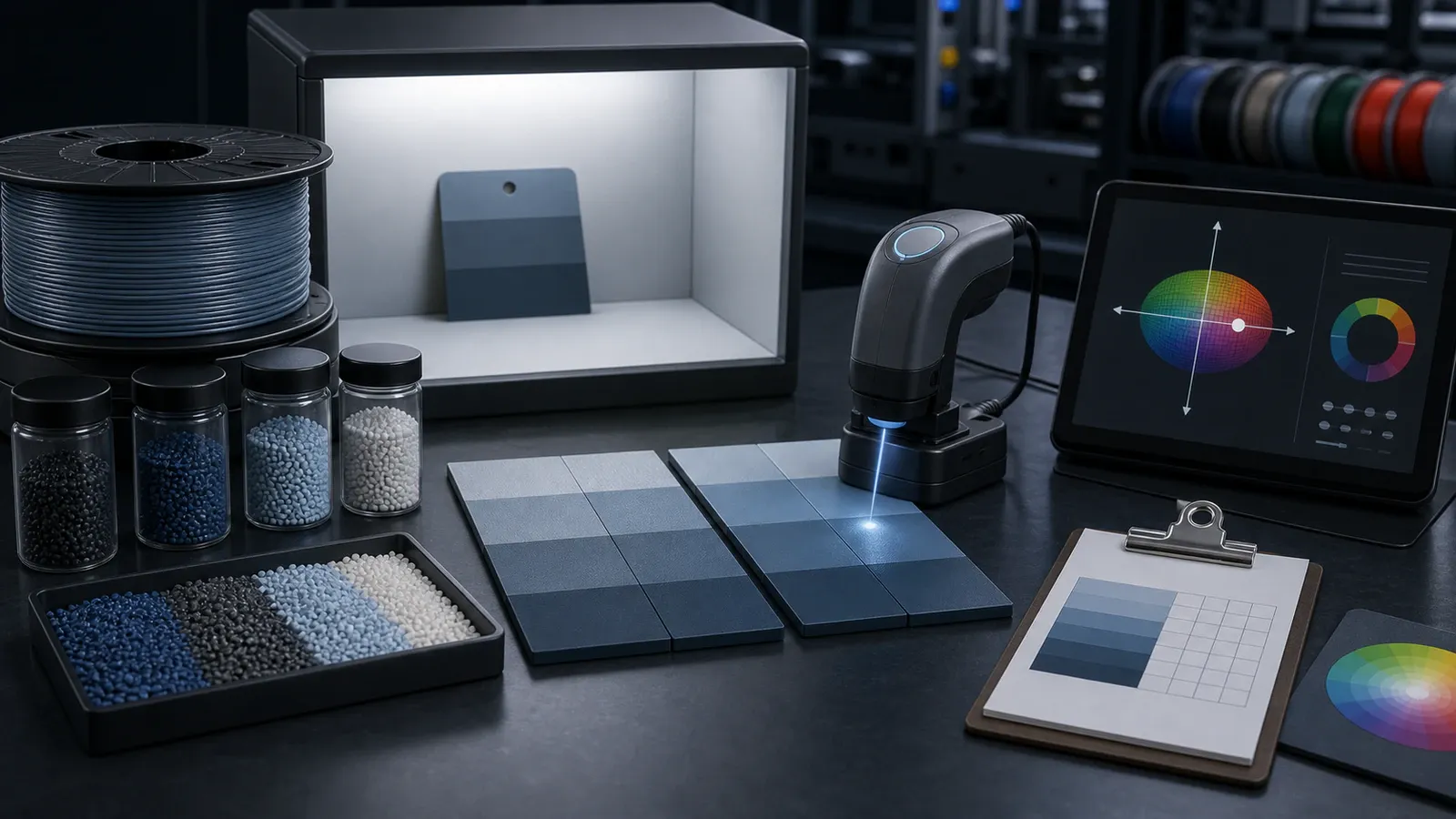
Stable color is the result not of one successful mix, but of a control system at every step.
Approving the reference. Names such as “graphite” or “signal orange” are not enough. The reference may be an approved physical sample, approved part, standardized color number, or digital colorimetric coordinates. For OEM or private label projects, the form in which color is evaluated is defined in advance: on the filament strand itself, a control plate, or a printed coupon.
Standardizing the control sample. Samples with different thicknesses and textures are not compared against each other. Each batch requires the same material and base color, geometry and thickness, print settings, surface condition, cooling conditions, and time between production and evaluation. For filament, both the strand itself and a standardized printed sample are checked because the customer will mainly evaluate color on the finished part.
Instrumental measurement. Quantitative evaluation is provided by a spectrophotometer and the CIELAB color space, where L* describes lightness, a* the green-to-red direction, and b* the blue-to-yellow direction. The difference between the reference and the batch is expressed as Delta E. Specify the calculation formula, for example CIE76 or CIEDE2000 (Delta E00), together with the limit: the same numeric threshold is not interchangeable between formulas. Within the agreed method, a smaller value indicates a closer match. Instead of subjective “similar / not similar” judgments, the parties agree on an acceptable threshold in advance, and the batch is accepted or rejected according to this criterion. There is no universal tolerance. Dark, light, saturated, transparent, matte, and glossy samples are perceived differently, so not only the value is fixed, but also the method: illuminant, instrument geometry, gloss-inclusion mode, and sample type.
Visual check under different lighting. A separate risk is metamerism: two samples match under one light source and diverge noticeably under another. Therefore instrumental measurement is supplemented with visual assessment under agreed light sources, especially when printed parts must match painted metal, textiles, molded components, or packaging.
Traceability. If the pigment grade and batch, dosing formulation, base polymer, and line parameters are recorded, the shade of the next order can be reproduced deliberately rather than by chance. It is repeatability of the formulation, not a one-time match, that separates series production from artisanal coloring.
What to agree before a series order
For reproducible color, a B2B specification should contain more than a shade name: type and grade of base material; desired opacity, matte finish, or transparency; physical or digital reference; surface on which color will be evaluated; lighting conditions; agreed method and acceptance criterion; whether formulation adjustment is allowed when raw materials change; and requirements for color compatibility between repeat batches. For TPU, Shore hardness is also considered because changing the elastomer base formulation also changes optical properties.
Stable color cannot be ensured only by choosing the “right pigment”. It requires a controlled system: stable raw materials, compatible masterbatch, repeatable dosing, proper dispersion, a fixed processing window, and a consistent evaluation method. In contract manufacturing, Bokotech discusses these questions, including material and color selection, reference approval, TPU Shore hardness, winding format, labeling, and packaging, as connected parameters before production begins. This approach is cheaper than rework: an approved color and fixed formulation provide a predictable result in every subsequent batch and make it possible to move from “we need roughly this shade” to a technical specification for repeat orders.