
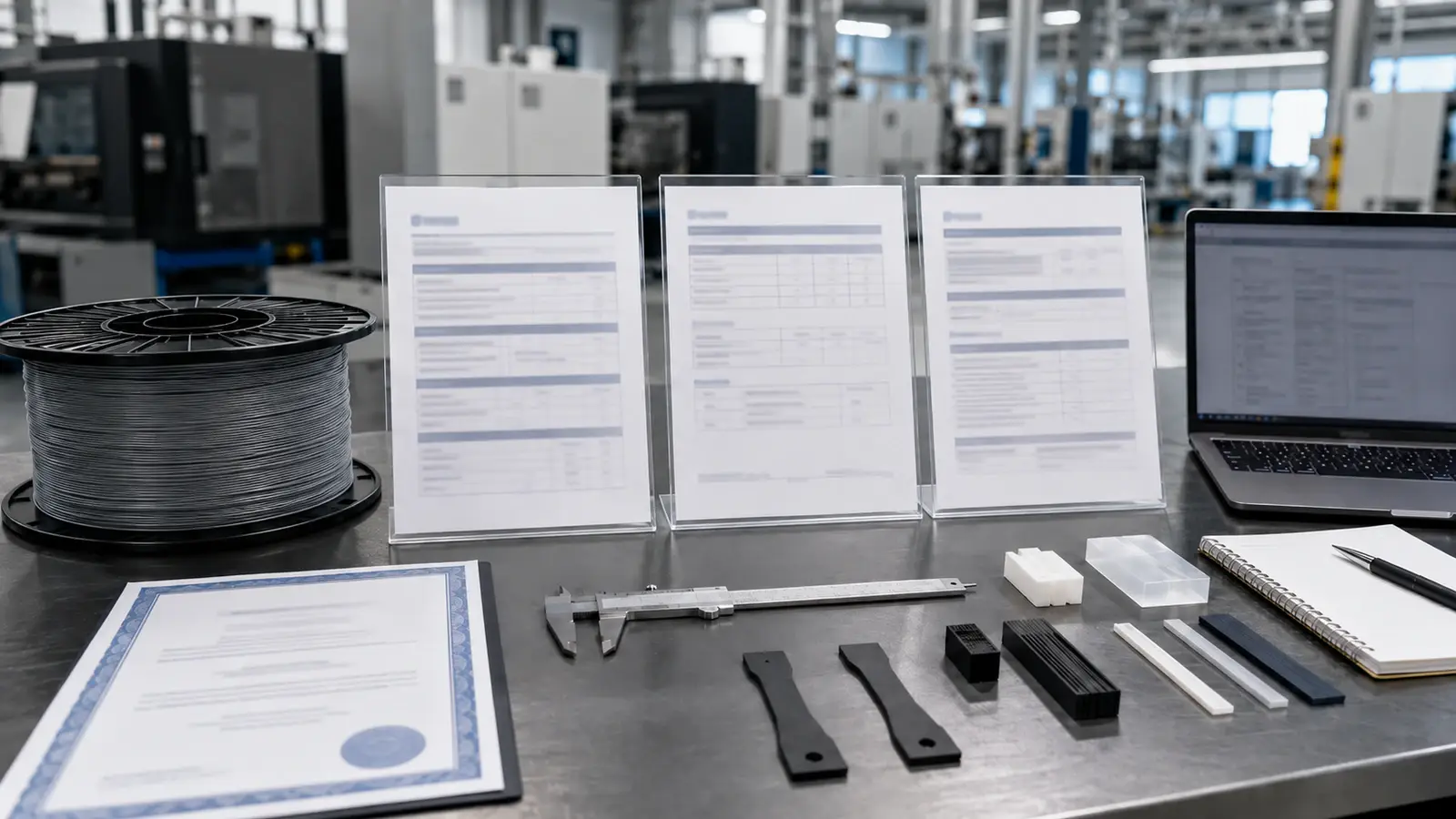
For an industrial buyer, filament is not only a material with a certain name and color. For a print farm, component manufacturer, distributor, or private label brand, it is important to understand how the material behaves in printing, what limitations it has, how to store it safely, and whether a specific batch can be traced. A TDS alone is not enough for this. An agreed package of technical and supporting documents is required.
How the main documents differ
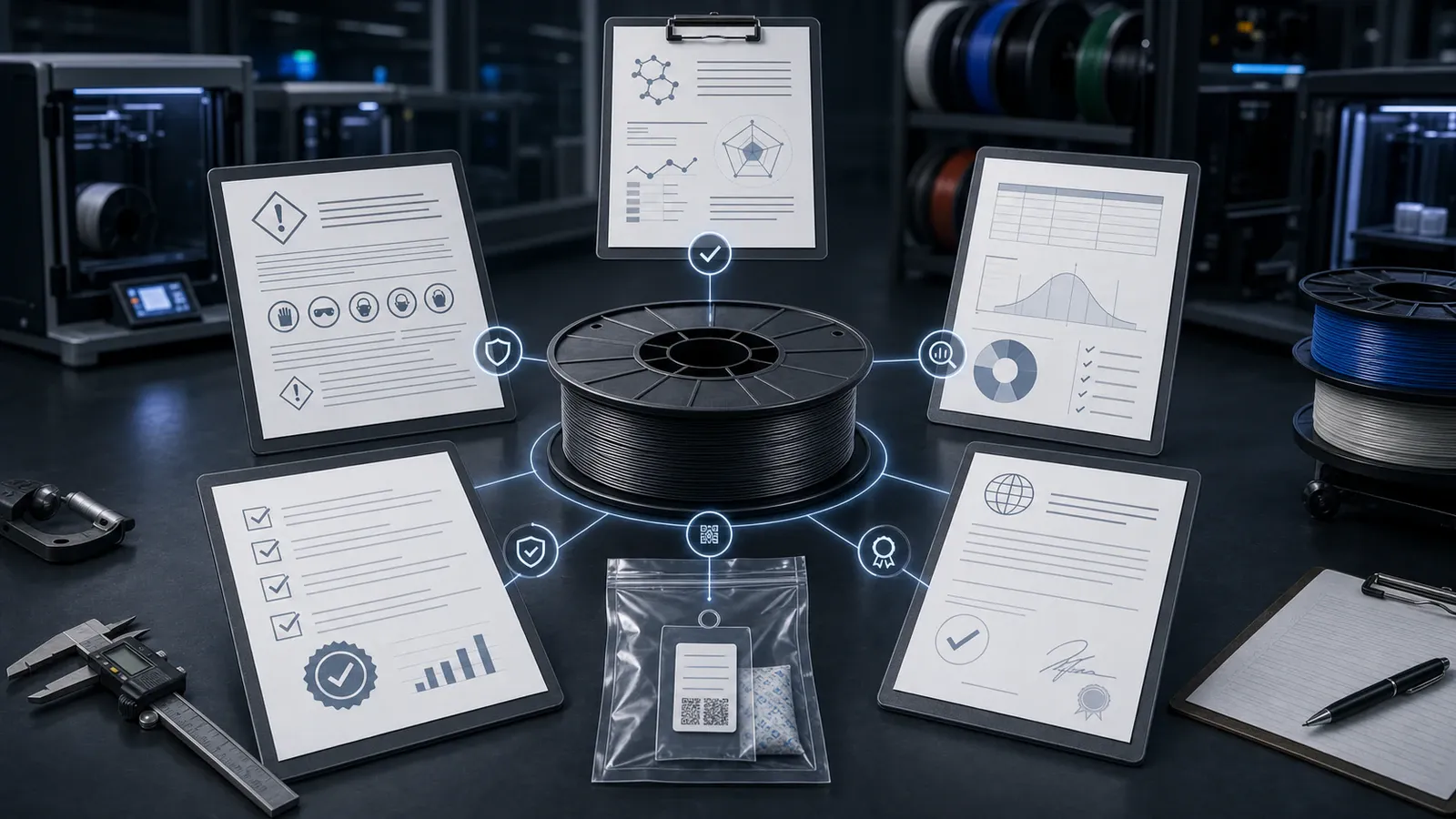
| Document | What question does it answer? | What to check |
|---|---|---|
| TDS (Technical Data Sheet) | What typical properties does the material have and how should it be processed? | Test methods, sample preparation, print direction, date, and version |
| SDS (Safety Data Sheet) | What hazards, protective measures, and storage conditions apply? | Product, market, language, and current revision compliance |
| CoA (Certificate of Analysis) | What results were obtained for the specific batch? | Batch number, actual values, acceptance limits, conformity status |
| CoC (Certificate of Conformity) | Does the supplier declare conformity to the specification? | Exact object, normative document, responsible party |
| Specification | Which parameters are mandatory for product acceptance? | Tolerances, control methods, sampling, rules for deviations |
Document names are sometimes used inconsistently: a “quality certificate” file may be a CoA, CoC, or simply a copy of a TDS. Therefore the content should be evaluated, not the name.
What a TDS should provide to a business customer
A TDS describes a specific material grade: product identification, intended use, recommended print settings, physical, mechanical, and thermal properties, and cautions. For filament, useful data include diameter, ovality, net weight, and spool format; density, hardness, moisture absorption, or drying requirements; nozzle and bed temperature, chamber, cooling, and adhesive requirements; strength, modulus, elongation, and impact toughness; heat deflection temperature, softening, glass transition (Tg), or melting temperature; and special properties such as Shore for TPU, resistance for ESD, flame resistance, or filler content.
The key word in many TDS documents is typical values. They help compare materials, but they do not automatically become guaranteed limits for every spool. If diameter, color, TPU hardness, or filler content is critical, it should be transferred into the agreed specification with a tolerance and control method.
Why numbers alone cannot be compared
The mechanical values of an FFF part depend not only on the polymer: the result is affected by sample orientation, temperature, layer height, extrusion width, number of perimeters, infill, drying, and equipment. Mechanical properties also depend on the test method (for example, ISO 527 for tensile testing, ISO 178 for flexural testing), sample shape, speed, and test temperature. Therefore it is especially incorrect to compare:
- data from a molded specimen with data from a printed part;
- results in the XY direction with interlayer strength along Z;
- dry polyamide with conditioned or moisture-conditioned polyamide;
- HDT measured under different loads;
- TPU hardness measured on different Shore scales.
A high-quality TDS makes it possible to understand under what conditions the values were obtained, but even a detailed document does not replace validation of the material on the buyer’s equipment.
What an SDS is for
An SDS (Safety Data Sheet) is not an “expanded TDS.” Its task is to communicate hazard classification, composition to the required extent, first aid, firefighting measures, safe handling, storage, protective equipment, disposal, and transport. In international practice, an SDS has a standardized 16-section structure. The older abbreviation MSDS is still sometimes used, but the modern term is SDS.
Finished filament in solid form may not be classified as a hazardous product. This does not mean the document is unnecessary. During printing, the material is heated and may emit thermal decomposition products, while sanding or shredding creates dust. The SDS is needed by occupational safety, warehouse, logistics, and environmental specialists: it is used to plan ventilation in rooms with printers, storage conditions, and personnel handling rules. Importantly, an SDS for the base resin does not always correctly describe finished filament with pigments, plasticizers, flame retardants, or fibers. Procurement requires a document for the commercial grade or clearly defined formulation. Before launch, it is worth checking the exact trade name and code, manufacturer, date and version, region and language, ventilation recommendations, and decomposition products.
Which document confirms a specific batch
TDS and SDS usually apply to the product as a whole. For incoming inspection, batch documents are important. A CoA should be linked to the batch number and contain actual results for the tested parameters: diameter, weight, color, hardness, moisture. Not every manufacturer controls every value for every batch, so clarify what is actually measured and what is transferred from a typical characteristic. A CoC or declaration of conformity confirms that the identified product meets requirements; the document should clearly state the object, specification or standard, date, and responsible organization.
The batch number connects each spool to a specific production cycle: if a deviation occurs, the source can be localized instead of checking the entire warehouse. For regular B2B deliveries, the best foundation is not a generic phrase such as “complies with the standard,” but an agreed specification between manufacturer and customer.
Declarations and reports depend on the application
Requesting every possible document package is not always rational. The necessary documents are defined by the final product and market. For electronics, declarations concerning restricted substances (REACH/SVHC, RoHS within the scope of application) may be important; a common mistake is assuming this applies only to electronics, while the requirements may also extend to polymers. For food contact, a general promise of “food safe” is not enough. Documents must have a clear scope, contact conditions, and, if needed, migration test results.
Raw material compliance alone does not confirm the safety of a printed part: additives, pigment, equipment, nozzle, process contamination, and geometry all matter. For flame-retardant, ESD, medical, or other specialized materials, check which thickness and manufacturing method the result applies to, what was tested (pellet, filament, or specimen), which formulation and color were tested, and whether the document applies to the current product version.
A processing guide is also useful: the recommended temperature in the TDS is only a starting point, while a verified profile may include drying, permissible dryer time, chamber temperature, speed, retraction, cooling, surface type, and wear-resistant nozzle requirements. This is especially important for PA/Nylon, TPU, and fiber composites, but a supplier profile is adapted to the specific printer and throughput.
Why names such as PLA, PETG, or ABS+ are not enough
A generic name does not mean identical properties. PLA can be standard, impact-modified, heat-stabilized, or filled; PETG differs in viscosity, transparency, and tendency to string; ABS+ is a commercial name for modified ABS compounds, not a single composition standard; TPU with different hardness requires different speeds and retraction settings. For B2B, this means procurement is based on a specific grade, batch, documents, and test print, not only on the polymer name.
Minimum package before the first purchase
To qualify a new filament, it is reasonable to request:
- current TDS for the exact grade, color, or formulation;
- current SDS for the required market;
- draft specification with acceptance parameters;
- example CoA or other batch document;
- drying, storage, and printing instructions;
- declarations and reports required for the final application;
- description of batch labeling and traceability system;
- procedure for notification of changes in raw materials, formulation, color, or process.
After that, a trial print and validation are performed on the buyer’s own equipment. For series production, the agreed material version, incoming inspection criteria, and storage of reference samples are fixed. Risk increases if a supplier provides one universal document “for all PLA” without a product code, does not specify the date and revision, publishes properties without test methods, mixes raw material data with part data, or when values in the TDS, label, and commercial offer contradict each other.
Documentation as part of technical alignment
In contract manufacturing and private label projects, the document package is discussed before the series launch: whose brand the TDS and SDS are issued under, which data is disclosed, what appears on the label, how batches are numbered, and who approves changes. A properly formed package does not remove the need for testing, but it makes procurement manageable: the TDS helps evaluate the material, the SDS helps organize safe work, the batch document helps accept a specific delivery, and the agreed specification turns the buyer’s expectations into measurable criteria.
Bokotech manufactures engineering filament in Ukraine (TPU, ABS+, ASA, PA/Nylon, PLA, PETG, and custom compounds) and discusses the necessary document list together with material parameters, including color, TPU Shore hardness, spool format, labeling, and packaging, before production starts. If you are planning a series purchase or private label launch, questions about TDS, SDS, batch documents, and required declarations should be included in the technical brief in advance.