
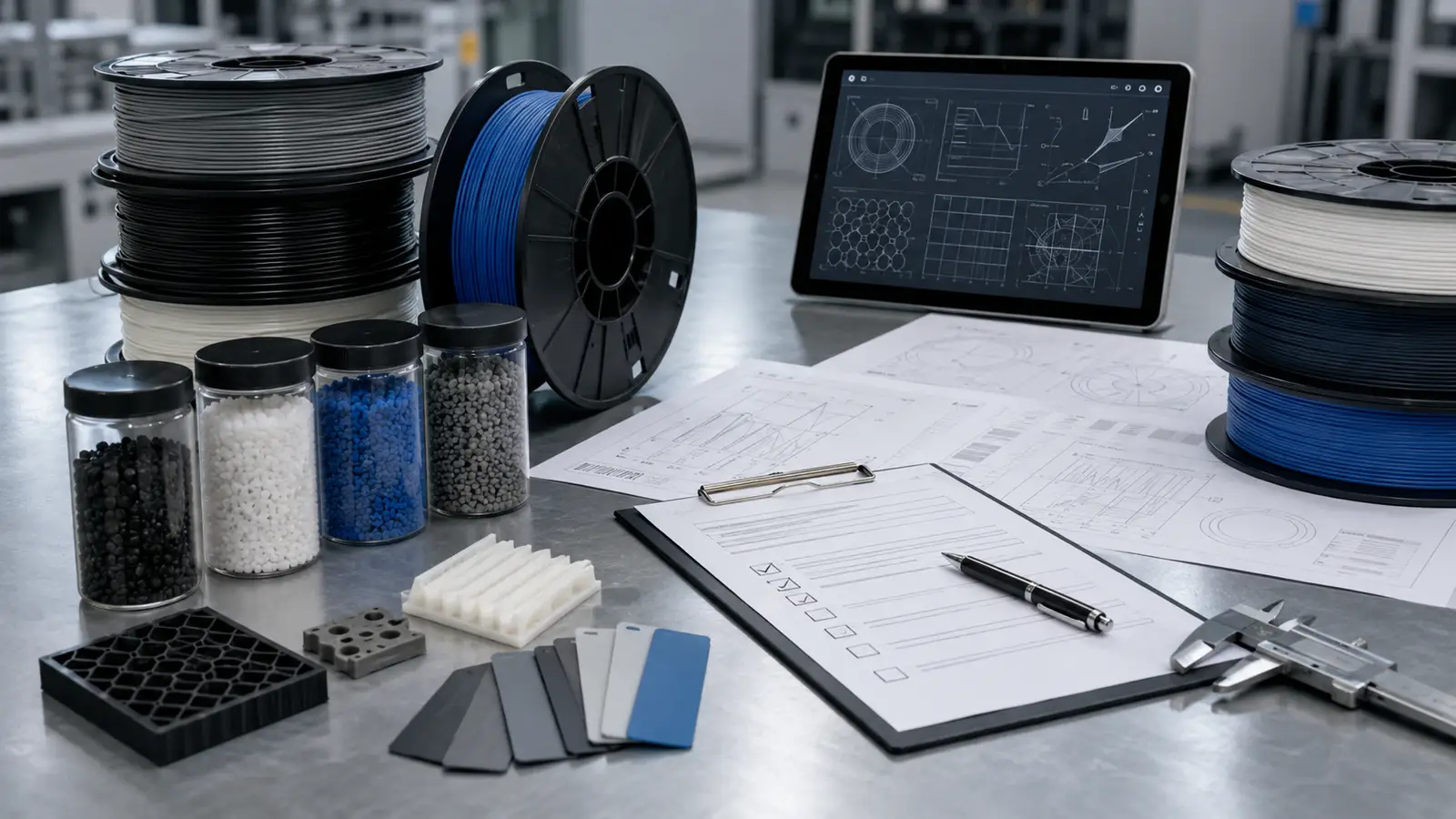
A technical brief turns a general request such as “we need our own filament” into a specific, verifiable specification. Its quality determines three things: how precisely you receive what you expect, how repeatable the result will be from batch to batch, and how comparable different manufacturers’ offers will be. A vague technical brief almost always means more iterations, longer alignment, and a higher risk of discrepancies after production has already started.
Below is a structured checklist that can be used as the basis for an initial request to a manufacturer.
1. Product purpose and target market
Start not with the polymer name, but with the future application. The technical brief should state:
- who the main user will be: a retail customer, 3D print farm, manufacturing unit, or laboratory;
- which parts are planned: prototypes, tooling, housings, seals, series components, or decorative products;
- which printers and feeding systems will use the material, and whether compatibility with an enclosed chamber, automatic feeding, or drying cabinet is required;
- in which countries the product will be sold.
This context affects formulation selection, strictness of repeatability requirements, packaging format, and the set of supporting documents.
2. Material and formulation requirements
Names such as PLA, PETG, ABS+, ASA, PA/Nylon, or TPU do not define a finished product by themselves; they are only families. Within each family, formulations differ in flow behavior, stiffness, impact strength, shrinkage, appearance, and print behavior. In the technical brief, specify:
- the base polymer type and, if available, the target grade or analogue you are using as a reference;
- the desired property balance: strength, impact resistance, heat or UV resistance, flexibility, wear resistance;
- whether modifiers, fillers, or recycled raw material are allowed;
- restrictions on composition, odor, transparency, gloss, or abrasiveness.
For TPU, always specify the hardness scale and target value, for example Shore 85A, 90A, 95A, or 98A. Shore 95A is often a practical balance between flexibility and extrusion stability, while the phrase “soft TPU” is not enough. It is important not to equate raw-material properties with printed-part properties: strength, elongation, and interlayer adhesion depend on model orientation, temperature, speed, cooling, and sample geometry.
3. Geometry: diameter, tolerance, ovality
These are basic but critical parameters for FFF/FDM. Agree on:
- nominal diameter: usually 1.75 mm or 2.85 mm; state it unambiguously;
- diameter tolerance: a typical industry level is about +/-0.05 mm, while more precise lines hold +/-0.02-0.03 mm; even a small deviation noticeably changes the volume of material fed;
- ovality (roundness): filament can have the correct average diameter but be flattened along one axis;
- control method and frequency, and rules for handling sections outside specification.
Checking in two mutually perpendicular directions provides more information than a single measurement. Do not write in numbers you do not really need: an excessively tight tolerance raises cost without benefit for your application.
4. Color and appearance
Set color using a physical reference or agreed sample. A Pantone code, RAL code, or digital value can be a starting point, but the result depends on the base polymer, pigment, transparency, and texture. In the technical brief, state the color reference, allowable difference between batches, visual approval conditions, transparency level, surface type (matte, semi-matte, glossy), and the control sample after approval. Remember that pigment can affect diameter stability and material behavior, so color is also a technical decision. If color is critical for the brand, approve it not only on the filament strand, but also on a printed sample.
5. Expected behavior during printing
Instead of “prints without problems”, describe the specific verification scenario: printer models or extrusion-system type, nozzle diameter and material, availability of an enclosed chamber, expected nozzle and bed temperature ranges, approximate speeds, cooling and retraction requirements, typical test parts, and acceptance criteria such as feed stability, absence of extrusion skips, controlled shrinkage, acceptable stringing level, surface quality, and interlayer bonding. It is better to agree on a working parameter range rather than one “correct” temperature.
6. Moisture, drying, and conditioning
Moisture sensitivity differs significantly: polyamides and TPU usually require the most careful handling. The technical brief should answer whether raw material must be dried before extrusion, whether finished filament is conditioned, what condition the material should be in before the control print, what packaging protects against reabsorption of moisture, whether desiccant is required in each package, and how an opened spool should be stored. Drying temperature and time should not be copied from another material; overheating can damage the polymer or the spool.
7. Spool, winding, and weight
The spool format is part of the product’s technical compatibility. Specify:
- net filament weight, for example 0.75 / 1 / 2 / 3 kg, and allowable deviation;
- outer diameter, width, and center-hole diameter of the spool;
- spool material and color;
- unwinding direction and method of fixing the filament end;
- winding uniformity requirements, with no crossovers that cause jams during automatic printing;
- spool type: plastic, cardboard, refill/masterspool without a spool;
- compatibility with holders, dryers, or automatic feeding systems.
8. Label and marking
For private label or OEM, the customer provides the data structure and rules for working with layouts. The label usually includes the brand and product name, material, color and diameter, net weight, batch number, production date, recommended temperatures, basic storage recommendations, barcode or QR code, labeling language, and legal data for the target market. Define separately whether this is white label, private label, or a fully custom design; who creates the layout; who checks the text; and which file version is approved.
9. Packaging
Agree on the need for vacuum packaging with desiccant, which is critical for hygroscopic materials such as PA/Nylon and TPU; the type of individual and group transport packaging; requirements for boxes and palletizing; and drying before packaging for moisture-sensitive materials.
10. Quality control and batch acceptance
Acceptance should rely on criteria agreed in advance. The control plan may include verification of raw-material identity, diameter and ovality along the length, color and appearance, net weight, winding quality, packaging condition, control print, moisture if critical, and batch traceability. Agree on sample size, report format, nonconformity handling, control-sample storage, and the complaint procedure. Agreeing on the scope of control after production is too late.
11. Documents and regulatory requirements
State whether a technical data sheet (TDS), batch certificate/passport (CoA), declarations regarding restricted substances, or origin data are required. Do not automatically transfer requirements for pellets to finished filament, and do not assume the material is suitable for food-contact, medical, or electrical applications without separate verification. Describe the end-use scenario, and the parties can agree which documents and tests confirm it.
12. Sample, pilot batch, and change control
Before series production, it is advisable to pass through these stages: agreement on a written specification -> laboratory or pre-series sample -> print and packaging verification -> control-sample approval -> pilot batch -> repeatable series orders. In the technical brief or a separate agreement, define which changes require reapproval, such as raw-material grade, pigment, additives, spool, label, packaging, or control method.
Short checklist before sending the request
Check whether your technical brief includes:
- product purpose and target market;
- exact material type and required properties;
- TPU hardness with the scale specified;
- diameter, tolerances, and ovality;
- agreed color reference;
- control-print scenario and criteria;
- drying and packaging requirements;
- spool format and net weight;
- label structure and packaging completeness;
- quality-control plan and required documents (TDS/CoA);
- sample approval and change-control procedure;
- approximate volume and frequency of repeat batches.
A good technical brief does not have to be as long as possible; it has to be unambiguous, measurable, and reusable for future batches. Bokotech manufactures engineering filament in Ukraine and works with contract manufacturing and OEM / private label. We carry out technical coordination before launch: material selection, color, TPU Shore hardness, spool format, labeling, and packaging. If you already have a draft technical brief, it is convenient to review it against these points so that all parameters are clear before the first batch.