
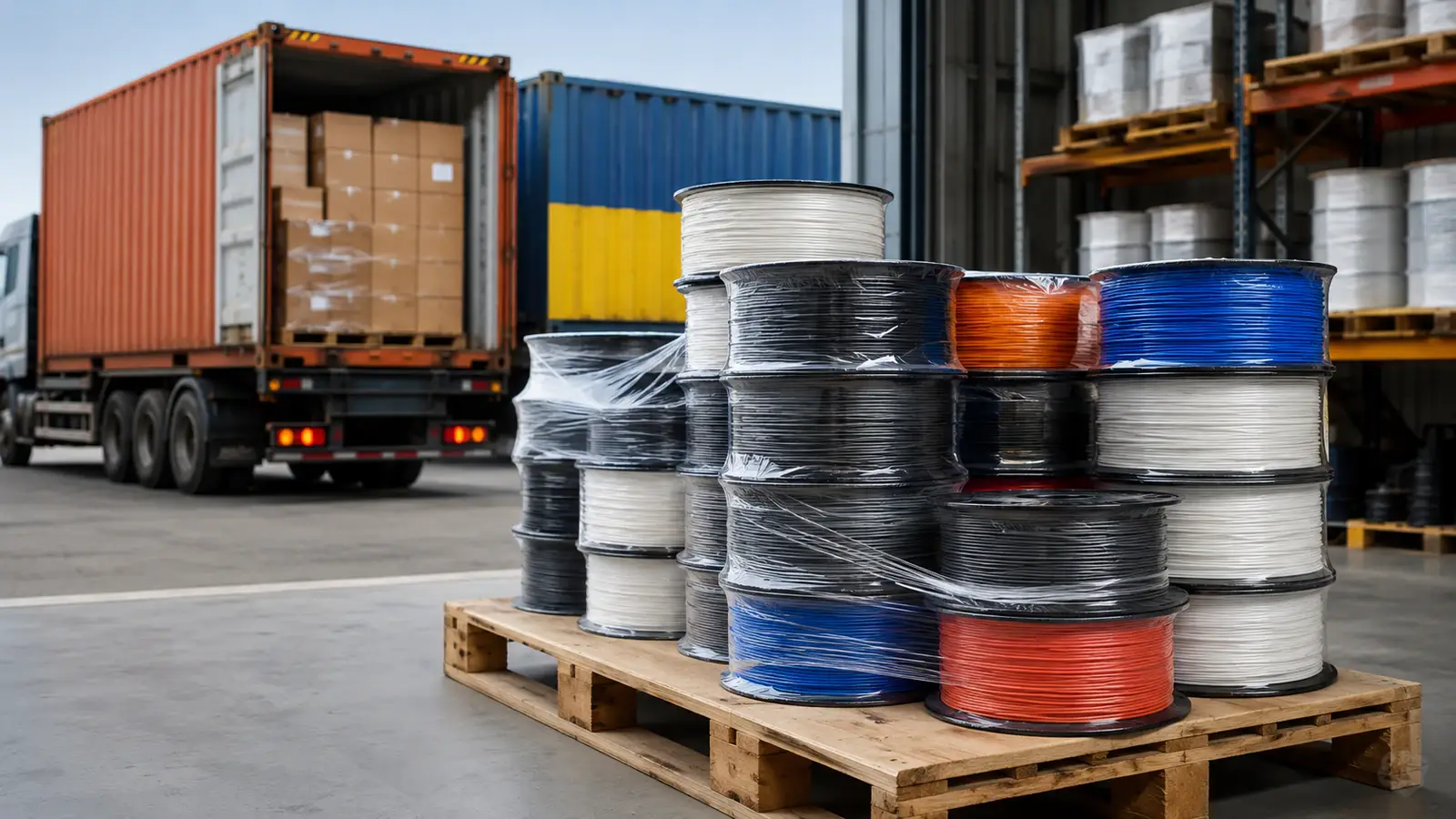
For a business that consumes filament regularly, such as a print farm, manufacturer, brand, or distributor, the choice between imported and Ukrainian material rarely comes down to price per kilogram. Predictability of supply, lead times, currency exposure, and what happens when something goes wrong with a batch matter much more.
This comparison assumes a buyer with a warehouse in Ukraine and covers three purchasing models: direct imports, imported filament stocked by a Ukrainian distributor, and purchases from a Ukrainian manufacturer. Imported filament already in Ukraine may arrive sooner than a new production batch from a local factory. Compare the actual stock location, availability of the required material, color and quantity, and replenishment terms before considering the country of manufacture.
For a buyer outside Ukraine, Ukrainian filament is itself an import. Compare the actual dispatch location, border formalities, payment currency, and return route for the destination country.
Country of origin alone guarantees neither high nor low quality. In practice, the result is determined by raw material, formulation, extrusion control, packaging, storage conditions, and the supplier’s ability to repeat the agreed characteristics. The decision should therefore be made based on a combination of commercial, logistical, and technical factors.
How the supply chain differs

Illustration of three models for a buyer in Ukraine. From top to bottom: direct import; imported goods stocked by a Ukrainian distributor; Ukrainian production from finished stock or made to order. The illustrated route length does not represent delivery time or cost.
With direct imports, the route from the overseas manufacturer to the buyer’s warehouse includes export clearance, international transport, border crossing, import clearance, and domestic delivery; groupage shipments also require consolidation. Each step adds time and a point where the schedule can shift. The actual lead time depends on availability at the factory warehouse, minimum order quantity, route, border-crossing workload, document accuracy, and the allocation of responsibilities under Incoterms.
For finished goods stocked in Ukraine, delivery does not require a new border crossing. Confirm the delivery time for the actual route and add production lead time for made-to-order goods. When stock is available, a shorter delivery cycle can support smaller, more frequent orders and reduce working capital tied up in inventory.
Buying imported goods that have already cleared customs from a Ukrainian distributor is a domestic purchase: the buyer does not repeat the import clearance. International logistics and customs costs are included in the seller’s price. However, current availability does not determine the next delivery date. Ask separately how the distributor will replenish stock once the remaining goods are sold.
At the same time, local production is not fully isolated from external factors: polymer raw materials, additives, colorants, and packaging may be imported. The real lead time therefore depends on the manufacturer’s stock, line load, and availability of components for the specific formulation. The phrase “Ukrainian production” does not automatically mean every product is available; it is worth checking whether the manufacturer stocks finished goods, keeps base raw material, or makes each order separately.
For each quotation, separate production or order-picking time from delivery time to your warehouse. Record the starting point — payment, order confirmation, or specification approval — whether days are working or calendar days, and the time needed for incoming inspection. Assess first and repeat orders separately: approval of a sample, color, or packaging may extend the first cycle.
Main differences for a B2B buyer
Scroll the table horizontally →
| Criterion | Direct import | Imported stock in Ukraine | Ukrainian manufacturer |
|---|---|---|---|
| Time to your warehouse | Availability or production, international delivery and customs | Picking and domestic delivery of available stock | Availability or production and domestic delivery |
| Repeat order | Factory schedule, route and clearance | Stock in Ukraine and its replenishment lead time | Raw-material stock, line load and dispatch schedule |
| Currency risk | Contract currency, conversion and payment terms | Price validity and revision terms | Price validity and currency exposure in raw materials |
| Minimum order | Factory minimum and delivery costs | Seller’s minimum and available quantity | Minimum for each material, color and packaging option |
| Customization | Factory capabilities and minimum order | Catalog or a separate order through the seller | Production capabilities and agreed specification |
| Claims | Seller’s procedure, return location and replacement terms | Local seller’s procedure and replacement stock | Manufacturer’s procedure and availability or production of replacements |
| Documents | Availability of TDS/SDS and batch data | Documents for the specific product and batch | Availability of TDS/SDS and batch data |
Customs, documents, and currency
Before importing directly into Ukraine, agree the commodity code, origin, customs value, required documents, and shipment-specific charges with the customs broker. Identify who prepares the documents and answers customs queries, and allow time for possible additional checks. A generic reference to a duty-free threshold is not a cost estimate for a commercial shipment.
Specify the Incoterms rule, edition, and named place of delivery separately. They allocate costs, risks, and clearance obligations, but do not replace a detailed contract. For example, under DAP the buyer handles import clearance; under DDP it is the seller’s responsibility. Under CPT the seller pays for carriage to the agreed destination, but risk passes to the buyer when the goods are handed to the carrier. Check the commodity code, description, net/gross weight, country of origin, and consistency between the invoice and actual cargo in advance.
If the price is fixed in a foreign currency, its hryvnia equivalent may change between ordering and payment even without a price-list change. A hryvnia price does not eliminate currency risk for future purchases either: both a distributor and a Ukrainian manufacturer may revise prices as the cost of goods, raw materials, or packaging changes. For all three models, record the pricing and payment currencies, quotation validity, advance payment, and price revision terms.
Total procurement cost, not the invoice price
A low factory price does not always mean a lower final cost. Start with the delivered cost per net kilogram of filament: product price, international and domestic transport, insurance where needed, transshipment and consolidation, broker services, non-recoverable import duties and taxes, and bank and currency costs. Add only costs borne by the buyer that are not already included in the price. In particular, do not add international transport and customs duty again on top of the distributor’s price for goods that have already cleared customs.
For total procurement cost, add storage, inventory financing, incoming inspection, and claims handling. Assess a delay scenario separately — emergency purchasing or downtime — using your own data rather than an arbitrary loss percentage.
In Ukraine, import VAT may qualify for input tax credit for a VAT-registered buyer on the basis of a properly completed customs declaration confirming payment of the tax. It should therefore not automatically be treated as a final cost, but the payment must be included in cash-flow planning. Compare quotations on the same VAT basis, agreed with your accounting team. A Ukrainian product is not necessarily cheaper than an imported alternative: compare identical specifications, volumes, net filament weight excluding the spool, packaging, delivery location, and payment terms.
For a print farm, a useful additional measure is cost of a trial production run / number of parts that pass acceptance. Include material used for supports and rejected parts, machine time, operator labor, drying, and setup. Compare the same part against the same quality criteria, using a suitable profile for each material. This shows whether procurement savings carry through to actual printing.
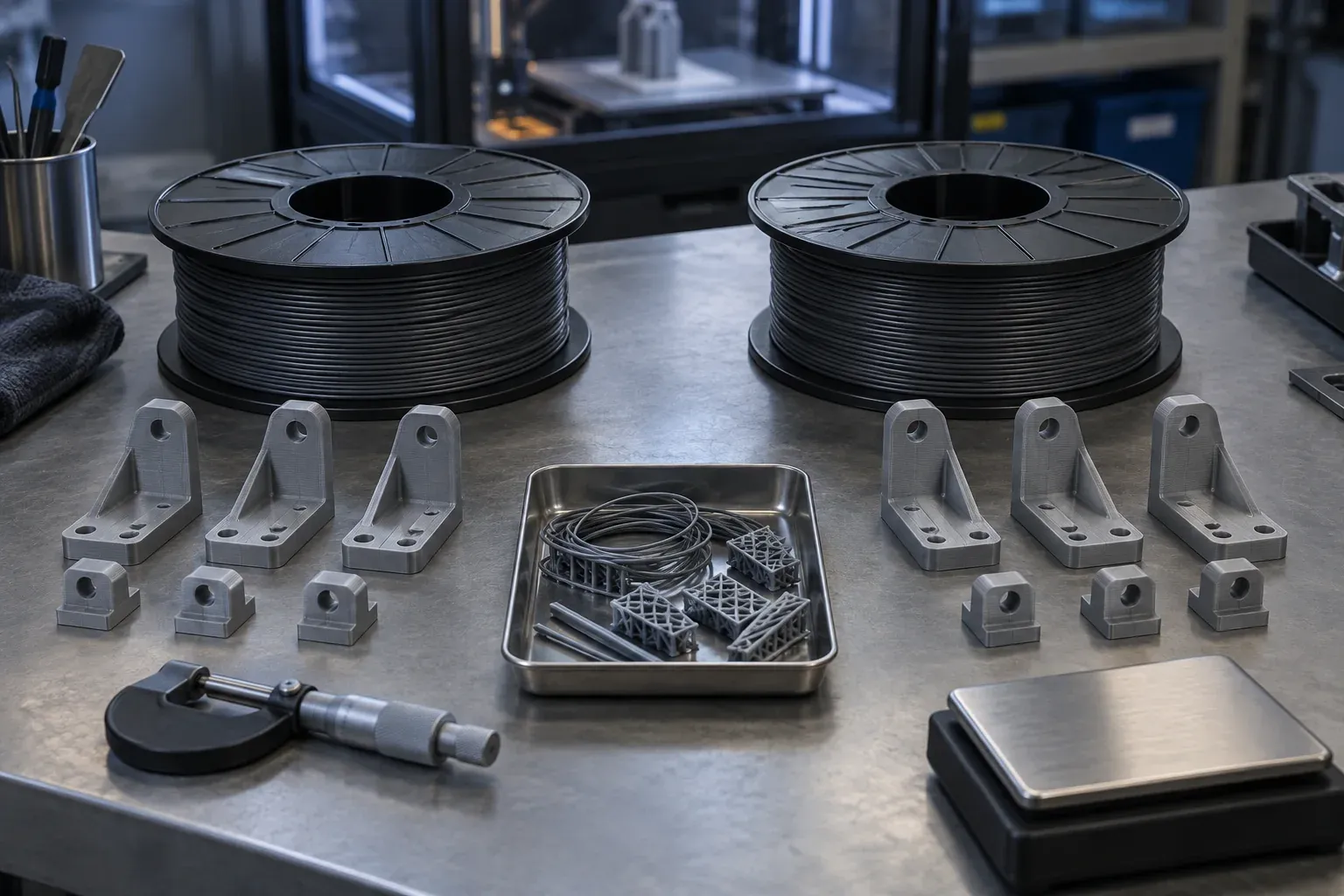
Illustration of a comparative trial run. Material consumption includes supports and offcuts as well as accepted parts; both batches are assessed against the same criteria.
Inventory, repeatability, and the effect of storage
Safety stock depends on consumption, the full replenishment lead time, and variability in demand and lead times. A longer or less predictable cycle may require a larger buffer regardless of the country of manufacture. Stock reduces shortage risk but ties up working capital, takes warehouse space, and increases the risk of accumulating slow-moving colors. Check minimum order quantities separately for each material, color, and packaging option: an overall order minimum does not imply that it can be split freely among products.
In 3D printing, batch stability is often more important than a one-time low price: diameter, ovality, winding, material dryness, color consistency, and print-profile repeatability are critical. For any route, check storage conditions in transit and intermediate warehouses, possible repacking, and batch traceability. Pay particular attention to hygroscopic PA/Nylon, TPU, and PETG: a longer route does not itself make filament wet, and local origin does not guarantee dryness. Moisture-resistant packaging, desiccant, and storage conditions matter; choose drying settings according to the recommendations for the specific material and the spool’s heat resistance. During incoming inspection, record the condition of boxes and vacuum bags, batch identifier, weight, diameter, and test-print result.
Agree the claims procedure separately: whom to contact, what evidence and samples are required, response and resolution times, who pays for returns, and where replacements will come from. Direct imports may require an international return; when buying from a local distributor, contact that seller first. For all three models, check whether replacement stock is available or whether you will need to wait for production or import. Geographical proximity makes exchanging samples easier, but does not itself guarantee a quick resolution.
When each option is appropriate
Import is justified when specialized materials are needed that are not available locally; when a specific formulation has already been qualified for a series part; when documentation is required for the customer’s requirements; when an international brand is specified by contract or tender; or when a broad assortment from one source is needed. Replacing a material only to shorten logistics may require revalidation of the print and finished part.
A Ukrainian manufacturer is worth considering when you need direct technical coordination, color or formulation adaptation, TPU hardness selection, a different spool format, OEM / private label, or your own labeling. Frequent orders and a shorter replenishment cycle are advantages only when the supplier has confirmed the relevant quantities and schedule. Ukrainian origin does not replace a supplier audit: check diameter stability and ovality, color repeatability, winding quality, net weight, moisture-resistant packaging, batch traceability, availability of TDS/SDS, and the claims procedure. Also discuss raw-material reservation and contingency measures.
Imported filament stocked by a Ukrainian distributor is appropriate when you need a specific imported grade, the required quantity is confirmed in stock, and local delivery and claims terms meet your requirements. For regular purchasing, also check the plan for replenishing that warehouse.
You can combine approaches based on a comparison of actual quotations. For critical materials, dual sourcing is advisable: a primary material and a pre-qualified alternative, which may be a combination of imported and Ukrainian filament. The backup supplier must be qualified before a shortage occurs: test batch, print profile, part verification, and recorded acceptance criteria. A contact for another manufacturer without completed testing is not a continuity plan.
What to ask before signing a contract
- Where are the required material, color, and quantity physically stocked? Can they be reserved, or is production needed?
- What are the separate production and delivery lead times for first and repeat orders, what starts the clock, and what is the contingency plan for delays?
- Which costs are not included in the stated price?
- In which currency is the price fixed, how long is it valid, and when can it be revised?
- How are production batches identified?
- Which characteristics are controlled, and are TDS/SDS and printing recommendations available?
- How is repeatability of color and formulation ensured?
- What are the claims procedure and response times, who pays for returns, and where will replacements come from?
- Are test, repeat, and custom batches available, and what is the minimum quantity for each material, color, and packaging option?
The optimal choice is determined not by the flag on the label, but by total procurement cost, supply predictability, technical fit, and the supplier’s ability to repeat the result consistently.
In this logic, Bokotech covers the local part: engineering filament production in Ukraine (PLA, PETG, ABS+, ASA, TPU, PA/Nylon, and custom formulations) with repeatable batches and agreement on material, color, TPU Shore hardness, spool format, labeling, and packaging before a batch is launched. This makes it possible to plan supply with a short logistics leg and coordinate technically and directly, without international transport of the finished product for a buyer in Ukraine. Confirm availability, lead times, and payment currency in the actual quotation.