
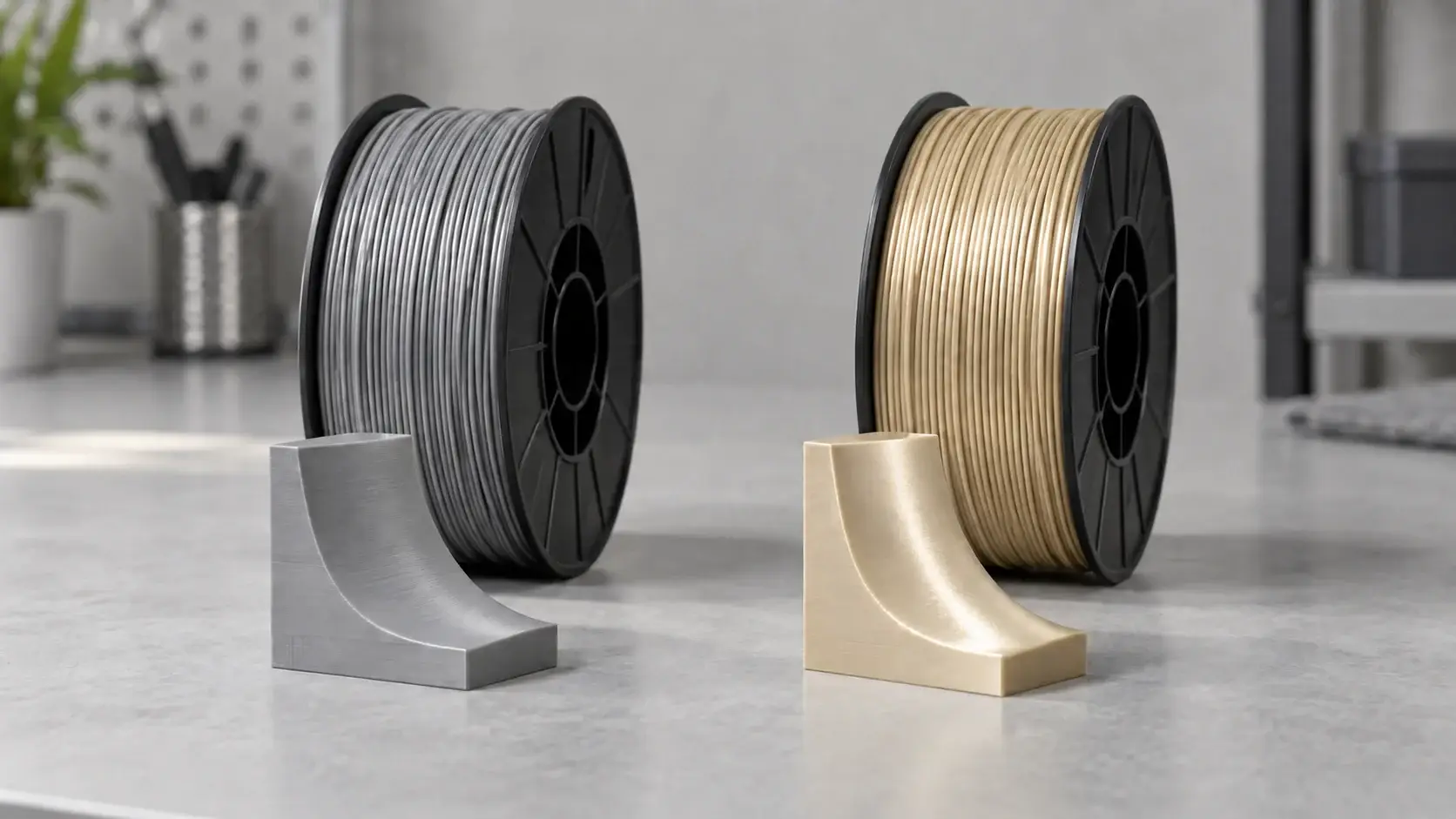
A private-label PLA range should be built around the objects your customers print. An architectural model workshop needs accurate geometry and the ability to reorder the same shade. An award maker needs a surface finish the customer has approved on a sample. Both need predictable printing, but their reasons for choosing a material differ.
Standard PLA can form the core range for prototyping, model making, and simple indoor products. PLA Silk can serve as a decorative range focused on a silky sheen. To make this distinction useful, each product needs a defined application, an agreed appearance, and verified printing recommendations. The organizational steps are covered separately in the filament brand launch plan; here, the focus is on the product range itself.
The images in this article are AI-generated concept illustrations.
Give each range a clear role
PLA, or polylactic acid, is often chosen for detailed models and quick prototypes because it is relatively straightforward to print and has a low tendency to warp. These applications also appear in Prusa’s PLA guide. The polymer name does not, however, define every property of the filament: the specific formulation, color, and printing process matter.
Ordinary PLA is not necessarily matte: its surface can show different levels of gloss depending on printing conditions. The Silk designation describes a characteristic visual effect, but does not specify a fixed composition or strength class. One useful example is Polymaker’s update to Panchroma Silk PLA: the manufacturer reports changes to the formulation and mechanical properties while retaining the silky finish. Those claims concern that particular product, not every Silk filament.
For assortment planning, it is useful to compare the roles of the products first:
| Range decision | Standard PLA | PLA Silk |
|---|---|---|
| Main applications | Scale models, geometric prototypes, educational models | Awards, souvenirs, display and decorative models |
| What the buyer expects | Reproduction of the shape, the required shade, predictable printing | The agreed shade and sheen on the finished surface |
| Approach to initial colors | Colors for the target customers’ recurring tasks | Shades in which a particular product calls for the Silk effect |
| Where to assess the result | A typical part with reference dimensions and visible surfaces | A decorative model with flat and curved areas |
| What needs separate verification | Suitability for loads, heat, and service conditions | The same requirements; a decorative appearance does not establish suitability |
Silk should not be called “reinforced PLA” simply because it shines. Nor is there a basis for declaring every Silk filament weaker than every standard PLA. A mechanical comparison requires specific products, comparable test methods, and comparable test conditions.
Choose the initial products and colors
Start with a list of repeat orders or customer inquiries. Record the material, color, product type, and estimated volume for each. If there is no sales history, distinguish assumptions about demand from confirmed needs. This helps identify which products should be permanent and which still need to be tested in the market.
For example, a distributor serving model workshops might consider white and grey PLA for building models, adding an accent color for a specific customer. A brand supplying souvenir printers could assess interest in gold-colored or silver-colored Silk for awards. These are examples of assortment decisions, not a confirmed Bokotech color range or a sales forecast.
There is no need to reproduce the entire PLA palette in Silk. The same color in both ranges is justified when it serves different results: for example, a standard demonstration model and a decorative version of the same object. If the buyer does not need that distinction, the second product simply adds complexity to inventory and catalog selection.
Each combination of material, color, and product format needs its own SKU, sample, and description. Expansion should be guided by repeat orders, inventory turnover, and requests for missing shades. The effect of product count on budgets and minimum batches is covered in the article on filament brand launch costs.
Define the applications you can promise
A description should explain what the buyer can make. For the core range, wording such as “for scale models, checking form, and demonstration models” is appropriate. For Silk, it might be “for decorative products with a silky surface when using the recommended print profile.” Terms such as “universal,” “ultra-strong,” or “for any technical part” do not give buyers useful boundaries.
Typical PLA materials have limitations involving heat, impact, and outdoor service; these are also noted in Prusa’s guide. That does not imply a single temperature limit for every formulation. A part used in a hot car or near a heat source requires assessment of the specific material, design, and load. Nozzle temperature is not a permissible service temperature for the finished product.
Similarly, a latch prototype that allows the fit to be checked does not establish that the material is suitable for repeated opening. For a bracket, clamp, or another loaded part, testing needs to address the actual geometry, layer orientation, and operating conditions. A successful print and an attractive surface answer only some of these questions.
For long-term outdoor use, assess exposure to sunlight, moisture, and temperature changes separately. If that scenario has not been tested, it should not be included in the range’s general application recommendations. Strength and heat-resistance data are explained in more detail in the guide to reading a filament TDS.
Agree on appearance together with the print profile
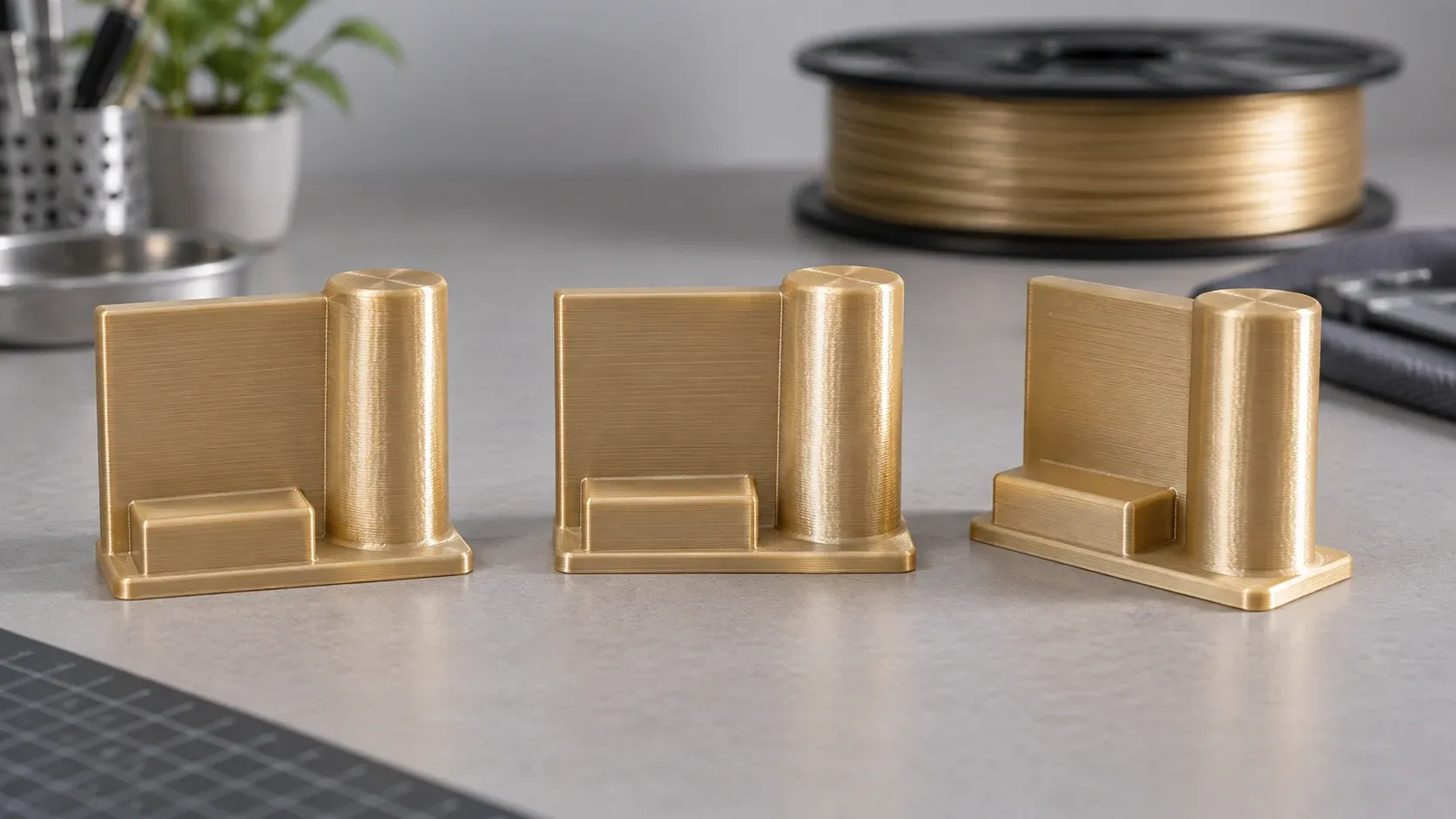
For a decorative range, a photograph of the spool is not enough. The brand needs a sample of the printed surface, because that is what it will show the buyer. The name “gold-colored” gives a starting point, but does not define the agreed shade, highlight intensity, or seam appearance. A metallic visual effect is also not a claim that the filament contains metal filler.
The relationship between printing conditions and the surface should be considered before approving the product. For example, Bambu Lab recommends lower outer-wall speeds for its PLA Silk+ to enhance gloss. This cannot be treated as a universal setting for another formulation. For the material being ordered, find an acceptable combination of appearance, geometry, and print time.
A practical sample can combine a flat wall, a curved section, raised lettering, and a seam. Add a typical customer product: the surface of a small test coupon does not show how a large award or display model will look. If the agreed sheen requires a longer print, account for that time in production planning.
Record the printer model, nozzle type, part orientation, layer height, temperature, cooling, outer-wall speed, and slicer profile version. Verify profiles for PLA and Silk separately. Shared settings are possible if the results support them; related material names alone do not provide that evidence.
Catalog photographs should also use approved printed samples. If the surface has been post-processed, state this: the buyer needs to understand which appearance comes from printing and which comes from subsequent finishing.
Turn the sample into an acceptance criterion
Once the color is selected, agree on a physical reference and comparison conditions: lighting, part position, and the areas to be assessed. For Silk, define what sheen and degree of visible banding are acceptable. “A good surface” leaves too much room for different interpretations. The general principles are covered in the article on stable filament color.
It helps to distinguish requirements for different areas of the product. For a decorative award, for example, the customer may identify the front face with lettering as critical and approve a seam on the back. Acceptance then addresses what actually affects the saleable appearance, without an abstract requirement for an equally flawless finish everywhere.
Assess color, gloss, and geometry separately from mechanical suitability. If a repeat batch looks different, first reproduce the agreed printing conditions and compare it with the reference. Changing settings during that comparison makes the cause harder to identify. The full procedure is described in the incoming inspection method.
For repeat orders, agree which changes to formulation, color, or the recommended profile require renewed sample approval. This is particularly relevant when a customer prints parts of one set from different batches: a shade that is acceptable on its own may not match parts already made.
What to send Bokotech to discuss your range
Bokotech lists PLA / PLA Silk among the materials on its website and discusses manufacturing under a partner’s brand. Specific parameters and production constraints are agreed for each project. Prepare a short set of information for a practical discussion:
- Buyer and products: who each range is for, example models, conditions of use, and required properties.
- Initial product list: PLA or Silk, desired colors, estimated volume per product, and expected repeat orders.
- Appearance: physical samples or visual references, shade and gloss requirements, and critical product surfaces.
- Equipment and printing: target printers, nozzles, existing profiles, and an acceptable production time for a typical part.
- Acceptance: what needs to be checked on the samples and the criteria for approving the result.
- Product description: planned buyer recommendations, limitations, and properties that require documentary evidence.
General spool, labeling, and packaging requirements can be added using the technical brief checklist. Availability of the required colors and effects, printing recommendations, and arrangements for sample checks should be clarified during the technical discussion.
Discuss your proposed range with Bokotech: send the product list and examples of the intended prints to identify the parameters and samples that need agreement before ordering.